Don’t be ashamed, we suck at air hockey too. Luckily for us, we now have a robot opponent to blame or losing streak on. Engineers at Nuvation didn’t build this air hockey playing robot, they simply adapted a standard industrial robot arm for the task. It is controlled jointly by a ColdFire processor and a 9S08 microcontroller. An array of high power LEDs and a camera are positioned over the air hockey table, which captures the position of the puck. The robot reportedly wins 90% of its games, even against solid opponents. While this is more of project to show the power of ColdFire processors, we can’t help but think it will lead to a rash of unbeatable robot opponents. We’ve already been robo-owned at foosball; what’s next?
Year: 2008
Tube Amp Monitor
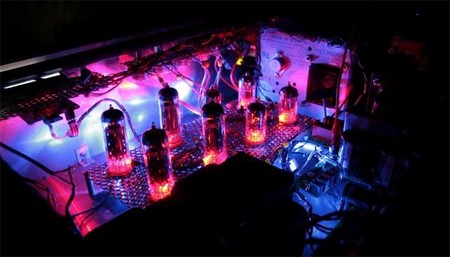
Sparkfun contributor [Pete] really loves tube amps, but he’s a very safety-conscious guy who doesn’t like being electrocuted. This is a problem, since tube amps are usually very high voltage, and a small mistake can be fatal. To deal with this voltage issue, he built a tube amp with a control system built around a 6DOF v3 controller board. The control system is there mainly in case of a failure, automatically shutting off the high voltage transformer in any such event. It has the added benefit of filtering any 60Hz noise from getting into the audio, which happened before he installed the control system.
In addition to regulating power, the controller board also monitors bias points in the output tubes and displays its diagnostics on an LCD. Aside from getting great sound from the tube amp, [Pete] made it look great too, installing colored LEDs under the tubes. We love his design: just because safety comes first it doesn’t mean cool-factor can’t come in a close second.
OLPC Dual Booting

Gizmodo has the first ever footage of an OLPC dual-booting both its default OS, Sugar Linux, and Windows XP. The BIOS was not originally intended to boot XP, so it had to be modified for this to work. The XO’s screen flipper and directional buttons work in XP as well.
It’s not all good news, though: XOs are designed to be ultra-lean, packing a meager 256MB of RAM, which is hardly ideal to run XP. Booting it alone took an eternity, so we can’t imagine anyone doing anything practical with this. The machines will never ship with only XP installed.
Xbox 360 Modding Case Details
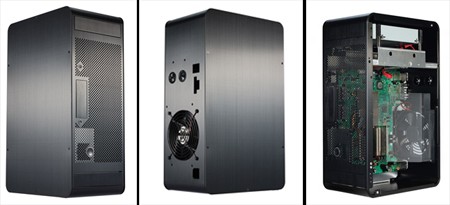
If you’ve been wondering about what changes Lian-Li implemented in their commercial XBox 360 casemod called the PC-XB01, they’ve recently updated their product page.
The case does not add any new functions to the console, but it improves its efficiency on several levels. To deal with the noise produced by the DVD drive, they installed sheets of sound insulation foam around the drive, greatly reducing the sound it makes when it spins up. They did even more for temperature control, replacing the standard dual 70mm fans with a single 120mm fan that cools more efficiently and quietly. The case is also larger and features a frontside grate, allowing for vastly improved airflow. Lian-Li designers even left opening in the back for option water tubes in case you want to add a liquid cooling system.
[via Xbox-Scene]
High Tech Coffee Tables

Time was, coffee tables were good for three things only: setting down your coffee, setting down your coffee table books, and maybe putting your feet up. To combat this perception, Born Rich has posted their top ten list of high tech coffee tables that are capable of these things and more.
Add A Second Internal Hard Drive To Your Laptop
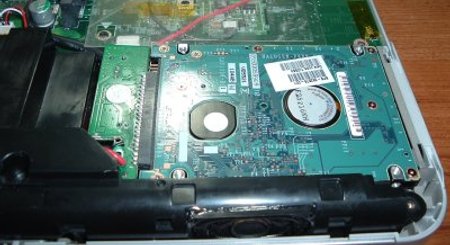
[Andrew] sent in something we’ve been considering for our 17 inch Dell. He squeezed a 100GB PATA notebook drive into the spare space in his Compaq laptop. He used a USB interface to provide the connection and added a toggle switch to conserve power when he doesn’t need the drive spun up. The mod would be even nicer if you added a keyboard activation switch like [sprite_tm]’s keyboard light.
Non-destructive Breakdown Voltage Tester
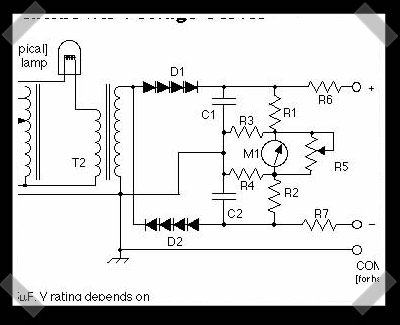
This applies more to older vacuum technology than your average solid state hardware, but [Richard] put together an interesting project. It’s designed to test a component for its breakdown voltage without destroying it. The general idea of the ‘BVT’ is to increase the voltage applied to a device until some current leakage is detected. Of course, any device that includes notes on probable arc length in relation to kilovolts is awesome by definition.