RGB Etched Box

[youtube=http://www.youtube.com/watch?v=KG4PWZyR4Sk&hl=en]
[Dine909] brings us this simple glowing box made out of five etched PCBs. The PCBs control RGB LEDs inside the box, which is also filled with clear glass beads. The four walls are connected to a base controller board that has a Cypress PSoC chip for color mixing. There’s no writeup, and even though it looks a lot like the Lament Configuration, it should be a lot easier to build; any transportation to other dimensions it provides will be strictly figurative.

[via ladyada]
Nintendo DrumAxe Controller


We can’t remember the last time a new cart or peripheral for the NES was released, but [Tony Amendolare] at ElektroKraft has just changed that. In conjunction with Nesdev.com, [Amendolare] created Super Synth Drums, a NES-compatible cartridge that turns button presses on the NES gamepad into drum sounds synthesized by the NES’s sound chips. To complement his software, he created the Sonic DrumAxe, a controller that looks a bit like a potato gun and is played like a guitar.

Continue reading “Nintendo DrumAxe Controller”

Waterproof USB For Underwater Cameras


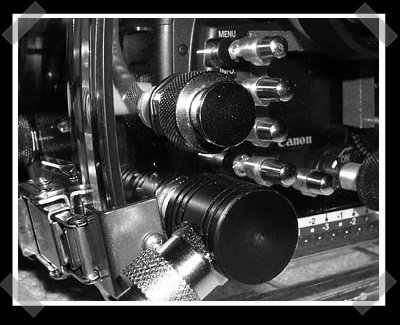
Underwater camera housings work great – but they are prone to humidity, dirt and dust problems if you open them more often than needed. In order to download the images off of his digital camera between dives, [Matt] decided to add a waterproof external USB port to his housing. He had an extra 5 pin strobe bulkhead installed by Ikelite (makers of excellent housings). Then he spliced on a mini-usb cable for the camera and spliced a standard USB end onto a strobe cable. During dives, the port is closed with an o-ring sealed cap.

Playstation 2 Controller Analysis


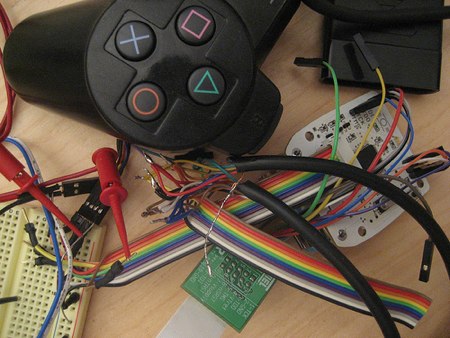
The people at Near Future Laboratory are trying to spoof the behavior of a Playstation 2 controller using just a microcontroller. They wrote some initial code using the controller info found here, but decided the best way to figure out what was going on, was to probe the interface. They’re using a Logicport, which features 34 channels plus two clock channels. They only need six channels because the PS2 implements an SPI protocol plus an ACK line. The post is just a preliminary investigation, but will give you a little insight into how the Logicport works and why you might find it useful.

Ice On Mars


It’s official: the Phoenix Lander has discovered ice on Mars. A few days ago, the lander exposed some bright white chunks of material while retrieving a soil sample. These spots have since disappeared over the following days, suggesting they’ve melted. An additional trench found a hard layer at the same depth as the original ice.

The spacecraft team has been dealing with some data storage issues as well and will be pushing a software patch soon.

EM Brace For Sensing Magnetic Fields


We’ve discussed the notion of using machines to add or improve sensory input to the body before, and we’ve found another project with the same idea. [Nick Hasty] has developed an object he calls the EM Brace, which allows the user to sense electromagnetic fields with a wave of the hand.

The device works by connecting two antennas to an enclosure that contains a speaker. The enclosure is intended to be worn on the back with a harness securing it in place and wrapping the arms around the wearer’s body. The antennas are incorporated into a pair of gloves. When the antennas pick up electromagnetic radiation, the speaker emits a low frequency sound waves. They vibrate the enclosure and the arms, which in turn vibrate the body, signaling to the wearer that he or she is in an electromagnetic field, also referred to as hertzian space. A good deal of detail about the project can be found on his blog, or if you prefer, download his thesis paper in(PDF).

[via Make]

Eavesdropping Encrypted Compressed Voice


A team from Johns Hopkins University has discovered a way to eavesdrop on encrypted voice streams. Voice data like the kind used by Skype for its VoIP service sends encrypted packets of varying sizes for different sounds. The team learned that by simply measureing the size of the packets, they could determine what was being said with a high rate of accuracy. VoIP providers often use a variable bit rate to use bandwidth more efficiently, but it is this compression that makes audio streams vulnerable to eavesdropping.

The team’s software is still in its early stages of development, yet incapable of parsing entire conversations. It is capable, though, of finding pre-determined keywords and inferring common phrases bases on the words it detects. It also has a higher rate of accuracy in identifying long complicated words than short ones. The team’s goal was not to eavesdrop, but to expose the vulnerability; team member [Charles Wright] notes, “we hope we have caught this threat before it becomes too serious.”

[via Schneier on Security]
[photo: altemark]