Arduino Programmer For Arduino

[youtube=http://www.youtube.com/watch?v=M-sFQNIXde8]

Wow, that title is flamebait… but give us a chance to explain. [George] wrote some code for the Arduino that allows it to program another Arduino. You may be thinking to yourself “this has already been done”. In a way it has, with the AVR ISP programming shield. But once the code has been uploaded to the Arduino, you don’t need a computer to program the next chip. This concept turns an Arduino into an in-the-field programmer. Right now his code only programs the ATmega328 and it’s a little buggy, but the concept is solid. A fully functioning independent programmer is easy to image; [George] has laid the ground work, the AVR ISP programming firmware has proven this can work with several different chips, and if your AVR has an ATmega328 there should be plenty of room to store the code you plan to flash to the target microprocessors. It’s up to you to put all the pieces together.

Frustromantic Box, A Reverse Geocache

One of the best feelings in the world is when one of our posts inspires a fellow hacker to plan, create, and execute his or her own project.

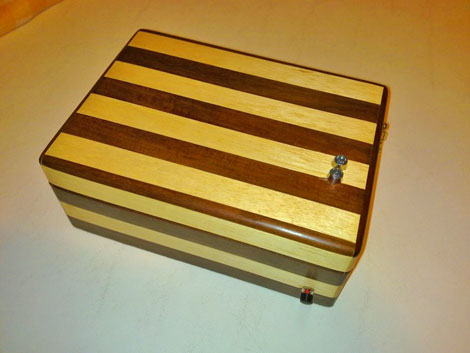
[Russ] let us know about his Frustromantic Box which he gained inspiration from the original Reverse Geochache we posted about. For those out of the loop, the box is locked and will only open in a certain location. The current distance to the  location is displayed on the screen when a button is pressed, and usually there is a limited number of button presses (3 presses for those that know geometry, 50 for everyone else). As soon as the box is at location, it will open.

The Frustromantic Box uses an Arduino, classic HD44780 display, a servo, and the pièce de résistance EM406 GPS. All built in time to frustrate his wife for Christmas.

SpiderBot Prompts Laser Envy

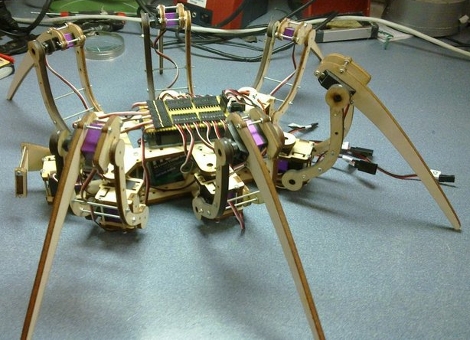
[Daniel’s] horrifying hexapod makes us wish we were sitting next to a laser cutter. The parts are cut from 4.9mm plywood and include laser-sculpted sections to allow the twenty servos to properly seat in their mounting spaces. We would suggest that you build it in secret so as not to ruin the surprise when your house mates come home to find this romping around their room.

Sadly, we couldn’t find video of this in action but go look at this other hexapod if the still shots aren’t good enough. Adding two legs to the party, you behold the video after the break of the 8-legged spider milled from ABS.

Continue reading “SpiderBot Prompts Laser Envy”

Adafruit Eagle Library

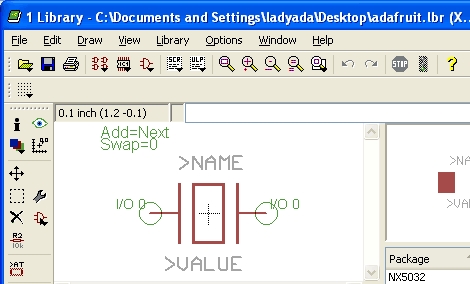
We love it when a PCB comes out right the first time. We’re careful enough with our designs that if something is wrong it’s usually a footprint problem, like we picked the wrong package for the components. Adafruit is helping to make the design process easier by sharing their Eagle library. Like the Eagle library version control we saw earlier in the month, this library is housed on github making it easy to stay up-to-date. The library includes many components (switches, crystals, IC’s, etc.), and fixes some prolbem-footprints, like 0805 surface mount pads.

Turntable Light Sequencer

[Benjamin] built a sequencer that uses a turntable and light sensors to lay down a funky beat. If you like creepy videos with repeated gratuitous corderoy-clad rear-ends we’ve got you covered after the break. Art film aside, he’s got an interesting project. Four light sensors are mounted below the turning record with LEDs hovering above. His hatred for old LP records is apparent because holes must be drilled in a disc for the light to shine through. The four notes in the sequence can be altered in voice and color, along with controls for motor speed and direction. The project also has four manual inputs to add some variety to the repetitive beat sequence. It’s a bit less practical than the penny sequencer but fun none-the-less.

Continue reading “Turntable Light Sequencer”

Coded Entry Using Your Wristwatch

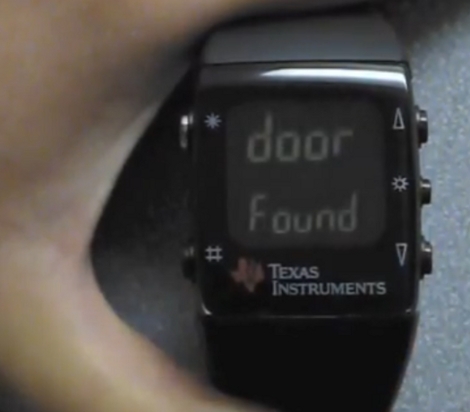
[Ziyan] and [Zach] built a door entry system that uses a code entered from your wristwatch. They’re using the TI eZ-430 Chronos that we saw in November. There is a project box mounted over the deadbolt lever. Inside, the wireless fob waits for the watch to connect. When a watch has connected and the correct code is received (using 128 bit encryption) the fob actuates a servo to turn the lock. On the user side of things the code is entered by tapping the watch. The built-in accelerometer picks up these taps and relays them to the door unit.

It’s a heck of a project! Check out their demonstration video after the break. We’d like to see a mechanical option for escaping the apartment in case the door unit fails but otherwise we think this is perfectly executed. We’re looking forward to seeing more projects that tap into this TI hardware.

Continue reading “Coded Entry Using Your Wristwatch”

Buzzle: A Morse Code Puzzle Box

[lucasfragomeni] built the Buzzle after being inspired by the reverse geocache puzzle. The Buzzle was built as a gift to a friend. It’s a tricky gift too. His friend can’t open it until he decodes the words being displayed in morse code via an LED. A word is chosen at random, so you would have to decode it each time you want to open the box. That’s a pretty neat security feature. Sure it’s not the most secure, but it would keep casual peepers out. Unfortunately, the box was empty when his friend received it.