Clock Hides Time Until You’re In Close Proximity

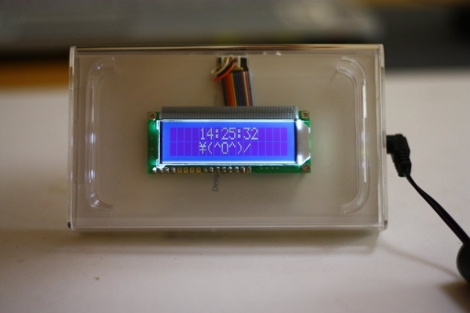
[Alan] is branching out beyond the Arduino with this clock. He’s still using the same code but built this board around an ATmega328 and the components he needed, saving his Arduino board for further development. The concept uses a character display housed in an old iPod Touch case. The build relies on an infrared sensor to actuate the LCD backlight. The closer your hand is the brighter the light.

The Maxim DS3232 RTC chip keeps time in this application. We’ve seen this little marvel used before, popular because it uses temperature compensation to maintain accuracy. If you’re interested in this part, check out the library file that [Alan] wrote for it.

Stanford’s Stickybot3

[youtube=http://www.youtube.com/watch?v=0y2MVuSyQlg]

Stickybot has gone through a pretty radical upgrade. Ā You may recall the gecko looking glass walking bot from all over the net. While it was pretty cool, the technology has gone much further. Not only is it designed to look like a gecko, the feet are actually made to adhere to surfaces in the same manner. They are using an adhesive system based off Van Der Waals forces. Ā Though the stickybot 3 doesn’t walk yet, Ā the feet are already impressive. Look how little of the foot is actually making contact with the glass. See how easily he can remove and re-adhere it? Simply amazing.

Make Cotton Candy At Home

[youtube=http://www.youtube.com/watch?v=JYmBGOiMOIo&w=470]

If you are anything like us, you are suddenly filled with childlike glee when you think of big fluffy poofs of cotton candy. The thought of making it at home has a certain appeal, but that machine is a mystery reserved only for those elite enough to get through cotton candy maker school. Or so we thought. As it turns out, it is actually quite simple. You can make one and be serving cotton candy in an afternoon with parts you probably have sitting around. The video above is pretty easy to follow, but if you want more information, there’s an instructable as well.

[via MakeZine]

Ask HackADay: Organization?!

Several people have been asking a similar question to,

“How do you at Hackaday keep track of and organize all your equipment?”
-[Jeff Allen] and others.

We have a variety of resources to help you keep track of your tools, equipment, parts, and supplies! Follow us after the jump for some tips for keeping your workspace clean and tidy. Continue reading “Ask HackADay: Organization?!”

Punching Accelerometers

Shortly after finishing his Makiwara punching bag, [Abieneman] wired and programmed an Arduino to an accelerometer to find out just how much acceleration (and with some math, force) is behind his punches. The project is simple and would be quick to reproduce for your own measuring and experiments: all that he used included an Arduino, accelerometer (with A/D converter), LED displays (and shift register). We were a little disappointed to learn of how much static the accelerometer produced, so measuring things such as impulse, energy, and pretty much anything not kinematic is nullified. But it makes us wonder, how much static would be in say, a Wii Remote punching bag?

Robotic Chess Opponent

[youtube=http://www.youtube.com/watch?v=CkGqn5rNzK8]

[Dennis] is using a robotic arm as a chess opponent. Rather than using an under-board movement system, a Lynxmotion AL5A robotic arm plucks each piece and moves it to the next space. He tells us that he’s using a Python script that he created to process the moves and decide what’s next. That must mean he’s using a webcam to capture the location of the pieces on the board. About half way through you can see the robot run into one of the pawns. We’d like to know if he has problems with picking up the pieces as the game progresses and they get further away from the center of each square. From what we can see, looks like a great job!

What Kind Of LED Matrix Does Your Vodka Come With?

Medea Vodka comes with a bottle that includes a blue scrolling LED Marquee. OK, great? It’s an interesting marketing ploy but kind of a waste don’t you think? Friends, it’s up to us to repurpose thisĀ  hardware. It can’t be that difficult to hack into the programmable display and make it do your bidding. Our friend Google tells us that you can get your hands on this 750 milliliter bottle for about $40. That’s around $25 more than a passable grade of Vodka sells for, a mere pittance for the challenge of cracking open the hardware for fun and profit. Don’t forget to document your work and tip us off once you’ve accomplished something. See Medea’s programming instructional video after the break. Oh yeah, remember to hack first and drink later… cheap soldering irons get hot!

Continue reading “What Kind Of LED Matrix Does Your Vodka Come With?”