Hackaday Links Column Banner

Hackaday Links: April 26, 2026

It’s been three weeks since the Artemis II crew returned to Earth, and while the mission might be over for Reid Wiseman, Victor Glover, Christina Hammock Koch, and Jeremy Hansen, the work is only just beginning for engineers back at NASA. In a blog post earlier this week, the space agency went over the preliminary post-mission assessments of the spacecraft and its ground support equipment, and detailed some of the work that’s currently taking place as preparations begin for Artemis III.

During Artemis I, higher than expected damage was noted on both the Orion’s heat shield and the Space Launch System (SLS) launch pad. But according to NASA, the changes implemented after that first mission seem to have prevented similar issues this time around. The post also explains that reusable components of the Orion spacecraft, such as the avionics and the crew seats, are already in the process of being removed from Integrity so they can be installed in the next capsule on the production line.

While watching the live stream of the Artemis mission is the closest most of us will ever get to experiencing spaceflight, that doesn’t mean you can’t explore the solar system from the comfort of your own home — or more specifically, your browser. [Sani Huttunen] has created an incredible web-based solar system simulator that lets you explore our celestial neighborhood throughout different periods of time. You can tour the moons of Jupiter, see how the planets aligned on the date of your birth, and even check in on the Voyager probes. There are some very valid reasons to be skeptical about software moving to the web, but we’ve got to admit, this is a very slick demonstration of just how far modern browsers have come.
Continue reading “Hackaday Links: April 26, 2026”

Prototype Proves Wii Was Two Gamecubes Taped Together All Along

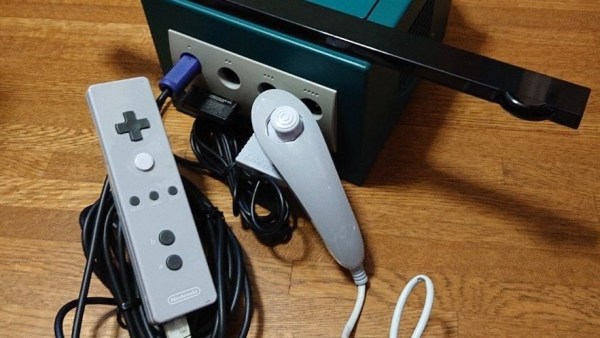
Say what you will about Nintendo’s little purple lunchbox, the GameCube, but it was home to many delightful experiences from Super Smash Bros. Melee to The Legend of Zelda: Twilight Princess. We now know it was also home to one of the very first Nintendo Wii remotes as well thanks to the recent listing from [Kuriaisu1122] on Yahoo Auctions.

The prototype Wii remote is a wired design and features a proprietary GameCube controller cable. Notable differences include the two buttons toward the bottom are labeled ‘B’ and ‘A’ respectively. This shows that Nintendo always intended to have players hold the remote sideways in order to play Virtual console games. The large white button next to the directional pad is unlabeled, and along the middle are the traditional ‘Start’ and ‘Select’ labels on either side of ‘Home’. However, these all would go through multiple revisions on the way to the final design. Interestingly there is an Ethernet jack at the base used to connect accessories. That connector would eventually become the often maligned “Nunchuk interface”, but what modder wouldn’t have loved it if that Ethernet port had carried on to the final design?

Continue reading “Prototype Proves Wii Was Two Gamecubes Taped Together All Along”

Star Wars Training Droid Uses The Force

Star Wars Training Droid

We all know the scene, Obi-Wan Kenobi gives Luke a helmet with the blast shield down. He tells Luke “Your eyes can deceive you. Don’t trust them. Stretch out with your feelings!” Easy for Obi-Wan to say – he doesn’t have a remote training droid flying around and shooting at him. [Roeland] and his team are working to create a real-life version of the training droid for Hackday’s Sci-Fi contest.

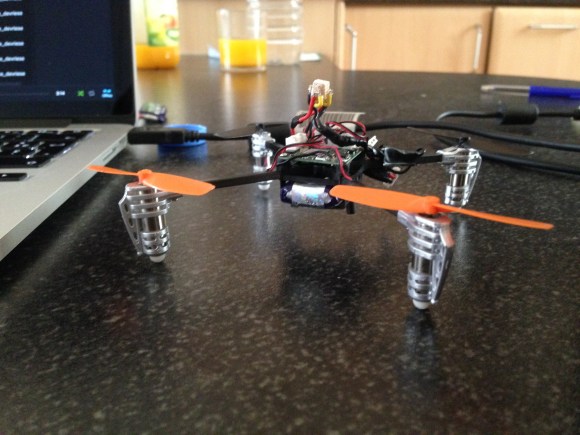
The training droid in Star Wars may not have had the Force on its side, but it was pretty darn agile in the air. To replicate this, the team started with a standard Walkera Ladybird micro quadcopter. It would have been simple to have a human controlling the drone-turned-droid, but [Roeland and co] wanted a fully computer controlled system. The Ladybird can carry a small payload, but it just doesn’t have the power to lift a computer and sensor suite. The team took a note from the GRASP Lab and used an external computer with a camera to control their droid.

Rather than the expensive motion capture system used by the big labs, the team used a pair of Wii Remote controllers for stereo vision. A small IR LED mounted atop the droid made it visible to the Wii Remotes’ cameras. A laptop was employed to calculate the current position of the droid. With the current and desired positions known, the laptop calculated and sent commands to an Arduino, which then translated them for the droid’s controller.

Nice work guys! Now you just have to add the blaster emitters to it!

Continue reading “Star Wars Training Droid Uses The Force”

Inconspicuous Guitar Hack Adds A Lot Of Control To Max/MSP

[Sam] is working on his Interactive Technology Degree and he made some alterations to this guitar as a class project. It doesn’t look much different, but closer inspection will reveal a handful of extra buttons, and a camera module. He actually added a Wii remote to the guitar which is used to control Max/MSP.

His pinky is pointing at one of the buttons. That one is red and triggers the Bluetooth sync function for the Wii remote. The other four buttons are wired to the up, down, A, and B buttons. In the video after the break [Sam] talks about the Max/MSP front-end which is used to connect the remote to the computer. Once communications are established the accelerometer sensor data is continuously streamed to the software, and the other four buttons are used for controlling the patches.

The camera module that is mounted in the guitar can be used to stream video but it appears to have no effect on the sound. In fact, the live video feed can be mixed with a waveform generation. Sound characteristics like volume affect the cross-fade between the two video signals. [Sam] talks about this feature, but when the playing demo starts about 6:10 into the clip we don’t seen any of the live video on the projection screen.

Continue reading “Inconspicuous Guitar Hack Adds A Lot Of Control To Max/MSP”

Wii Remote Controling The Vehicle You’re Riding In

Make sure your health insurance premiums are all paid up; if you decide to replicate this project you may need it. [Corey], [Kris], and [Jess] built their own go cart which is controlled with a Wii remote. The website has a poor navigation scheme, but if you hover over the horizontal menu bar you can get quite a bit of information about the build.

The cart has two motors which use a chain to drive each of the rear wheels. A pair of H-bridge controllers let the Arduino interface with them. It’s also has a Bluetooth module that makes it a snap to pull accelerometer data from the Wii remote. The front end looks like it uses rack and pinion steering, but you won’t find a pinion or a steering column. Instead, a linear actuator is mounted parallel to the rack, moving it back and forth at the command of the Arduino.

We can’t help but think back to silent movies where the steering wheel comes loose in the middle of a car chase. See if you get the same image while watching the demo after the break. This doesn’t seem quite as dangerous as adding remote control to a full-sized automobile, but we’ve played MarioKart Wii before and know how lousy the accelerator performance can be. Hopefully the firmware kills the motors if the batteries in the controller die.

Continue reading “Wii Remote Controling The Vehicle You’re Riding In”

Walking Motion Analysis Using Wii Remotes

WiiGait is not a political scandal, it’s a project that records motion data while walking. [Bilal Chishti] and [Zassa Kavuma] are strapping a Wii remote onto each leg and recording the sensor data while making video of the walker at the same time. The two are using an Ubuntu box to pull the sensor data from the Bluetooth-enabled devices and utilizing its built-in webcam for the video. They graph the data for each axis and we’re sure that syncing up data anomalies with the video is just a matter of matching timestamps.

So what good is this? The creators are keeping us in the dark about an end-goal for collected data; this may just be for the experience of using the hardware. But we could see it having uses in making distance runners more efficient, or teaching that bipedal robot how to balance.

Continue reading “Walking Motion Analysis Using Wii Remotes”

Wiimote Controlled Ruben’s Tube

While we could be content following our “kiddie d-day” as [Caleb Kraft] suggested. We know you can’t continue such an awesome Friday without trying to blow yourself up first.

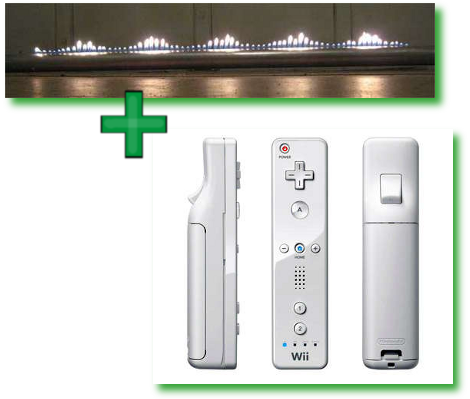
This Wiimote Rubens’ tube caught our eye. A PVC Aluminum irrigation pipe is drilled with holes and propane is pumped through. A speaker on one end creates changes in pressure and a neat light show follows suit. [ScaryBunnyMan] went further though, with a collection of software and a Wii Remote he “plays god” controlling the music, and thus, the fire. Check out a fun video after the split.

[Via Make]

Continue reading “Wiimote Controlled Ruben’s Tube”