FareBot – Android NFC Proof Of Concept

farebot_logo

Upon learning that the Nexus S smartphone was equipped with a Near Field Communications NFC) radio, [Eric Butler] decided he would put the newly released Gingerbread SDK to good use.  Focusing initially on ORCA fare cards used by several Washington state transit systems, he built an open-source application he calls FareBot, which can read data from any MIFARE DESFire branded cards.  Utilizing the NFC radio in the Nexus S, he was able to dump all of the unprotected information from the fare cards, including  the remaining card balance and the last 10 locations where the card was used.

The author hopes that his proof of concept application encourages other developers to expand on his project and to explore the data stored on transit cards around the world. While it is in its early stages, [Eric] would ultimately like to see this project expanded to allow the use of NFC-enabled smartphones as transit cards themselves via downloadable apps.  He suggests that helping people understand the amount of data which can be freely obtained from these cards will eventually force the manufacturers to better inform consumers of the existing system’s shortcomings, which in turn might spur on smartphone-based transit initiatives.
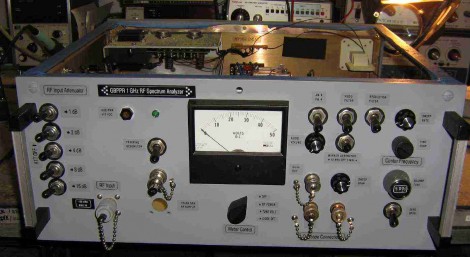

Building A Better Spectrum Analyzer For Radio Enthusiasts

This spectrum analyzer project seeks to improve the quality of tools available to amateur radio operators. A lot of thought has gone into the design, and those details are shared in the verbose project log. The case was originally a CATV link transmitter, but most of the controls seen above have been added for this build, with unused holes filled and finished to achieve the clean look.

One noteworthy part of the build is the time that went into building a rather complicated-looking 1013.3 MHz cavity bandpass filter. Despite the effort, the filter didn’t work. Details are a bit sketchy but it seems that some additional tuning brought it within spec to complete that portion of the device.

This certainly makes other toy spectrum analyzers look like… toys.

[Thanks William]

Arduino Asteroids

[nootropic] has a new game out for hackvision, “Asteroids”! We covered the hackvision back when it first started appearing in October of 2010, and hardware wise it has not changed. It is still an Arduino (software) compatible system sporting a atmega328, video and audio out connections (uses the TV-out library), all on a nice printed circuit board that, with the buttons, resembles a game controller.

While its impressive enough to run arcade inspired games like space invaders, pong, and tetris while using Arduino and a library, Asteroids takes the game up a notch.

Features that make Asteroids well, Asteroids include a mod of the TV-out library so that bitmaps can fly over each other without erasing the pixels under them to give that old time vector arcade feel, and “point in polygon” style collision detection, which is a fantastic / efficient way of collision detection against irregular shapes, limited platform or not.

Last but not least, [nootropic] used the set_vbi_hook() function of the tv out library in sound design, going from simple “beeps” and “boops”, to “beeps” and “boops” on a constant 60Hz refresh (in the case of NTSC) that allows him to build more complex sound effects that give a nice arcade sound of explosions and laser blasts.

Join us after the break for a quick video, and remember, this is Arduino based so if you already have an Arduino, you can add the supporting hardware (buttons, resistors, and RCA jacks) and run any of the games currently offered, or make your own.

Continue reading “Arduino Asteroids”

Upvote/Downvote Cards

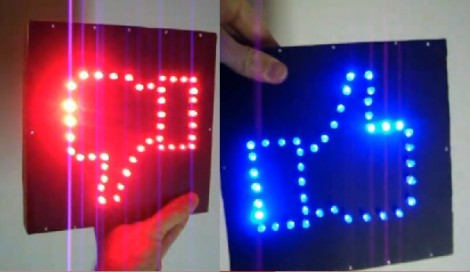
Next time you throw together a talent show consider using these cards for up and down voting. [Frits Rincker] came up with the idea over the weekend based on the like and dislike buttons of Facebook. They consist of some foam board with LEDs in the outline of a hand. He built a switch which completes he blue circuit for the thumb’s up and a red circuit for thumb’s down by using a weight that slides freely in a channel, with a reed switch at either end. We’ve embedded the video after the break for you enjoyment.

Oh, and in case you were wondering; Hackaday likes this.

Continue reading “Upvote/Downvote Cards”

Replace An N64’s Worn Out Joystick

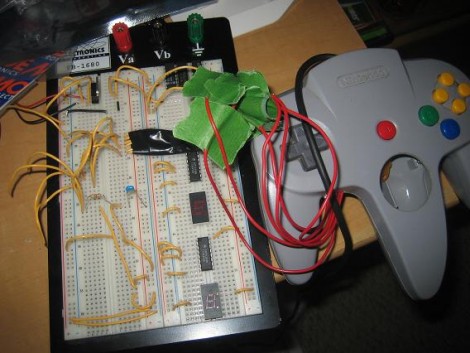
As gaming consoles age the controllers will inevitably show some wear, and sadly may give out all together. [Kyle] couldn’t bear to watch his Nintendo 64 controller bite the dust so he replaced the thumb stick with one from a PlayStation. This is a bigger job than you might imagine because the two parts are fundamentally different. The original N64 stick uses a rotary encoder to output data to the control chip, while the PlayStation stick is an analog device. [Kyle’s] solution was to read the analog values using a PIC, but lower in the thread you can read about another user who pulled off a similar hack using an AVR. Both convert the signals into the rotary encoder format that the N64 chip is listening for. From the looks of the clip embedded after the break, this couldn’t work any better!

Continue reading “Replace An N64’s Worn Out Joystick”

Home Built Revolving Shotgun

Sometimes, you just need more ammo available. In this weapon mod, the chamber of a 12 gauge shotgun, a hammer from an 1857 Remington Perc Revolver, and other parts from an Italian auto shotgun were all combined to make this happen. The gun is of questionable legality depending on what state or country it resides in. Don’t quote us on it, but the members of the forum seem to think it should be fine anywhere in the US but California. Slightly more practical than other shotgun mods we have seen, the inventor has been kind enough to share some stills of the inner mechanisms to see how this gun ticks.

[via Neatorama]

Chroma – Mesmerizing LED Driven Fractal Display

chroma in action

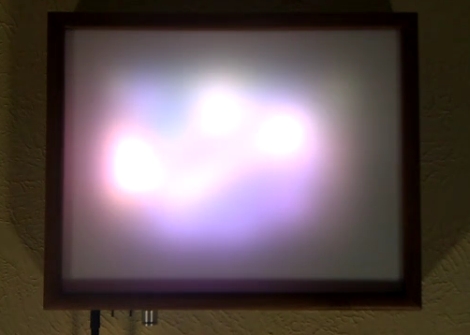
A big fan of generative art, [Andrew Magill] wanted to build an LED display for his wall that constantly displayed images from the Electric Sheep project.  After discounting the possibility of generating these fractals on the fly, he settled on using prerecorded video clips gathered over a year’s time by Electric Sheep users.  With thousands of video clips in hand, he wrote some custom software that enabled him to sequence these 5-second video clips into just over 6 hours of video, which he later downsampled to fit his 24×16 pixel display.

Now that he had some impressive video put together, [Andrew] began designing the LED panels he would use to show off his creation.  After choosing TI TLC5947 drivers to control the LED arrays, he got to work on designing the PCBs, soldering in all of the components, and testing the displays.  Initial testing completed, he wrote some more custom software to direct the individual LED boards from a master controller, and mounted everything in a frosted-glass adorned picture frame.

Be sure to check out mesmerizing video of Chroma in action after the break.

Continue reading “Chroma – Mesmerizing LED Driven Fractal Display”