Equipment Needed To Get “Started” In Electronics

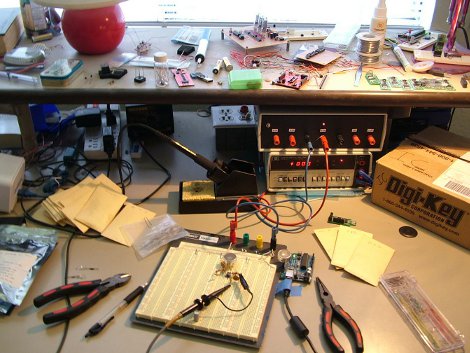
[Kenneth] is a Mechanical Engineer who likes to dabble in electronics. Besides providing us with an excellent picture of his workbench, he has put together a list of things that you’ll need as you learn to work with electronics. A beginner electronics kit from one of a number of different sources may work for some, but others may not be interested in a kit.

[Kenneth] gives links and recommendations for categories of: books, electrical equipment, development tools, components, digital electronics, and analog chips. As he puts it, this post is a “gigantic list of everything I would buy right now to replace my entire workshop if mine were to disappear.”  This is a great list of things you may need if you’re starting out.  If you have some experience, this list may introduce you something new. Check out some of [Kenneth’s] other projects like his cloud chamber or the Chumby webserver that he made.


Electronic Cufflinks For The Discerning Hacker

icufflinks

[Phillip Torrone] gave us a heads up about a project he and [Limor Fried] along with [Mike Doell] have just wrapped up. Their aptly-named “iCufflinks” softly pulsate with light the same way in which you see many Mac products do.

The cufflinks are made from machined aluminum and have the ubiquitous “power symbol” milled into the face. Inside the cufflinks, you will find a small circuit board and a battery, which powers the device for up to 24 hours. The team reverse-engineered the soft LED pulse found in Mac products in order to deliver the exact same visualization in their cufflinks.

Ignoring for a minute, the name and the inspiration for the product, we think they are pretty darn cool. There’s nothing like a set of softly glowing cufflinks to spark conversation at any social gathering.

Like anything else you’ll find on Adafruit.com, the cufflinks are completely open source, so you can feel free to tweak and remix the design any way you’d like.

Continue reading to see a video of the cufflinks in action.

Continue reading “Electronic Cufflinks For The Discerning Hacker”

Mini Google Street View Car Built From Lego

lego_street_view

[Mark] was playing around with a small GPS sensor when a light bulb lit over his head. He imagined it would be pretty cool to replicate one of Google’s Street View cars at a fraction of the scale using Lego NXT parts. He figured it would be easy enough to rig a few cameras to a remote controlled car, recording images and GPS coordinates as it went along.

The mini Street View car is controlled by a single NXT module that receives commands from a PS2 controller via a PSPNx sensor he purchased. A trio of cameras have been attached to the car, which are meant to take pictures in all different directions when triggered by his remote. A handful of additional motors are also used for driving the car, steering, and for activating the shutter release on the cameras.

The car worked decently during testing, but [Mark] says there is still plenty of room for improvement. He is having issues reliably triggering all cameras at the moment, but we’re sure he’ll have it sorted out soon enough.

Keep reading to see a video of his mini Street View car in action.

Continue reading “Mini Google Street View Car Built From Lego”

Arduinos…. In…. Spaaaaaace…..

Since 2007, [Adam Kemp] has been leading a team of students from Thomas Jefferson High School, guiding them through the process of designing and building a small satellite that NASA selected for launch early next year.

The CubeSat, officially named TJ³Sat, uses commercial, off-the-shelf components for nearly all its systems. The team ran into a problem interfacing the FM430 Flight Module (PDF warning), so [Adam] designed an Arduino-based replacement. Based on an ATMEGA328, the entire board is a drop-in replacement for the FM430 Flight Module. On July 1st, the TJ³Sat will begin testing at Orbital Sciences Corp. to make sure the entire satellite is up to snuff.

The TJ³Sat’s payload will take data from the ground controllers and using a TextSpeak module convert serial data into spoken voice. This audio will then be transmitted over amateur radio frequencies and will be picked up by hams all over the world. We’d like to wish the students at Thomas Jefferson High a hearty congratulations for being the first High School to build a satellite and hope the testing and launch go as planned.

The Infrared Graduation Cap

It’s graduation time for many high schoolers, and while many students would love to decorate their caps, administration generally looks down upon this practice. [Victor], however, thought of a way around this.

The human eye cannot see infrared light, but camcorders generally can. Putting these two concepts together with a couple of infrared LEDs, [Victor] was able to make a cap that displayed his decoration in everyone’s “digital memory”, but wouldn’t be detected until the video of the offense was displayed. Hopefully by the time the prank is detected, [Victor] will have successfully graduated and presumably gone on to other pursuits.

An ATmega 168 controls this hat to display his message, “Congratulations Class of 2011,” in Morse code. What a creative use of both old and new technology to pull off an awesome graduation prank. Be sure to check out the video after the break to see how everything was put together. Continue reading “The Infrared Graduation Cap”

Hackaday Links: Saturday, June 18th

Tripod CNC Machining Setup:


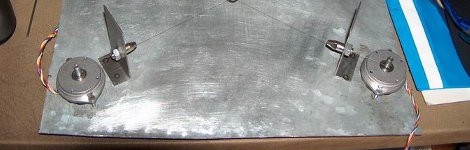
Here’s a strange “tripod” device using the EMC software package generally used for CNC machining.  In this case it looks like something that (when scaled up) might control a sky-cam-like device that one would see at football games.

The Off-Grid Container House:


Project to make an off-grid container house.  Pretty crazy idea, but definitely not developed yet. This seems like a cool idea, so hopefully this guy will come through. It may give you some other ideas, so check it out. Pizza in a cup anyone?

Iphone Window Pocket


Iphone window pocket – This Instructables article shows how to make a “window” in your pants for your Ipod. The combination of bad style and nerdiness gives a great first impression every time. Not sure how it works with the capacitive touch screen, but it should be good for viewing at least.

The Multiple AC Unit Experiment


Here’s someone who’s done some experimenting with using a central AC unit with several window units. Not bad, considering he documents shaving about 1/3 off his power bill.  Maybe it could inspire something even better!

Incredible CNC “hexapod” Milling Center


Finally, this machine isn’t exactly a “hack”, but a professionally designed machining center. It uses a machining setup similar to a delta robot. Six linear actuators are coordinated to allow this CNC robot to move in five degrees of freedom with incredible speed.

Modding A Car Charger To A Variable Power Supply

For an upcoming road trip, [Patrick] needed a small variable power supply. Instead of lugging around a bench supply, [Patrick] did the sensible thing and reverse engineered a cell phone charger to fit his requirements.

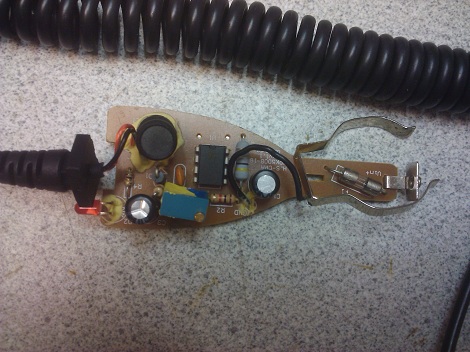
After cracking open an old Kyocera car charger, [Patrick] found a small PCB with completely labeled, all through-hole components – excellent reverse engineering potential. After finding an On Semi MC33063 IC, [Patrick] tore through the datasheets, generated a netlist, and developed a schematic that closely resembled the reference schematic given by the datasheets.

With all the grunt work done, [Patrick] set out to finish what he started – modifying the charger to output 3-10 Volts. After replacing a resistor with a 5k multiturn pot, [Patrick] was left with a power supply with a variable output from 2.8 to 8.8 Volts. Not exactly what was desired, but more than enough for the application at hand. While this hack isn’t a disco floor, it’s a great walkthough of the hacking process – building or modifying something to suit a need.