Help 2600 Magazine Compile A List Of Dates For Their Hacker Calendar!

2600, the magazine familiar to many as a preeminent hacking quarterly, is publishing a calendar. While, according to the 2600 site, most calendars only mark holidays, 2600 intends to “provide as complete a guide to milestones in the hacker world as humanly possible.” Not an easy task considering that, depending on your definition, hacking could extend to the discovery of fire, or at least the wheel.

2600 gives some examples in which they only list events back to March 3, 1885, when AT&T was founded.  If this example is followed, that “only” gives one 126 years to work with, but compiling a full list of hacking dates is still a daunting task. If you can think of any dates worthy of consideration, email them to: calendar@2600.com.  We think maybe September 5th, 2004 might be a notable date to include. We’ll leave it up to figure out what that date is, in case it wasn’t painfully obvious.
Build Your Own Panoramic Pinhole Camera

panoramic_pinhole_cam

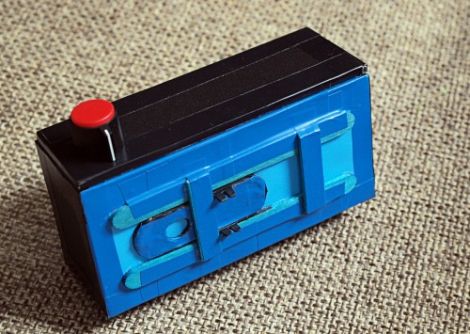
While it seems that the digital camera is king, some people still love shooting with good old 35mm film – [Costas Kaounas], a high school teacher and photographer certainly does. He recently published plans for a great-looking 35mm pinhole camera over at DIY photography that we thought you might enjoy.

[Costas] put together a set of simple hand-drawn plans for the camera, that you can easily replicate with a bit of free time. The camera is built mostly from card stock, both in 1mm and 3mm flavors, also incorporating popsicle sticks and an aluminum can. The popsicle sticks are used to create a manual shutter for the camera, while the pop can is used to form the pinhole aperture.

It’s a pretty simple hack as you can see, with nary an electronic part to be found. It will take you a bit of time to construct however, since you’ll need to let the glue dry between certain steps.

Love it or leave it, you’ve got to admit that the panoramic shots it takes are pretty nice!

If we’ve piqued your interest in pinhole cameras, be sure to check out this Lego pinhole camera as well as this beer can pinhole camera.

[via Lifehacker]

Two Kinects Plus One HD Projector Makes The Coolest “Snowglobe” Ever

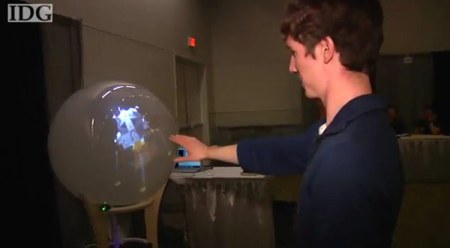
Looking for something to replace the flat screen display that was amazing in your house ten years ago?  How about a circular display similar to a snowglobe (crystal ball?) that will display the image you are watching correctly no matter at what angle you view it.

This amazing student project from Queens University combines elements that many hackers are familiar with, including: Kinect sensors, a 3-D projector, and a giant acrylic sphere.  Actually, most people have never worked with a giant acrylic sphere, but they look like fun.  Check out the video after the break. Continue reading “Two Kinects Plus One HD Projector Makes The Coolest “Snowglobe” Ever”

Amazing 3d Telepresence System

encumberance_free_telepresence_kinect

It looks like the world of Kinect hacks is about to get a bit more interesting.

While many of the Kinect-based projects we see use one or two units, this 3D telepresence system developed by UNC Chapel Hill student [Andrew Maimone] under the guidance of [Henry Fuchs] has them all beat.

The setup uses up to four Kinect sensors in a single endpoint, capturing images from various angles before they are processed using GPU-accelerated filters. The video captured by the cameras is processed in a series of steps, filling holes and adjusting colors to create a mesh image. Once the video streams have been processed, they are overlaid with one another to form a complete 3D image.

The result is an awesome real-time 3D rendering of the subject and surrounding room that reminds us of this papercraft costume. The 3D video can be viewed at a remote station which uses a Kinect sensor to track your eye movements, altering the video feed’s perspective accordingly. The telepresence system also offers the ability to add in non-existent objects, making it a great tool for remote technology demonstrations and the like.

Check out the video below to see a thorough walkthrough of this 3D telepresence system.

Continue reading “Amazing 3d Telepresence System”

DIY High Voltage Electric Field Detector

electric_field_detector

Who needs a Fluke high voltage detector when you’ve got one of these things?

Actually, we still recommend a professional high voltage detector for serious work, but you’ve got to like this electric field detector that [Alessandro] recently put together.

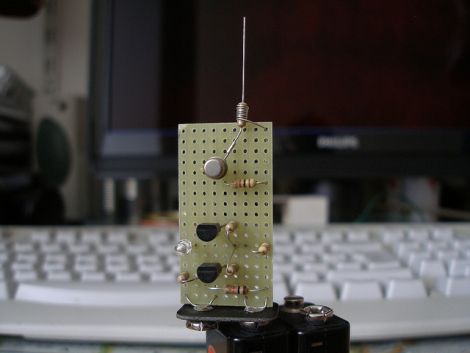
The detector works by using a JFET to detect the high impedance electric fields that are generated by high voltage lines. The JFET amplifies the signal while dropping the impedance in order to drive a pair of NPN transistors which are used as a threshold amplifier. Once the voltage hits 3V, an LED is lit, indicating the presence of high voltage near the detector’s probe. A wire-wrapped resistor does double-duty serving as the probe while providing a high impedance path to ground, ensuring that stray charge does not accumulate on the JFET’s gate, causing false readings.

It’s a neat project, and something that can be constructed in no time, making it perfect for beginner electronics classes.

Keep reading to see a quick video of the HV detector in action.

Continue reading “DIY High Voltage Electric Field Detector”

[Dino] Celebrates The 131st Anniversary Of The Photophone

photophone_demonstration

[Dino Segovis] wrote in to share yet another installment of his Hack a Week series, though this one is quite timely.

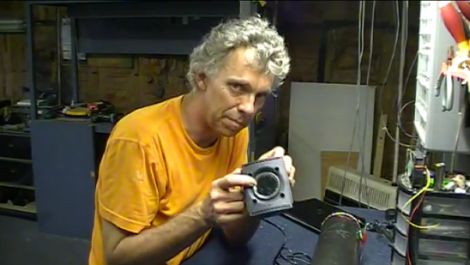
It was 131 years ago today that [Alexander Graham Bell] unveiled the Photophone to the world. A precursor to fiber optic technology, [Bell’s] incredibly important invention can be easily replicated in your garage, as [Dino] shows us.

The original Photophone was constructed using a megaphone and crystalline selenium cells at the focal point of the receiver, however this version can be made with easy to obtain parts. [Dino] rigged his laptop up to a speaker on which he mounted a mirror, before setting it out in the sun. The vibrations of the mirror modulate the sunlight, reflecting it onto a solar cell positioned at the end of a long, black PVC tube. The solar cell’s leads are fed into an amplifier followed by a speaker, which broadcasts the audio.

The demonstration goes off without a hitch, and while some might be underwhelmed by the technolgy, imagine how incredible it would have looked 131 years ago!

OnshouldersTV Knows How To Use OpenSCAD

Recently there’s been a increase in the popularity of OpenSCAD as the tool of choice in the 3d printing community. [Gavilan Steinman] is putting out a series of webTV shorts on the use of OpenSCAD. While it lacks a lot of the features of big CAD suits (such as the ability to generate drawings of your parts), the community has proven it’s effectiveness as a design tool. There are only two episodes out so far but they cover  OpenSCAD, mathcast, 3d printing, and a really neat robot design.  Watch them below.

Continue reading “OnshouldersTV Knows How To Use OpenSCAD”