Robot Fish Detect Pollutants

If you happen to visit the Spanish port of Gijon, you may notice some giant yellow robotic fish swimming around. These 5 foot long swimmers are part of a proposed sensor network to detect pollutants in the water.  Equipped with an array of sensors, the fish can test for general water quality, or swap out the sensors for specific testing. They communicate with each other to keep from straying too far from the rest of the network and the base charging station.

The fish was designed by the Shoal Consortium, a European commission funded program that draws from intelligent minds in universities all over europe. While the fish cost over $35,000 right now, mass production should reduce that cost considerably.

You can see them swimming around in the BBC video at the link.

[Adam Savage] Giving A Speech About The Maker Movement

[youtube=http://www.youtube.com/watch?v=_otrgJ8Lmx4&t=1m1s]

[Adam Savage] gives an interesting talk titled “why we make” at the Bay Area MakerFaire. Many have been comparing the leaps we’ve been taking in home engineering/hacking/making etc, to the early days of computers. People are making things at home that are actually making a difference.

[Adam] is a huge collector and maker of movie prop replicas. When he was talking to someone and showing off some of the amazing replicas that determined individuals are constructing in their homes, the person lamented the lack of originality. [Adam] does a good job of representing the other side of that argument. He explains how the drive to replicate these things is sometimes what is pushing the methods and technology further and supporting the community. It is an interesting video to watch, if only for the fun stories you get to hear.

Though he does open the speech by mentioning that he wants to play with an Arduino, you should continue watching. He’s done some amazing work and has some great insight.


Tornado Lamp Made With Lasers

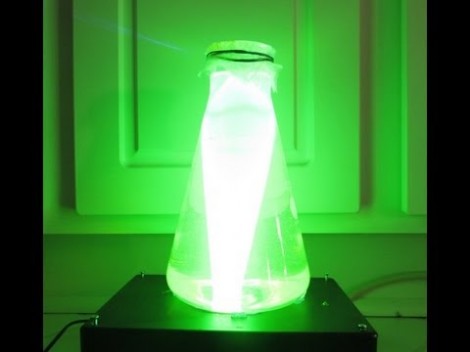
[Styropyro] did a great job of taking common parts and making an interesting item. He calls this his Tornado lamp, and it’s made with stuff you probably have around the house — well you might have to substitute more common glassware for that Erlenmeyer flask.

The bulk of the hack is in the base. You’ll find a laser diode pointed at a small scrap of mirror. That mirror is mounted on the center of a small case fan, giving the tornadic effect when spinning. To make everything fit just right, the laser is pointed horizontally, with the fan/mirror at a 45 degree angle. The beam points up through a hole in the project box and illuminates the liquid in the flask. That liquid is water doped with a substance that fluoresces. In this shot it’s some fluorescein, but we did mention you can do this with stuff from around the house. [Styropyro] demonstrates the use of liqud from some highlighting markers as a substitute.

If you’re decoration a mad scientist’s lab this is a perfect companion for a Jacob’s ladder.

Continue reading “Tornado Lamp Made With Lasers”

Lighting Up A Runway Into The Garage

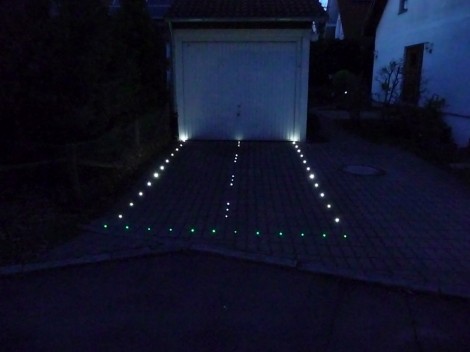
[Timo] didn’t want to look like every other lighted driveway but using solar path lights. Instead he decided to light it up as if it were a runway. It’s easy to look at the result as cute and move on to the next hack. But look again. If you were going to do this yourself how would you implement it considering a car will drive over it, and it’s outdoors?

The first issue of protecting this from traffic is actually not too tough in this case. [Timo’s] driveway is made of pavers and is not a solid sheet of asphalt or concrete. He drilled out some of the intersections to make just enough room for each of the PCBs he etched to house the LEDs and host the driver. These boards are inserted horizontally into the sand between the pavers like a fin, with the surface mount LED positioned along the edge. Power and control wires run along each line of lights. They are serial controlled which cuts down on the number of conductors needed. [Timo] didn’t mention weather proofing but we’d suggest casting them in crystal clear resin just like this headphone amplifier.

CAPTCHA Bot Beats New Are You A Human PlayThru Game

What do you put on your pancakes? Butter and syrup but not a pair of shoes? This makes sense to us, and it’s the premise of the new CAPTCHA game PlayThru. The space that is normally filled by nearly illegible text is now taken up by a little graphic-based game where you drag the appropriate items to one part of the screen. In addition to being easier than deciphering letters, this new platform shouldn’t require localization. But alas, it seems the system is already broken. [Stephen] sent us a link to a bot that can pass the PlayThru CAPTCHA.

Take a look at the video after the break to see the four test-runs. It looks like the bot is just identifying the movable objects and trying them out. Sometimes this is quick, sometimes not. But it does eventually succeed. For the PlayThru developers this should be pretty easy to fix, just make an error limit for trying the wrong item. At any rate, we can’t think defeating the current system is nearly as hard as defeating reCaptcha was.

Update: [Tyler] over at Are You A Human wrote in to share their side of this story. Apparently we’re seeing the bot play the game, but not necessarily pass it. It isn’t until the game if finished and the playing information is sent to their servers that a decision is made on whether it is successful or not. This way they can change the authentication parameters from the server side at any time.

At the same time, [Stephen] updated his bot and made a video of it playing the game without any shoes on the pancakes.

Continue reading “CAPTCHA Bot Beats New Are You A Human PlayThru Game”

Soldering From The Hip

You can be the Sheriff around these parts, but only if you have a solder gun and holster to boot. [Mikasaurus’] latest build is certainly fun, even if it’s not so practical. We’re not giving up our Weller knock-off any time soon, but this quick-heat repackage will certainly be a conversation starter at your next Hackerspace event.

The business end of the build is taken from a cheap four-battery soldering iron. [Mike] separated each of the components, then grabbed a toy gun to see where each of them might fit. The batteries are just the right size to fit into the gun’s magazine. All he had to do to make that happen is add contacts to the gun and springs to the magazine. A momentary push switch was positioned behind the trigger and used to connect the battery pack to the solder tip.

After the break you’ll find a little over-the-top modeling, and some solder melting. This will go great with that 9mm Bluetooth headset you built. Just don’t stick the wrong one in your ear.

Continue reading “Soldering From The Hip”

Retrotechtacular: 7-function Remote Control Color Television

Ah, the days when a television was a solid piece of furniture. When it comes to moving, we can’t say we miss it. But looking at this wooden TV cabinet with storage for its 7-function remote we can’t help but think that today’s TVs seem more… trivial… when it comes to the layout of the living room.

The promotional video that goes with this model is a gem of a different era. As you probably have heard, this week [Eugene Polley] passed away. He is credited with inventing the first wireless television remote control. It was not nearly as advance as what’s shown in the video after the break. Instead, it used visible light in conjunction with four light sensors at each corner of the CRT screen. You could turn the set on and off, and flip through channels, but sometimes with the right lighting conditions the set would change all by itself. We wonder if you’d ever come home to find the TV has mysteriously flipped itself on?

Continue reading “Retrotechtacular: 7-function Remote Control Color Television”