Reading RFID Cards From Afar Easily

RFID hacking has been around for years, but so far all the builds to sniff data out of someone’s wallet have been too large, too small a range, or were much too complicated for a random Joe to build in his workshop. [Adam]’s RFID sniffer gets around all those problems, and provides yet another reason to destroy all the RFID chips in your credit cards.

The project was inspired by this build that took a much larger RFID reader and turned it into a sniffer capable of covertly reading debit cards and passports from the safety of a backpack or briefcase. [Aaron]’s build uses a smaller off-the-shelf RFID reader, but he’s still able to read RFID cards from about a foot away.

[Aaron]’s build is very simple consisting of only an Arduino and SD card reader. [Aaron] is able to capture all the data from an RFID card, write that data to the SD card, and emulate a card using his RFID cloner.

What’s really impressive about the build is that [Aaron] says he’s not a programmer or electrical engineer. His build log is full of self-denegration that shows both how humble [Aaron] is and how easy it is for anyone with the requisite skill set to clone the bank card sitting in your wallet. We don’t know about you, but you might want to line your wallet with aluminum foil from now on.

Motorized Skateboard Just Begging To Be Your Next Project

You’re not going to be doing any flip-tricks with this board, but it’ll let you get around without getting sweaty. The ZBoard is a motorized skateboard which is in the pre-order stages thanks to a successful Kickstarter campaign. It’ll set you back $500 now or $600 later. With that kind of budget wouldn’t it be fun to build your own?

This base model can go about five miles or five hours between charges. It carries a seal lead-acid battery (really?) but if you upgrade to the pro model for just $250 more you get a LiFePo that doubles the range (but curiously not the run time). To make it go there are pressure sensitive foot pads on the front and rear of the deck. This allows you to go slow with just a bit of pressure, or put the pedal to the metal to get up to the 15 mph speed limit. It’s even got regenerative breaking to slow things down while giving a boost to the battery.

The idea is nothing new. But the cleanliness that this product brings to market is something to be respected. We’re hoping this sparks some inspiration for a rash of DIY clones, kind of like we’ve seen with the Segway.

Continue reading “Motorized Skateboard Just Begging To Be Your Next Project”

Reading Wax Cylinders With Lasers

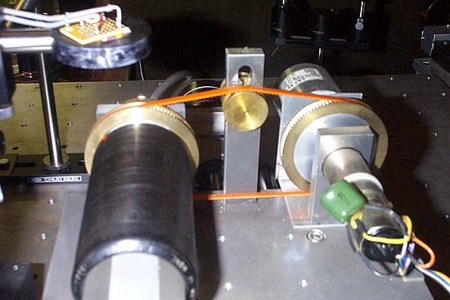
From 1902 to 1905, Polish anthropologist [Bronislow Pilsudski] did a series of recordings in Hokkaido japan on wax cylinders. Researchers at the university of Hokkaido have been working on ways to read the cylinders without causing any further damage to the grooves. Their preferred method has been to use reflected laser light. They have a very short writeup on their configuration, but it should be enough to get the idea.

Another project they’ve taken on is reading the original molds as well. They had to completely reconfigure their device to be able to be inserted into the cylinder. The quality they get from those is far superior though.


Ask Hackaday: Troll Physics Super Deluxe Edition

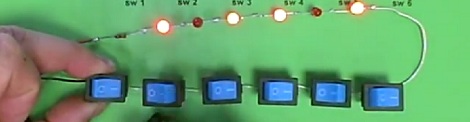
Here’s a brain bender for you: YouTube user [Fredzislaw100] put up a video of six LEDs and six switches wired up in series. After soldering a resistor and 9V battery connector, the first switch turns on the first LED, the second switch turns on the second LED, and so on for the rest of the circuit.

We’ve seen this trick before from [Fredzislaw100], only this time he’s moved up from 3 LEDs to 6. In the reveal of the previous trick, [Fredzislaw] built two AC power supplies inside a nine volt battery connector; one high frequency and one low frequency. The low frequency AC line powers the first two LEDs with the help of diodes in the switches and LEDs. The high frequency AC line turns on the third LED with the help of an inductor inside an LED. Apparently [Fredzislaw] still has some soldering skills to show off; the circuit powering this trick is most likely the work of a soldering god.

From a close viewing, it looks like LEDs are wired up in pairs, i.e. LED 1 works the same as LED 2, LED 3 works the same as LED 4, etc. We’ll let Hackaday readers argue it out in the comments as to how this trick is possible.

Tip ‘o the hat to [Th0m4S] for sending this one in.

Small Life On A Character LCD

[Duality] just finished programming Conway’s Game of Life on a character LCD. The game is a great programming exercise that everyone should undertake at one point or another. It uses a very simple set of rules to evolve the playing area from a given starting state. In this case the game grid is only 64 pixels, one for each of the positions on this 16×2 character LCD screen. This makes for very quick games as the cells tend to quickly reach an equilibrium as they arrive at the outer borders. See for yourself in the clip after the break.

We could have sworn we’ve seen this before, but with four times the playing space thanks to some custom characters. We couldn’t find an example of that, but the idea is to use a larger grid (something more like what’s seen on this graphic LCD) by generating a set of custom characters that slices each 5×8 pixel character into four smaller discrete areas. Something along the lines of what is being done with this spectrum analyzer.

Continue reading “Small Life On A Character LCD”

Electric Motorcycle Is Awesome, Goes 54 Mph

The folks over at the Cincinnati hackerspace Hive13 were wowed last week by an electric motorcycle built by one of their own.

[Rick]’s new ride is built from a 1989 Honda VTR 250. After removing the 24 HP motor, the frame was loaded up with four deep cycle batteries and a DC golf cart motor. Even with the addition of the four heavy batteries, the new electric bike only weighs about 70 pounds more than the stock Honda, allowing all that power to be translated into speed. Right now, [Rick]’s build can reach 54 mph; comparable to an earlier ebike we saw, but [Rick] can also go 100 about 20 miles on a single charge.

After the break you can see a short time lapse of [Rick] tearing down his bike, the first ride though the Cincinnati hackerspace, and a very nice road test showing off the speed of [Rick]’s new ride. There’s also a great Flickr slideshow with some really great pics of the build in progress. Very nice work, [Rick].

Continue reading “Electric Motorcycle Is Awesome, Goes 54 Mph”

Moppy Lets You Play Your Floppy Drives

Get ready to join a band. Just follow the guide over at the Moppy project page and you’ll have your very own floppy drive instrument.

The name is a mashup between Musical and Floppy. By using an Arduino UNO as a translator, you can command an array of floppy drives with a musical keyboard (think piano). The head on each floppy drive is controlled by a stepper motor which will put out some sweet sounds if driven at just the right frequency. The lower notes tend to fair a bit better than the high range. One great example of this is the Imperial March theme as heard after the break.

Once you get the base system up and running, it’s time to think of some alternate interfaces. Sure, you can obvious things like toy keyboards. But wouldn’t it be more fun to make it fruit controlled?

Continue reading “Moppy Lets You Play Your Floppy Drives”