Smoothing PLA Printed Parts

We’ve seen a few advances in the finishing processes of 3D prints over the last few months that result in some very attractive parts that look like they were injection molded. Smoothing ABS prints is now a necessary skill for anyone looking to produce professional parts, but those of us using PLA for our RepRaps have been left in the cold. After some experimentation, the guys over at protoparadigm have come up with a way to smooth out those PLA prints, using the same technique and a chemical that’s just as safe as acetone.

Instead of acetone, the guys at protoparadigm are using tetrahydrofuran, or THF, as a solvent for PLA. Other PLA solvents aren’t friendly to living organisms or are somewhat hard to obtain. THF has neither of these qualities; you still need to use it in a well ventilated area with nitrile gloves, but the same precautions when using acetone or MEK still apply. It’s also easy to obtain, as well: you can grab some on Amazon, even.

The process for smoothing PLA prints with THF is the same as smoothing ABS prints with acetone. Just suspend the print in a glass container, pour in a tiny amount of the solvent, and (gently) heat it. The evaporated solvent will smooth all the ridges out of the print, leaving a shiny and smooth surface. You can, of course, hand polish it by dedicating a lint-free cloth and a pair of gloves to the task.
Apple MagSafe Protocol Hacking

[Ken Shirriff] was interested in how the Apple MagSafe works. Specifically he wanted to know what controlled the LED on the connector itself so he tore one open to see what is inside. There’s a chip present and he didn’t waste time figuring out how the MagSafe communication protocol works.

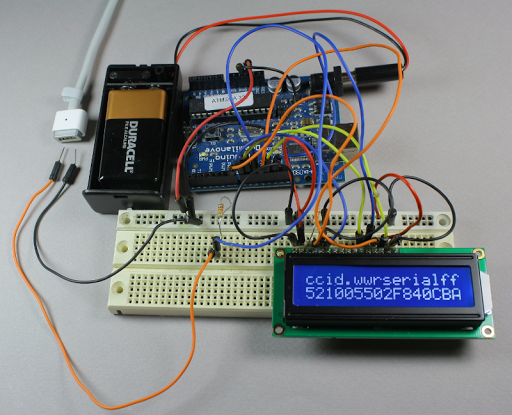
The DS2413 chip he found on the MagSafe’s tiny little PCB has just six pins. Two of these control a pair of LEDs, which give the indicator its color range.  Another pin is used for 1-wire communications. When polled the charger will return a 64-bit identification number that includes a variety of information. [Ken] looks into what data is offered from several different models of charger by using the Arduino setup above. But the results are not entirely straight-forward as he discusses in his article. The 1-wire protocol is also used to switch the LEDs. This process is the responsibility of the computer being charged, but [Ken] shows how the colors can be cycled using an Arduino (with a couple of 9-volts as a source instead of a connection to mains).

Alarm Clock Uses Raspberry Pi To Poll Google Calendar

rpi-google-calendar-alarm-clock

We know a lot of people love using their smart phone as a bedside alarm clock. The problem is that a mobile phone is mobile by nature and eventually you’ll forget to put it in the bedroom one night. That’s why we like the solution that [Devon Bray] has chosen. He set up his Raspberry Pi as an alarm clock that is set using Google Calendar.

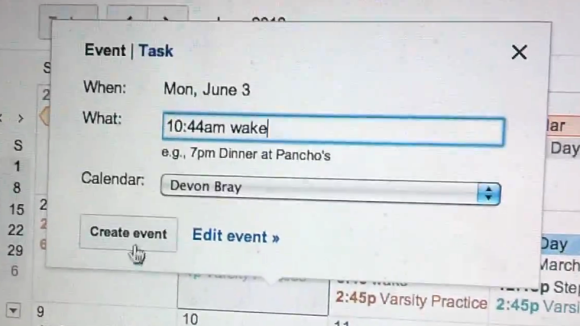
The setup which he shows off in his video is quite simple. The Raspberry Pi is connected to a set of powered computer speakers. It plays a song whenever an appointment called “wake” comes up on his Google Calendar. This is accomplished by using the Google Data APIs Python Client Library (isn’t that a mouthful?).

This only scratches the surface of what is possible. With this in place you could easily add LEDs to the room for a sunrise alarm. But if you’d prefer a more bare-bones hardware side of things that’s possible too.

Continue reading “Alarm Clock Uses Raspberry Pi To Poll Google Calendar”

Sliding Gopro Rig For Timelapse

timelapsethumb

This week I released a project for LIFE. involving a timelapse rig.

After seeing this super simple timelapse egg timer we had earlier this week, I wanted to have a try at doing a “no tools required” rig for moving timelapse.  I used an egg timer to pull it along a table.  It wasn’t perfect but it worked. Admittedly not as well as if I had just pulled out a teensy and a geared motor, but still ok.


Hacking The R-390A Military Shortwave Radio Receiver To Transmit As Well

hacking-r390a-radio

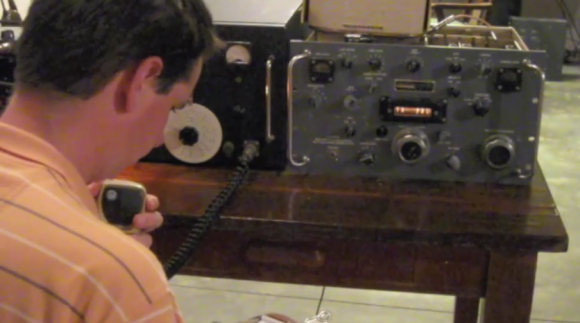
After getting his hands on this relic [Gregory Charvat] manage to hack it, converting the receiver into a transceiver.

It may be old, but the R-390A is nothing to scoff at. It’s abilities include AM, code, and FSK operation from 500 kHz to 32 MHz. But it is a receiver with no way of transmitting on the same bands. This is where [Gregory’s] hack comes into play. He rerouted the variable-frequency oscillator feed inside of the R-390A in order to use his 20M single-sideband unit. Basically what this does is allow him to control everything from the 390, using the microphone from the SSB — along with some switching hardware — to transmit his own messages.

His demo video starts with him making a few contacts using the hacked equipment. He then spends some time at the whiteboard explaning the changes. This portion went over our heads, but it becomes more clear when he cracks open the case and shows the actual modifications.

Continue reading “Hacking The R-390A Military Shortwave Radio Receiver To Transmit As Well”

Sugar Painting: Street Vendors Make Works Of Edible Art

Street vendors can sometimes show the best examples of refined skill. These street vendors in China have carved out a niche with a very specific type of candy. They pour heated sugar in various shapes and designs, then put it on a stick for your consumption. It doesn’t sound that impressive, but watch these videos and see the skill they show. As with many street vendors, you can tell these people have done this 10,000 times and the muscle memory could almost carry them on autopilot.

I would be happy to support street vendors like this.

http://www.youtube.com/watch?v=239GSmRW9XY