The Rise And Fall Of Free Dial Up Internet

In the early days of the Internet, having a high-speed IP connection in your home or even a small business was, if not impossible, certainly a rarity. Connecting to a computer in those days required you to use your phone. Early modems used acoustic couplers, but by the time most people started trying to connect, modems that plugged into your phone jack were the norm.

The problem was: whose computer did you call? There were commercial dial-up services like DIALOG that offered very expensive services, such as database searches via modem. That could be expensive. You had a fee for the phone. Then you might have a per-minute charge for the phone call, especially if the computer was in another city. Then you had to pay the service provider, which could be very expensive.

Even before the consumer Internet, this wasn’t workable. Tymnet and Telenet were two services that had the answer. They maintained banks of modems practically everywhere. You dialed a local number, which was probably a “free” call included in your monthly bill, and then used a simple command to connect to a remote computer of your choice. There were other competitors, including CompuServe, which would become a major force in the fledgling consumer market.

While some local internet service providers (ISPs) had their own modem banks, when you saw the rise of national ISPs, they were riding on one of several nationwide modem systems and paying by the minute for the privilege. Eventually, some ISPs reached the scale that made dedicated modem banks worthwhile. This made it easier to offer flat-rate pricing, and the presumed likelihood of everyone dialing in at once made it possible to oversubscribe any given number of modems.

The Cost

Once consumer services like CompuServe, The Source, and AOL started operations, the cost was less, but still not inexpensive. Some early services charged higher rates during business hours, for example. There was also the cost of a phone line, and if you didn’t want to tie up your home phone, you needed a second line dedicated to the modem. It all added up.

By the late 1990s, a dial-up provider might cost you $25 a month or less, not counting your phone line. That’s about $60 in today’s money, just for reference. But the Internet was also booming as a place to sell advertising.

Continue reading “The Rise And Fall Of Free Dial Up Internet”

This is an image that would have been difficult to chroma key by hand.

CorridorKey Is What You Get When Artists Make AI Tools

You may not have noticed, but so-called “artificial intelligence” is slightly controversial in the arts world. Illustrators, graphics artists, visual effects (VFX) professionals — anybody who pushes pixels around are the sort of people you’d expect to hate and fear the machines that trained on stolen work to replace them. So, when we heard in a recent video that [Niko] of Corridor Digital had released an AI VFX tool, we were interested. What does it look like when the artist is the one coding the AI?

It looks amazing, both visually and conceptually. Conceptually, because it takes one of the most annoying parts of the VFX pipeline — cleaning up chroma key footage — and automates it so the artists in front of the screen can get to the fun parts of the job. That’s exactly what a tool should do: not do the job for them, but enable them to enjoy doing it, or do it better. It looks amazing visually, because as you can see in the embedded video, it works very, very well.

Continue reading “CorridorKey Is What You Get When Artists Make AI Tools”

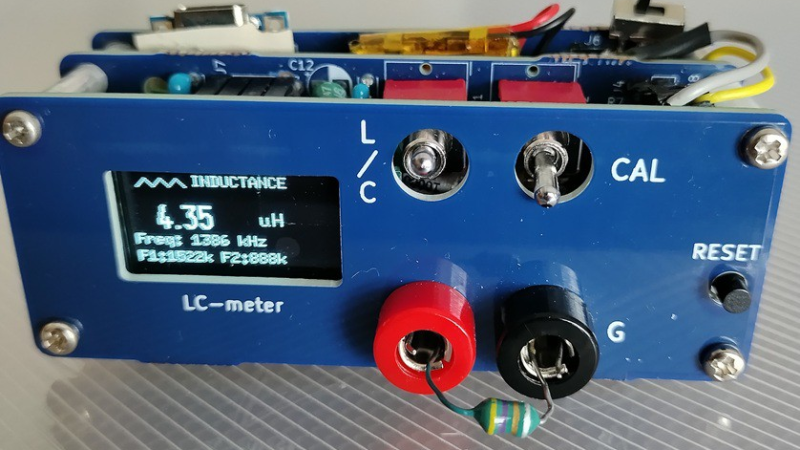
A blue frontplate to a circuit board is shown. On the left side is an OLED screen displaying "4.35 µH". To the right of this are a red and a black socket, with an inductor between them.

Building An LC Meter With A Franklin Oscillator

Although it dates back to the early days of the Marconi Company in the 1920s, the Franklin oscillator has remained a relatively obscure circuit, its memory mostly kept alive by ham radio operators who prize its high stability at higher frequencies. At the core of the circuit is an LC tank circuit, a fact which [nobcha] used to build quite a precise LC meter.

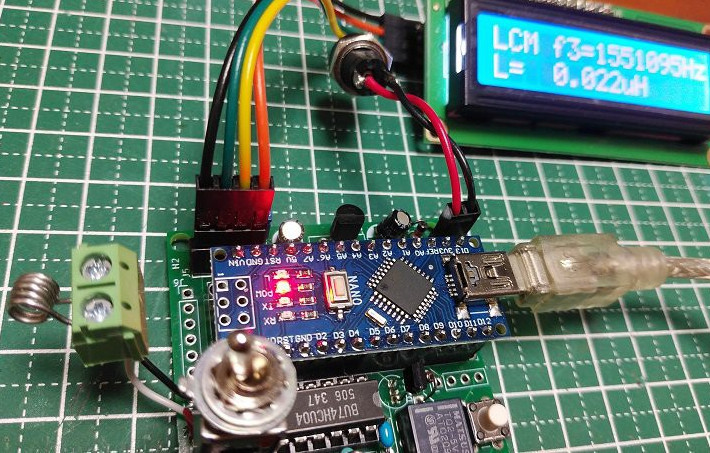
The meter is built around two parts: the Franklin oscillator, which resonates at a frequency defined by its inductance and capacitance, and an Arduino which counts the frequency of the signal. In operation, the Arduino measures the frequency of the original LC circuit, then measures again after another element (capacitor or inductor) has been added to the circuit. By measuring how much the resonant frequency changes, it’s possible to determine the value of the new element.

Before operation, the meter must be calibrated with a known reference capacitor to determine the values of the base LC circuit. In one iteration of the design, this was done automatically using a relay, while in a later version a manual switch connects the reference capacitor. Because the meter measures frequency differences and not absolute values, it minimizes parasitic effects. In testing, it was capable of measuring inductances as low as 0.1 µH.

We’ve seen a few homebrew LC meters here, some battery-powered and some rather professional.