Wireless Rocket Motor Analyzer Tests Rockets, Saves Fingers

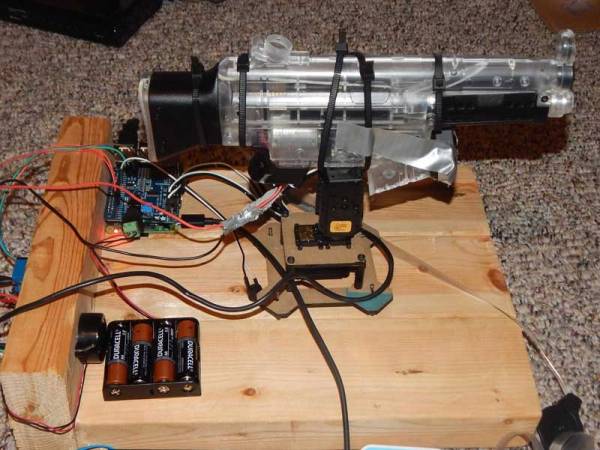
Testing rocket motors is a dangerous business, as they have an annoying habit of releasing all of that energy a little quicker than you might like. [Jeff Hopkins] knows this, so he made his own wireless rocket motor analyzer that allows him to trigger, test and monitor rocket motors from a safe distance. This involves more than just pushing a button and watching them go whoosh: his platform measures the thrust of the prototype over 90 times a second and transmits this data to him remotely for logging and later analysis. His current prototype can measure engines with up to 400 lbs of thrust. That is a lot, so it is a good thing that his rig can also remotely arm, fire or safe the motors, all over a 70cm wireless radio link that keeps him safely out of the way. It is also built of cheap parts, so if a RUD (Rapid Unplanned Disassembly) does occur, it won’t cost him much to rebuild and start again.

This project is part of a bigger plan: [Jeff] is looking to build a high-power launch platform that can launch an electronics platform high above the earth. Could this be the beginning of the race to be the first hacker in space? We shall see…


Amazon Giving Out (Sort Of) Hackable Amazon Dash Button

We’ve seen some interesting hacks of the Amazon Dash buttons, a neat device where you press a button and it orders a product from Amazon for you. Now, [Amazon] themselves are getting into the hacking fun with the AWS IoT Button. This is a Dash button that Amazon is giving out at events to promote their new Amazon Web Services (AWS) Internet of Things (IoT) service.

As part of their efforts to take over the world, the AWS IoT service allows you to create button-based services like ordering pizza or starting Netflix, but without running your own server. Instead, Amazon handles all of the hard stuff behind the scenes on their Lambda engine, which receives the small bit of JSON that the button sends and runs a Lambda function that orders pizza, kicks off Netflix, then starts World War III. Amazon provides sample actions for things like launching the missiles sending a text message over Twilio and writing to a database. Amazon isn’t selling these buttons: they only seem to be available as swag at events. Make a loud enough noise in the comments section and maybe they’ll allocate some for the Hackaday community.

Continue reading “Amazon Giving Out (Sort Of) Hackable Amazon Dash Button”

Halloween Hood Has Hideous LED Gaze

Looking to create fear and dread with your Halloween costume? [Becky Stern] over at Adafruit has you covered, with her tutorial on building a mystical hood with LED eyes, perfect for your next Jawa, Black Mage, or Orko costume.

This creepy-looking creation is based around a Gemma controller driving two NeoPixel Jewels, small circular RGB LED boards. The Gemma drives the boards to slowly fade on and off for the required creepy eye effect, but it would be easy to create other lighting patterns.

Speaking of patterns, the tutorial also includes a sewing pattern for the hood, and plans for a 3D printed battery holder that would make the whole thing very easy to carry. If the eyes aren’t enough, how about adding an LED magic staff to complete your creepy ensemble? Or perhaps some light-up dinosaur spiky plates?

Do you have any good Halloween costume hack plans? Let us know in the comments, and we’ll put together a list of the best closer to the hideous day.

Continue reading “Halloween Hood Has Hideous LED Gaze”

Hand Cranking The Malevolent Mechanical Pumpkin

Meet Marty. He’s a pumpkin that has been fitted out with a moving eyes, tongue and an expression of malevolent glee. You would probably assume that this is all driven by servos, right? Nope: Marty is driven by an old-fashioned crank mechanism, designed and built by [Ben Brandt].

He wanted to make something that could be driven by a hand crank. Of course, there is nothing stopping you from throwing a motor on the back to drive the mechanism, but [Ben] wanted the internals to be fireproof so he could light it with a candle. His mechanism, built from old bits of wire and sheet metal, is not flammable or adversely affected by heat like a motor and power supply would be. He succeeded admirably, and he has also done an excellent job of documenting the process to providing handy tips on creating a mechanical pumpkin-based monstrosity.

Those hackers down with a little electronic wet work you should start building their LED-integrated Jack-O-Lantern now. These things take a lot of time turn out.

Continue reading “Hand Cranking The Malevolent Mechanical Pumpkin”

Raspberry Pi Sentry Turret Is The Enemy Of All Mankind

War, huh, what is it good for? Absolutely nothing, except as an excuse to build a Raspberry Pi powered sentry turret that will track and fire upon your enemies. That’s what [Matt Desmaris] decided to do, and he has released the full details of his build.

It lacks the polished elegance of most military hardware, but what do you expect of a quick and dirty hack? It’s not shiny or ominous, but it has that killer motion-tracking feature. [Matt] is using OpenCV to detect movement from a USB webcam, two servos to pan and tilt the camera and gun and a small relay to pull the trigger. Manual control over the Interwebs is also available.

We’ve seen lots of similar builds using weaponry such as rubber bands and Nerf guns, but this one is a great start if you are interested in seeing how you can tie together tools like OpenCV and servos to create a camera that actively tracks movement.

Creating Video Trails In OpenCV

The video trail effect is nothing new: it was first used in music videos like “Blame it on the boogie” from the Jackson 5 in 1978. Now,  [Antonio Ospite] has put together a nice article that shows the basics of using OpenCV to create this effect in live video. He used the open source video processing package OpenCV for this, creating the effect with a short script. It can run in multiple ways, creating video trail effects, or “catch-up”trails (where the trail reverses into a final frame).

This provides an interesting example of how these video effects have become so much easier to create. The Jackson 5 video was created using a Scanimate and Quantel Paintbox system that was as big as a closet and cost hundreds of thousands of dollars. Now, you can create these effects with free software and a cheap PC. Now you just need to figure out what in our modern world looks awesome with this throwback effect.

Continue reading “Creating Video Trails In OpenCV”

Party Balloon Crosses Atlantic, Tours Europe & Phones Home

For the past few months, [David VE3KCL] has been launching balloons from his Canadian home fitted with radio transmitters. Nothing unusual there: quite a few people do this, including schools, hackerspaces, and individuals. What is remarkable is how far he has gotten. His S-4 flight in August of this year crossed the Atlantic, reached France and took a tour of Germany, Denmark, Sweden, Finland and Norway before finally landing in the Norwegian Sea. That’s over 10,000 kilometers (6200 miles): not bad for a couple of party balloons strung together.

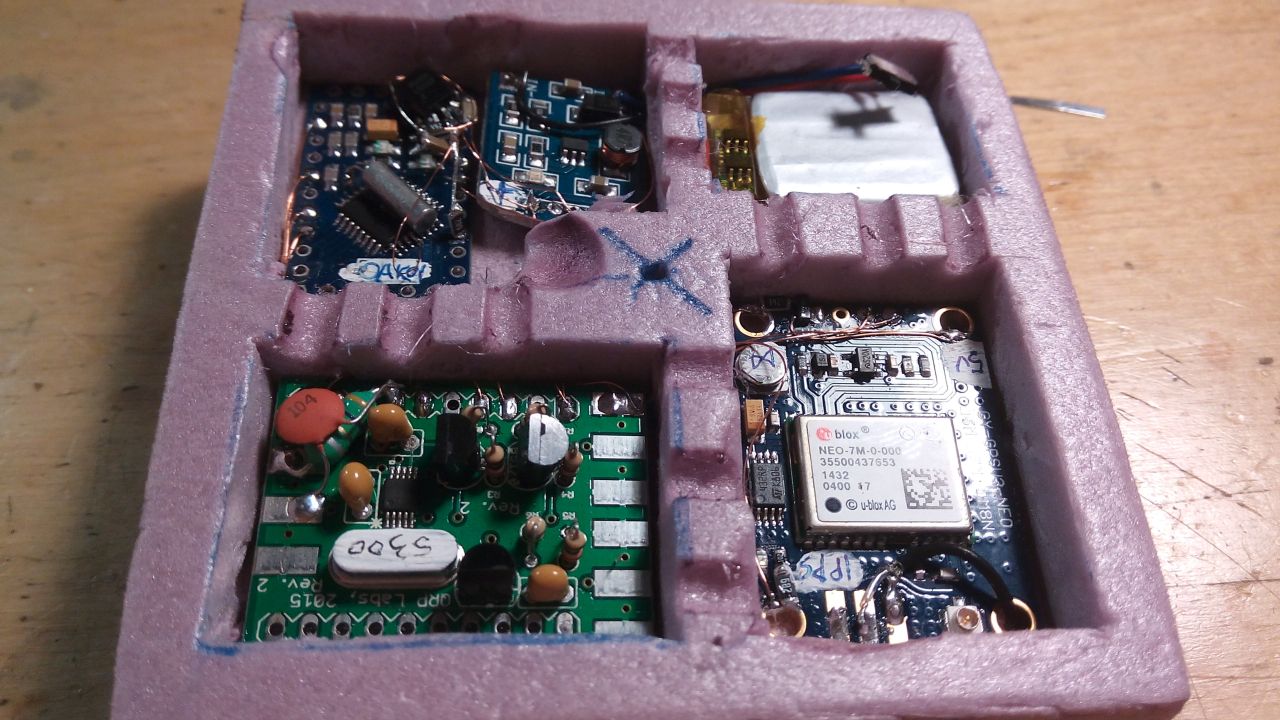
The flight payload of one of the balloon flights.

Although the distance these balloons have travelled is quite remarkable, the interesting part is how [David] is tracking the balloons. Cell phones obviously won’t work over the Atlantic, and satellite transmitters are expensive, so he used a low-cost transmitter that was programmed to broadcast using a variety of Ham radio signals. The most effective seems to be WSPRnet (the Weak Signal Propagation Network), a system used by Hams to see how far low strength signals will go. This system relies on Hams leaving their receivers on and running software that uploads the received signals to a central server.

By cleverly encoding information such as height and position into this signal, he was able to turn this worldwide network into a tracking network that would report the balloon’s position pretty much anywhere on the globe. [David] is continuing to launch balloons: his latest went up on the 24th of September and travelled over 4300km (2600 miles) before the signal was lost over the Atlantic.