Lithium Ion Versus LiPoly In An Aeronautical Context

When it comes to lithium batteries, you basically have two types. LiPoly batteries usually come in pouches wrapped in heat shrink, whereas lithium ion cells are best represented by the ubiquitous cylindrical 18650 cells. Are there exceptions? Yes. Is that nomenclature technically correct? No, LiPoly cells are technically, ‘lithium ion polymer cells’, but we’ll just ignore the ‘ion’ in that name for now.

Lithium ion cells are found in millions of ground-based modes of transportation, and LiPoly cells are the standard for drones and RC aircraft. [Tom Stanton] wondered why that was, so he decided to test the energy density per mass of these battery chemistries, and what he found was very interesting.

The goal of [Tom]’s experiment was to test LiPoly against lithium ion batteries in the context of a remote-controlled aircraft. Since weight is what determines flight time, cutting even a few grams from an airframe can vastly extend the capabilities of an aircraft. The test articles for this experiment come in the form of a standard 1800 mAh LiPoly battery and four 18650 cells wired together as a 3000 mAh battery. Here’s where things get interesting: the LiPoly battery weighs 216 grams for an energy density of 0.14 Watt-hours per gram. The lithium ion battery weighs 202 grams for an energy density of 0.25 Watt-hours per gram. If you just look at the math, all drones are doing it wrong. 18650 cells appear to have a much higher energy density per mass than the usual LiPoly cells. How does that hold up in a real-world test, though?

Using his neat plane with 3D printed wing ribs as the testbed, [Tom] plugged in the batteries and flew around a field for the better part of an afternoon. The LiPo flew for 41.5 minutes, whereas the much more energy dense lithium ion battery flew for 36.5 minutes. What’s going on here?

While the lithium ion battery has a much higher capacity, the problem here is the internal resistance of each battery chemistry. The end voltage for the LiPo was a bit lower than the lithium ion battery, suggesting the 18650 cells can be run down a bit further than [Tom]’s test protocol allowed. After recharging each of these batteries and doing a bit of math, [Tom] found the lithium ion batteries can fly for about twice as long as their LiPo counterparts. That means an incredibly long test of flying a plane in a circle over a field; not fun, but we are looking forward to other people replicating this experiment.

Continue reading “Lithium Ion Versus LiPoly In An Aeronautical Context”

Hackaday Links Column Banner

Hackaday Links: October 22, 2017

A few weeks ago, the popcorn overflowed because of an ambiguous tweet from AdafruitDid Adafruit just buy Radio Shack? While everyone else was foaming at the mouth, we called it unlikely. The smart money is that Adafruit just bought a few fancy stock certificates, incorporation papers, and other official-looking documents at the Radio Shack corporate auction a few months ago. They also didn’t pick up that monster cache of Trash-80s, but I digress.

Here’s some more popcorn: Adafruit just applied for the ‘Radiofruit’ trademark. Is this Adafruit’s play to take over the Radio Shack brand? Probably not; they put a bunch of radio modules on Feather boards, and are just doing what they do. It does demonstrate Adafruit’s masterful manipulation effective use of social media, though.

Remember those 2D tilty maze rolling marble labyrinth game things? Here’s a 3D version on Kickstarter. It’s handheld, so this really needs a gimbal and associated twisty knobs.

In a video making the meme rounds, someone found an easter egg in the gauge cluster of a Russian GAZ van. It plays Tetris.

It’s Sunday, so it’s time to talk Star Trek. Here’s something interesting that hit my email: a press release telling me, “Trekkies Scramble To Get The First Toothbrush In Space As Seen On Star Trek Discovery”. This is the toothbrush, and here is the press kit. Dumb? Not at all. Star Trek has a long history of using off-the-shelf tools and devices for props. For example, the hyperspanners seen in Star Trek: Enterprise were actually this non-contact thermometer available from Harbor Freight. At least the hyperspanners and thermometers came out of the same injection mold.

There’s a new LimeSDR board on CrowdSupply. It extends any LimeSDR to 10 GHz.

Kerf bending is the application of (usually laser-cut) slots to bend plywood around corners. You’ve seen it a million times before, and done correctly the technique can produce some very interesting results. What about metal, though? You need a pretty big laser for that. [Proto G] is using a 2000 W fiber laser to experiment with kerf bending in stainless steel. It works as you would expect, and we eagerly await someone to replicate this, if only to see another 2000 Watt laser in action.

Chemotransfer For DIY PCBs

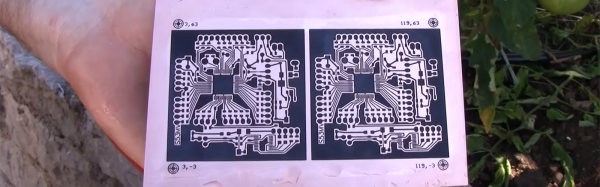
Making PCBs with the toner transfer method has been around since you could buy your traces at Radio Shack. There are a million techniques for removing copper from sheets of fiberglass, from milling to using resist pens, to the ubiquitous laser printer toner transfer. Here’s a technique we haven’t seen before. [Darko Volk] is calling this ‘chemotransfer’. It’s mostly a laser printer toner transfer process, but the toner is transferred from paper to copper with the help of a special mix of solvents.

This chemotransfer process is almost identical to the usual process of making a toner transfer PCB. First, the design is printed in reverse on dextrin-coated paper, the paper is placed down on polished copper, the entire assembly is sent through a laminator, and finally the board is etched with the chemical of your choice. The key difference here is a solvent applied to the copper just before the design is laid down. [Darko Volk] made a mixture of 25% “cleaning petrol” (benzene, naphtha, or gasoline, or some sort of light hydrocarbon, apparently), 5% linseed oil, and 70% isopropanol. This apparently aids in releasing the toner from the paper and sticking it down to the copper.

From there, the process is effectively a standard toner transfer process. [Darko Volk] is using a solution of sodium persulphate for the etch, and rigged a camera up to a CNC machine for the drilling.

This process can be expanded to two-layer boards very easily using a light table to align the layers of paper before placing them down on the copper. You can check out a video of the fabrication of a single side and double sided board below.

Thanks [Andrej] for the tip.

Continue reading “Chemotransfer For DIY PCBs”

These Twenty Projects Won $1000 In The Hackaday Prize

For the last several months, we’ve been hosting the greatest hardware competition on Earth. This is the Hackaday Prize, and we’ve just wrapped up the last of our five hardware challenges. For the Anything Goes challenge in this year’s Hackaday Prize, we’re asking hardware hackers to build the best, the coolest thing. No, it doesn’t matter what it is. We’re looking for technical skill and awesome applications. There are no limits here.

We just wrapped up the Anything Goes challenge last week, and now it’s time to announce the winners. These are the best, the coolest projects the Hackaday Prize has to offer.

The winners of the Anything Goes challenge are, in no particular order:

Anything Goes Hackaday Prize Finalists:

Continue reading “These Twenty Projects Won $1000 In The Hackaday Prize”

Friday Hack Chat: Energy Harvesting

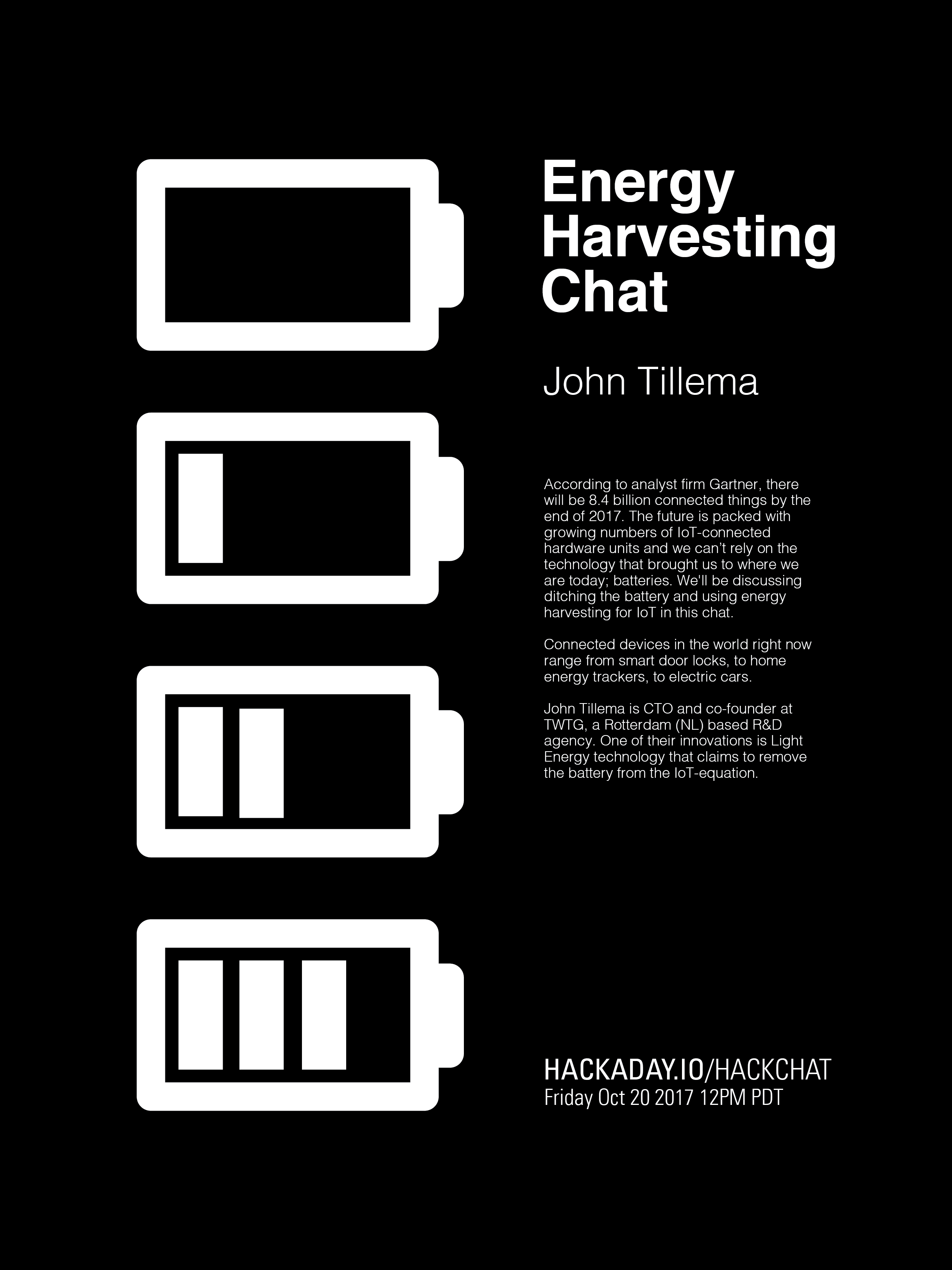
Think about an Internet-connected device that never needs charging, never plugs into an outlet, and will never run out of power. With just a small solar cell, an Internet of Thing module can run for decades. This is the promise of energy harvesting, and it opens the doors to a lot of interesting questions.

Joining us for this week’s Hack Chat will be [John Tillema], CTO and co-founder of TWTG. They’re working on removing batteries completely from the IoT equation. They have a small device that operates on just 200 lux — the same amount of light that can be found on a desktop. That’s a device that can connect to the Internet without batteries, wall warts, or the black magic wizardry of RF harvesting. How do you design a device that will run for a century? Are caps even rated for that? Are you really going to download firmware updates several decades down the line?

For this week’s Hack Chat, we’ll be discussing what energy harvesting actually is, what TWTG’s ‘light energy’ technology is all about, and the capabilities of this technology. Going further, we’ll be discussing how to design a circuit for low-power usage, how to select components that will last for decades, and how to measure and test the entire system so it lives up to the promise of being always on, forever, without needing a new battery.

This is a community Hack Chat, so of course we’ll be taking questions from the community. If you have a question, add it to the discussion sheet

join-hack-chatOur Hack Chats are live community events on the Hackaday.io Hack Chat group messaging. This Hack Chat will be going down noon, Pacific time on Friday, October 20th. Is it always five o’clock somewhere? Yes, so here’s a time zone converter!

Click that speech bubble to the right, and you’ll be taken directly to the Hack Chat group on Hackaday.io.

You don’t have to wait until Friday; join whenever you want and you can see what the community is talking about.

Hackaday Prize Entry: Playing With USB Power Delivery

USB Power Delivery is the technology that’s able to pump 100 Watts down a USB cable. It’s been around for half a decade now, but only in the last few years have devices and power supplies supporting USB PD shown up on the market. This is a really interesting technology, and we can’t wait to see the outcome of people messing around with five amps flowing through a cable they picked up at the dollar store, but where are the DIY solutions to futz around with USB PD?

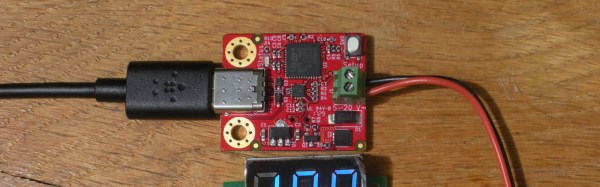
For his Hackaday Prize entry, [Clayton] is doing just that. He’s built a tiny little power jack for USB PD that has a USB type-C plug on one end and a pair of screw terminals on the other. It’s the USB PD Buddy Sink, and once we find some cheap 100 Watt USB power adapters, this is going to be an invaluable tool.

Getting 100 Watts out of a USB charger is a bit more complex than just soldering a few wires together. The power delivery must be negotiated, and for that [Clayton] is using a simple, cheap STM32F0 ARM microcontroller. Plugging into a USB bus is a bit more complicated, but luckily On Semi has a neat little programmable USB Type-C controller PHY that does all the work. Throw in a few MOSFETS and other ancillary parts, and you have a simple, small 100 Watt power supply that plugs right into your new fancy laptop charger.

The design of the USB PD Buddy Sink is complete, and [Clayton] has a bunch of these on hand. He’s selling them on Tindie, but it’s also a great entry to the Hackaday Prize.

Hackaday Prize Entry: Giving Phones Their Tactile Buttons Back

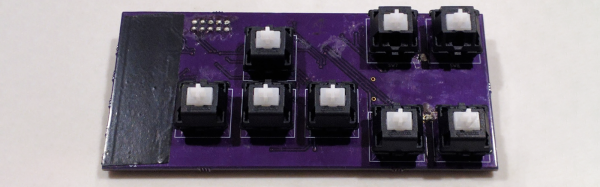
In the before-times, we could send text messages without looking at our phones. It was glorious, and something 90s Kids™ wish we could bring to our gigantic glowing rectangles stuck in our pocket. For his Hackaday Prize Entry, [Kyle] is bringing just a little bit of this sightless functionality back to the modern smartphone. He’s building a tactile remote control for smartphones. With this device, you can navigate through icons, push buttons, and even zoom in on maps with real, physical controls.

This keyboard is built around a handful of Cherry MX mechanical key switches for a great tactile feel, and a single capacitive touch strip for zooming in and out on the screen. This is pretty much exactly what you want for real, mechanical buttons for a smartphone — a satisfying click and a zoomy strip. The microcontroller used in this device is the BGM111 Bluetooth LE module from Silicon Labs. It’s an extremely low-power module that is able to read a cap touch strip and a few button inputs. Power is provided by a 2032 coin cell, giving the entire device a low profile form factor (except for the MX switches, but whatever), and more than enough run time.

It should be noted that [Kyle] is building this as a solution to distracted driving. True, looking down to send a quick text while driving is the cause of thousands of deaths. However, while typing out a quick note with a T9 keyboard on your Nokia seems like it’s less dangerous, it’s really not. Doing anything while driving is distracted driving, and there are volumes of studies to back this up. Outside the intended use case, this is a fantastic project that uses a neat little Bluetooth module we don’t see much of, and there are some pretty cool applications of a tiny wireless mechanical keyboard with cap touch we can think of.