The Tiny, $25 PocketBeagle

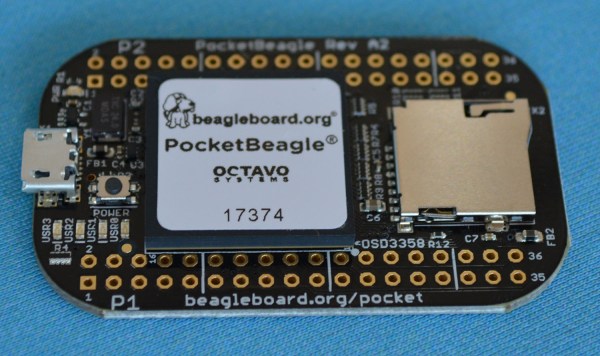
It was announced a day or two ago, but now the PocketBeagle has made its first real-world appearance at the World Maker Faire in New York this weekend. This is a tiny, tiny Linux computer that’s small enough to fit on a keychain, or in an Altoids mini tin. It’s only $25 USD, and from the stock lists on Mouser and Digikey, there are plenty to go around.

The specs for the PocketBeagle are more or less exactly what you would expect from any BeagleBone. There’s an ARM Cortex-A8 running at 1GHz, 512 MB of RAM, and SD card storage. I/O is eight analog inputs, up to 44 digital GPIOs, up to 3 UARTs, 2 I2C busses, 2 SPI busses, and 4 PWM outputs. All of this is packed into the OSD3358 System on a Chip from Octavo Systems.

This isn’t the first time we’ve seen Octavo Systems’ ‘BeagleBone on a Chip’ — Before the release, head Beagle herder [Jason Kridner] built a PocketBone in Eagle, which was shortly followed by [Michael Welling]’s similar efforts in KiCad. The PocketBeagle has been a reality for months, but now it’s accessible to hackers who don’t want to deal with soldering BGA packages.

This version of the PocketBeagle is getting close to as Open Source as you can get, with the design files available in Eagle and KiCad. One interesting feature of the PocketBeagle is which pins, busses, and peripherals are enabled by default. The killer feature of the BeagleBone has always been the PRUs — programmable real-time units — that enable vast arrays of LEDs, fast steppers for CNC machines, and DMA tomfoolery. The pins for the PRUs on the PocketBeagle are set up by default, with no need to screw around with configurations, modules, or drivers.

Continue reading “The Tiny, $25 PocketBeagle”

Cheap, Full-Duplex Software Defined Radio With The LimeSDR

A few years ago, we saw the rise of software-defined radios with the HackRF One and the extraordinarily popular RTL-SDR USB TV tuner dongle. It’s been a few years, and technology is on a never-ending upwards crawl to smaller, cheaper, and more powerful widgets. Now, some of that innovation is making it to the world of software-defined radio. The LimeSDR Mini is out, and it’s the cheapest and most capable software defined radio yet. It’s available through a Crowd Supply campaign, with units shipping around the beginning of next year.

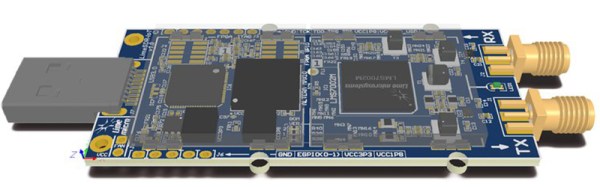
The specs for the LimeSDR mini are quite good, even when compared to kilobuck units from Ettus Research. The frequency range for the LimeSDR Mini is 10 MHz – 3.5 GHz, bandwidth is 30.72 MHz, with a 12-bit sample depth and 30.72 MSPS sample rate. The interface is USB 3.0 (the connector is male, and soldered to the board, but USB extension cables exist), and the LimeSDR is full duplex. That last bit is huge — the RTL-SDR can’t transmit at all, and even the HackRF is only half duplex. This enormous capability is thanks to the field programmable RF transceiver found in all of the LimeSDR boards. We first saw these a year or so ago, and now these boards are heading into the hands of hackers. Someone’s even building a femtocell out of a Lime board.

The major selling point for the LimeSDR is, of course, the price. The ‘early bird’ rewards for the Crowd Supply campaign disappeared quickly at $99, but there are still plenty available at $139. This is very inexpensive and very fun — on the Crowd Supply page, you can see a demo of a LimeSDR mini set up as an LTE base station, streaming video between two mobile phones. These are the golden days of hobbyist SDR.

Friday Hack Chat: All About Drones

In the future, drones will fill the skies. The world is abuzz (ha!) with news of innovative uses of unmanned aerial vehicles. Soon, our flying robotic overlords will be used for rescue operations, surveillance, counter-insurgency missions, terrorism, agriculture, and delivering frozen dog treats directly from the local Amazon aerodrome to your backyard. The future is nuts.

For this week’s Hack Chat, we’re going to be talking all about unmanned aerial vehicles. This is a huge subject, ranging from aeronautical design, the legal implications of autonomous flying machines, the true efficiency of delivering packages via drones, and the moral ambiguity of covering a city with thousands of mobile, robotic observation posts. In short, the future will be brought to us thanks to powerful brushless motors and lithium batteries.

Our guest for this week’s Hack Chat will be [Piotr Esden-Tempski], developer of UAV autopilot hardware for Paparazzi UAV. Paparazzi can be used for autonomous flight and control of multiple aircraft, and we’ll be talking about the types of embedded systems that can be used for these applications. [Pitor] is also the developer of the 1Bitsy ARM dev platform, the Black Magic Probe JTAG/SWD programmer/debugger and the founder of 1BitSquared.

In this Hack Chat, we’ll be discussing Open Source hardware design for UAVs, all things airborne robotics, the sensors that go into these flying robots, the stalled development (ay, another pun) of consumer and prosumer fixed-wing UAVs, ARM embedded systems, and JTAG and SWD programming and debugging. We’re also taking questions from the audience, and here’s the spreadsheet that will guide the discussion.

Here’s How To Take Part:

join-hack-chatOur Hack Chats are live community events on the Hackaday.io Hack Chat group messaging. This Hack Chat will be going down noon, Pacific time on Friday, September 22nd. Sidereal and solar getting you down? Wondering when noon is this month? Not a problem: here’s a handy countdown timer!

Click that speech bubble to the right, and you’ll be taken directly to the Hack Chat group on Hackaday.io.

You don’t have to wait until Friday; join whenever you want and you can see what the community is talking about.

Hackaday Prize Entry: The $50 Raspberry Pi Smartphone

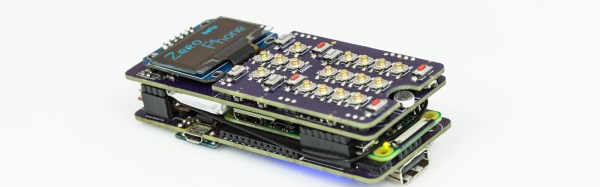
The Hackaday Prize is a challenge to create hardware, and the ZeroPhone is quite possibly the most popular project entered in the Hackaday Prize. What is it? It’s a mobile phone built around the Raspberry Pi Zero that can be assembled for about $50 in parts. Already, it’s a finalist in the Hackaday Prize best product competition, a finalist for the grand prize of $50,000, and one of the most popular projects on Hackaday.io of all time.

We took a look at the ZeroPhone early this year, and while there have been significant advances in this project, the philosophy is still pretty much the same. This is a mobile phone with a numeric keypad and a 128 x 64 pixel OLED display — basically the same user interface as a Nokia brick. The brain of the phone is a Raspberry Pi Zero wrapped in a PCB sandwich, with options for WiFi, Bluetooth, HDMI and audio outputs, a USB port, battery charging, and a ton of GPIOs that include ISM band radios, infrared receivers and transmitters, more flash storage, and anything else you can imagine. Basically, we’re looking at one of those modular, reconfigurable smartphone ideas, using a Raspberry Pi as the brains. Tech journos should be creaming themselves over this. We’re looking forward to [Arsenijs]’ cover story in Wired.

As with any Open Source / DIY cell phone, the big question surrounding the ZeroPhone is the cellular radio. 2G radios are cheap and plentiful, but the infrastructure is either coming down shortly, or already is down. A 3G radio is a must for a minimum viable product, and [Arsenijs] says there are provisions for replacing the 2G radio with a 3G module. Of course, 3G modules aren’t as capital-‘O’-Open as their technological predecessors, but that’s a discussion for another time.

Already the ZeroPhone is a huge success. There’s an actual team working on this project, the ZeroPhone subreddit is bigger than the Hackaday subreddit, there are newsletters, a wiki, and there will be a crowdfunding campaign ‘shortly’. This is one to look out for, and a very worthy project in the running for the 2017 Hackaday Prize.

Single Board Relay Computer

We all know you can build a computer out of relays, and if you’re a regular reader of Hackaday, you’ve probably seen a few. Actually designing and fabricating a computer built around relays is another thing entirely, and an accomplishment that will put you right up there with the hardware greats.

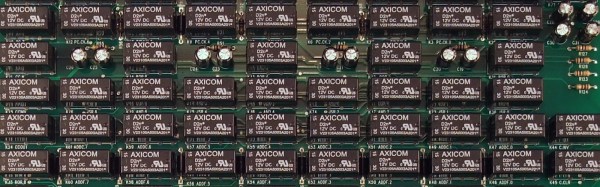
The newest inductee of the DIY microcomputer hall of fame is [Jhallen]. He’s built a microcomputer ‘trainer’ out of relays. It’s got more click and clack than the Tappet family, and is a work of art rendered in DPDT relays.

The biggest consideration in designing a relay computer is the memory. You can implement a CPU in a few dozen relays, but even a small amount of memory is still hundreds of additional components. In this computer, [Jhallen] is sort of cheating. The memory is implemented as 256 32-bit words on a microcontroller alongside a controller for the front panel. The CPU is still all relays, with support for self-modifying code, a bunch of instructions for conditional jumps, and an ‘increment and jump if not equal to zero’ instruction.

Below, you can check out a very in-depth video of the relay computer in action, starting off with some satisfying click and clack of Euclid’s algorithm and a demonstration of the variable clock rate. The video goes on to demonstrate the assembly language of the relay computer itself and a bit of the overall architecture. This is really one of the most educational demo videos for vintage computing we’ve ever seen.

[Jhallen] assembled a few of these boards and he’s selling some of the extras. If you have $600, you can pick one up over on Tindie (standard Hackaday / Tindie disclosure statement). Considering the amount of soldering required to assemble this board, we’re going to guess that’s a very fair price.
Continue reading “Single Board Relay Computer”

A Smaller, Cheaper RISC V Board

Early this year, the world of electronics saw something amazing. The RISC-V, the first Open Source microcontroller was implemented in silicon, and we got an Arduino-derived dev board in the form of the HiFive 1. The HiFive 1 is just a bit shy of mindblowing; it’s a very fast microcontroller that’s right up there with the Teensy when it comes to processing power. There’s support for the Arduino IDE, so all those fancy libraries are ready to go. That’s not to say there aren’t a few problems; it’s a relatively expensive board, and it does use the ubiquitous but somewhat unfortunate Arduino form factor.

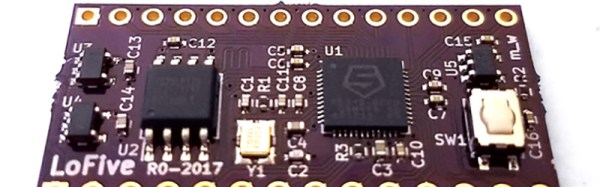
In the past few months, SiFive, the folks behind the FE310 microcontroller inside the HiFive 1, have been working to get bare chips out on the market. Now, those trays of microcontrollers are being turned into newer, slightly more development-friendly boards. Meet the LoFive RISC-V. It’s a GroupGets crowdfunding campaign from [Michael Welling], and it takes all the openness from the HiFive 1 and the FE310 microcontroller and stuffs it into a cheap, easy-to-use board.

Like the HiFive 1, the LoFive features the FE310 microcontroller and a 128 Mbit SPI flash. Unlike the HiFive 1, there’s not much else on this board. There’s a few voltage regulators, a crystal, some caps, and a button on an interrupt pin. If you’re looking for an Open Source microcontroller development board without a lot of cruft, here you go. This is a RISC-V microcontroller with the minimum amount of support circuitry.

The GroupGets campaign is offering up 1,000 of these little boards for $25 each plus shipping. If you’ve been looking for an excuse to play around with Open Source microcontrollers, this may be the best chance you’re going to get for a while.

A Slew Of NYC Meetups With Tindie And Hackaday This Week

This is a busy, busy week for Tindie and Hackaday. We’re going to New York, and we have a ton of events planned.

First up is the monthly Hackaday meetup. This time, we’re teaming up with Kickstarter for a pre-Maker Faire Meetup. We’ll be hosting this at Kickstarter’s HQ, and already we have an impressive line of speakers set up to talk about Assistive Technology. These speakers include:

  • Anita Perr and R. Luke Dubois from the NYU Ability Project
  • Andrew Chepaitis from ELIA Life Technology

Also on deck for the for the Hackaday x Kickstarter meetup are live demos from WearWorks, who are developing the WAYBAND, a haptic navigation device and from Elia Frames, a tactile reading system.

The Hackaday x Kickstarter meetup will be Thursday, September 21st, starting at 6:30pm. Here’s the link to RSVP.

This weekend is also World Maker Faire New York and Tindie will be out in force showcasing all the wonderful bits and bobs developed by the Tindie community.

On deck will be [Jasmine] and [Brandon] from Tindie, and of course we’re inviting Tindie sellers to drop by the booth throughout the weekend and showcase their wares.

Also on deck for the World Maker Faire will be [Shulie], [Shayna] and myself. We’ll be tossing brand new Tindie stickers into the audience and giving out Tindie Blinky Badges. If you’ve ever wanted to show your enthusiasm for DIY hardware, now you can with an electronic blinky lapel pin. Solder it up and listen to Benchoff rationalize why it doesn’t need a current limiting resistor! Such fun!