DEF CON Badgelife: Someone Finally Did It

Badgelife is the celebration of electronic conference badges, a way of life that involves spending far too much time handling the logistics of electronics manufacturing, and an awesome hashtag on Twitter. Badgelife isn’t a new thing; it’s been around for a few years, but every summer we see a massive uptick in the lead up to Def Con.

For the last few years, the designers and engineers deep into Badgelife have had the same conversation dozens of times. One person says, “you know, someone should build a badge that’s a quadcopter.” Another person replies, “Can you imagine how annoying that would be? You’d be putting ten thousand people in a room during the closing ceremonies at DefCon, and a few dozen people would have quadcopters. It would be horrible” Yes, there have been plans to build a quadcopter badge for the last few years, but cooler heads prevailed.

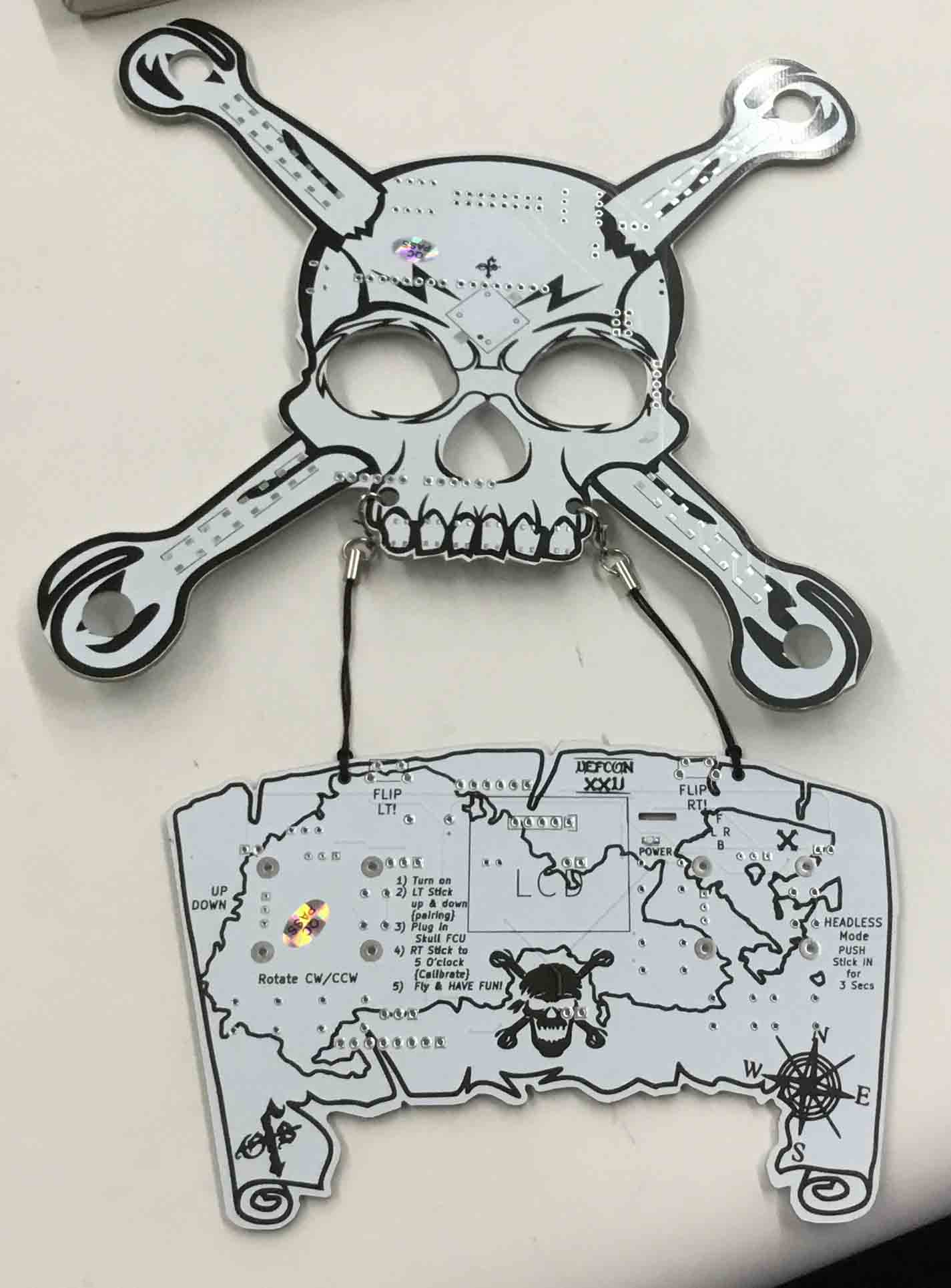
Someone finally did it. The wearable electronic conference badge that’s also a quadcopter is finally here. It’s the work of [b1un7], and it’s going to be exactly as annoying as you would expect.

This badge is actually two PCBs, the first being the quadcopter itself, the second being the joystick/controller. The quad is shaped like the familiar jolly roger found in most Whiskey Pirate badges ([b1un7] hangs with that crew), and the controller is a pirate’s treasure map loaded up with joysticks, buttons, and radios. The motors for this quad appear to be brushed, not brushless, and it looks like the arms of the quad have some space for obnoxiously bright LEDs.

This is an awesome badge but it’s still [b1un7]’s first attempt at making a badge. Right now, there’s still a bit of work to do — there’s only one week until Defcon — but with any luck [b1un7] will have 25 of these wearable electronic conference badges buzzing around. It’s a terrible idea and we love it.


Customize Forstner Bits For Fidget Spinner Explosions

[Matthias Wandel] is a woodworker par excellence. He’s the guy behind all those wooden gear contraptions, he made cove molding on a table saw, and if the phrase, ‘don’t do this unless you know what you’re doing’ applies to anyone, it applies to [Matthias]. Now he’s getting into the fidget spinner craze, but there’s a problem in the workshop: [Matthias] couldn’t find the right sized drill bit, so he modified a Forstner bit to contain the heart of a spinner.

[Matthias] has a few roller skate bearings, which are 22mm in diameter. However, the closest drill to this size was 7/8″, or 22.23mm. A drill can be ground down, so the bit was chucked into a hand drill and taken over to the bench grinder. As with most things [Matthias] demonstrates, you shouldn’t do this unless you know what you’re doing. [Matthias] does.

With the bit ground down to 22mm, [Matthias] drilled a hole in a piece of wood, inserted the bearing, and completed an epic quest that was his destiny. There is no use for fidget spinners, so [Matthias] decided to make this one explode. After cutting several notches in this wooden spinner, [Matthias] applied shop air liberally and spun the spinner up until it fell apart.

You can check out the video of the fidget spinner carnage below, or check out [Matthias]’ write-up here.

Continue reading “Customize Forstner Bits For Fidget Spinner Explosions”

Hackaday Links Column Banner

Hackaday Links: July 16, 2017

[Carl Bass] has joined the board at Formlabs. This is interesting, and further proof that Print The Legend is now absurdly out of date and should not be used as evidence of anything in the world of 3D printing.

Here’s something cool: a breadboardable dev board for the Parallax Propeller.

Finally, after years of hard work, there’s a change.org petition to stop me. I must congratulate [Peter] for the wonderful graphic for this petition.

Want some flexible circuits? OSHPark is testing something out. If you have an idea for a circuit that would look good on Kapton instead of FR4, shoot OSHPark an email.

SeeMeCNC has some new digs. SeeMeCNC are the creators of the awesome Rostock Max 3D printer and hosts of the Midwest RepRap Festival every March. If you’ve attended MRRF, you’re probably aware their old shop was a bit on the small side. As far as I can figure, they’ll soon have ten times the space as the old shop. What does this mean for the future of MRRF? Probably not much; we’ll find out in February or something.

Rumors of SoundCloud’s impending demise abound. There is some speculation that SoundCloud simply won’t exist by this time next year. There’s a lot of data on the SoundCloud servers, and when it comes to preserving our digital heritage, the Internet Archive (and [Jason Scott]) are the go-to people. Unfortunately, it’s going to cost a fortune to back up SoundCloud, and it would be (one of?) the largest projects the archive team has ever undertaken. Here’s your donation link.

If you’re looking for a place to buy a Raspberry Pi Zero or a Pi Zero W, there’s the Pi Locator, a site that pings stores and tells you where these computers are in stock. Now this site has been expanded to compare the price and stock of 2200 products from ModMyPi, ThePiHut, Pi-Supply, and Kubii.

Slimline Nixie Clocks

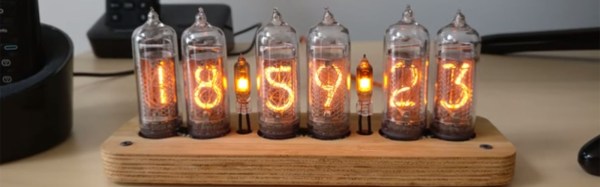
Everyone needs to build a Nixie clock at some point. It’s a fantastic learning opportunity; not only do you get to play around with high voltages and tooobs, but there’s also the joy of sourcing obsolete components and figuring out the mechanical side of electronic design as well. [wouterdevinck] recently took up the challenge of building a Nixie clock. Instead of building a clock with a huge base, garish RGB LEDs, and other unnecessary accouterments, [wouter] is building a minimalist clock. It’s slimline, and a work of art.

The circuit for this Nixie clock is more or less what you would expect for a neon display project designed in the last few years. The microcontroller is an ATMega328, with a Maxim DS3231 real time clock providing the time. The tubes are standard Russian IN-14 Nixies with two IN-3 neon bulbs for the colons. The drivers are two HV5622 high voltage shift registers, and the power supply is a standard, off-the-shelf DC to DC module that converts 5 V from a USB connector into the 170 V DC the tubes require.

The trick here is the design. The electronics for this clock were designed to fit in a thin base crafted out of sheets of bamboo plywood. The base is a stackup of three 3.2mm thick sheets of plywood and a single 1.6 mm piece that is machined on a small desktop CNC.

Discounting the wristwatch, this is one of the thinnest Nixie clocks we’ve ever seen and looks absolutely fantastic. You can check out the video of the clock in action below, or peruse the circuit design and code for the clock here.

Continue reading “Slimline Nixie Clocks”

Let’s Play Spot The Fake MOSFET

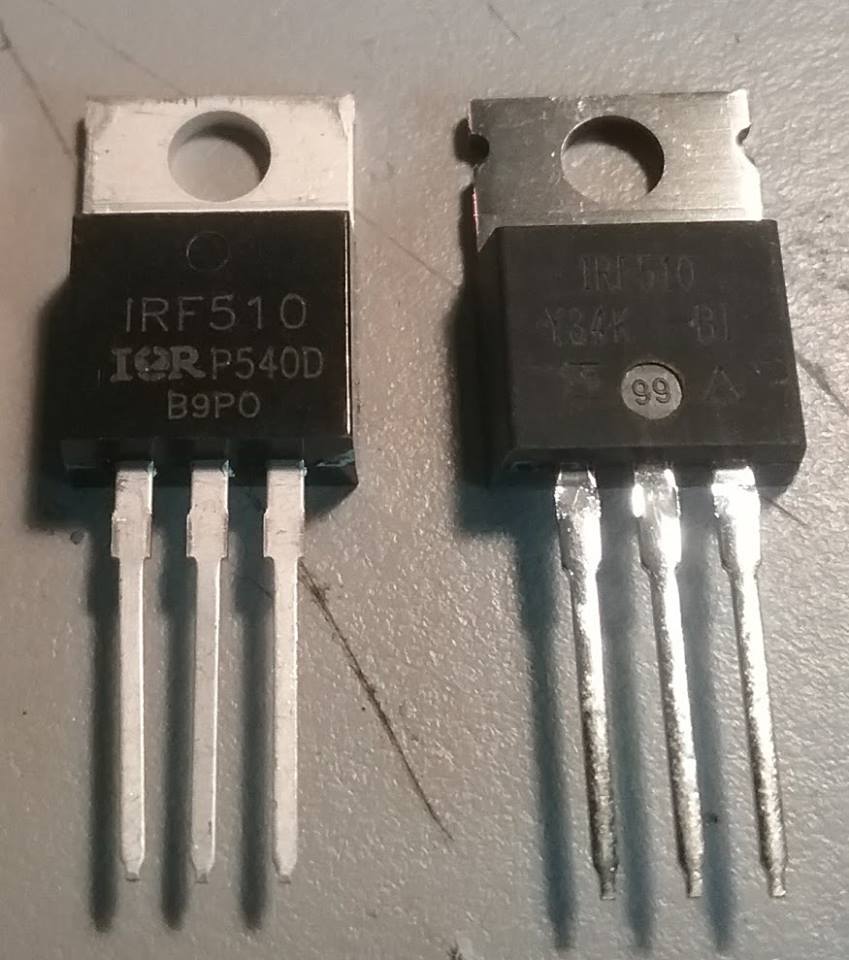
Recently, the voice push to talk circuit in [Ryan]’s BITX40 radio was keyed down for a very long time. Blue smoke was released, a MOSFET was burnt out, and [Ryan] needed a new IRF510 N-channel MOSFET. Not a problem; this is a $1 in quantity one, but shipping from Mouser or Digikey will always kill you if you only buy one part at a time. Instead, [Ryan] found a supplier for five of these MOSFETs for $6 shipped. This was a good deal and a bad move because those new parts were fakes. Now we have an opportunity to play spot the fake MOSFET and learn that it’s all about the supply chain.

Spot the fake

To be fair to the counterfeit MOSFET [Ryan] acquired, it probably would have worked just fine if he were using his radio for SSB voice. [Ryan] is using this radio for digital, and that means the duty cycle for this MOSFET was 100% for two minutes straight. The fake got hot, and the magic blue smoke was released.

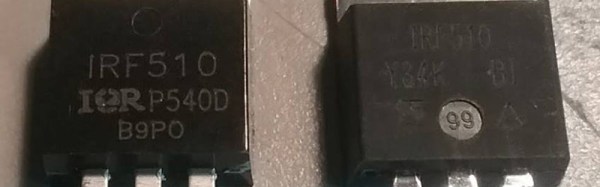
Through an industry contact, [Ryan] got a new, genuine IRF510 direct from Vishay Semiconductors. This is a fantastic opportunity to do a side-by-side comparison of real and counterfeit semiconductors, shown at right. Take a look: the MOSFET on the left has clear lettering, the one on the right has tinned leads and a notched heatsink. [Ryan] posed the question to a few Facebook groups, and there was a clear consensus: out of 37 votes, 21 people chose the MOSFET on the left to be genuine.

The majority of people were wrong. The real chip looked ugly, had tinned leads, and a thinner heatsink. The real chip looked like a poor imitation of the counterfeit chip.

What’s the takeaway here?  Even ‘experts’ — i.e. people who think they know what they’re talking about on the Internet — sometimes don’t have a clue when it comes to counterfeit components. How can you keep yourself from being burned by counterfeit components? Stick to reputable resellers (Mouser, Digikey, etc) and assume that too good to be true is too good to be true.

Fidget Spinners Put The ‘S’ In STEAM Education

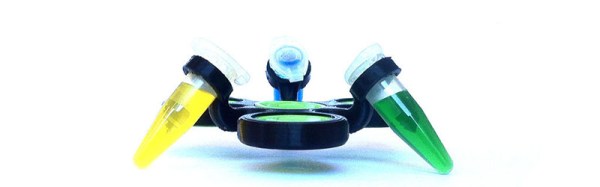
Centrifuges are vital to the study of medicine, chemistry, and biology. They’re vital tools to separate the wheat from the chaff figuratively, and DNA from saliva literally. Now, they’re fidget spinners. [Matlek] designed a fidget spinner that also functions as a simple lab centrifuge.

The centrifuge was designed in Fusion 360, and was apparently as easy as drawing a few circles and hitting copy and paste. Interestingly, this fidget spinner was designed to be completely 3D printable, including the bearings. The bearing is a standard 608 though, so if you want to get some real performance out of this centrispinner, off-the-shelf bearings are always an option. The design of this fidget spinner holds 2 mL and 1.5 mL vials, but if your lab has 500 μL tubes on hand, there are handy 3D printable adapters.

Still think using a toy to do Real Science™ is dumb? Contain your rage, because a few months ago a few folks at Stanford devised a way to build a centrifuge out of paper. This paperfuge can — at least theoretically — save lives where real commercial centrifuges or even electricity aren’t available. Fidget spinners save humanity once again.

Improving The Accuracy Of Gas Sensors

If you need a sensor to detect gasses of some sort, you’ll probably be looking at the MQ series of gas sensors. These small metal cylinders contain a heater and some electrochemical sensor. Wire the heater up to a voltage, and connect one end of the resistor to an ADC, and you have a sensor for alcohol vapors, hydrogen sulfide, carbon monoxide, or ozone, depending on which model of sensor you’ve picked up.

These are simple analog devices, and as you would expect they’re sensitive to both temperature and humidity. [Davide Gironi] wanted a more accurate gas sensor, so he’s diving into a bit of overengineering and correlating the output of these sensors against temperature and humidity.

There’s a difference between accuracy and precision, and if you want to calibrate gas sensors, you’ll need to calibrate them against something. Instead of digging out a gas sensor of known precision, [Davide] took the easy way out: he graphed the curves on the datasheets for these sensors. It’s brilliant in its simplicity.

These numbers were thrown into R, and with a bit of work, [Davide] had a look up table of various concentrations of gasses plotted against certain resistances. In testing these sensors, he found a higher correlation between humidity and temperature and gas concentrations, which one would expect.

The files for these sensors are available on [Davide]’s website, and he included a neat little video showing everyone what went into these calculations. You can check that out below.

Continue reading “Improving The Accuracy Of Gas Sensors”