Porting NES To The ESP32

There’s an elephant in the room when it comes to the Raspberry Pi Zero. The Pi Zero is an immensely popular single board computer, but out of stock issues for the first year may be due to one simple fact: you can run a Nintendo emulator on it. Instead of cool projects like clusters, CNC controllers, and Linux-based throwies, all the potential for the Pi Zero was initially wasted on rescuing the princess.

Espressif has a new chip coming out, the ESP32, and it’s a miraculous Internet of Things thing. It’s cheap, exceptionally powerful, and although we expect the stock issues to be fixed faster than the Pi Zero, there’s still a danger: if the ESP32 can emulate an NES, it may be too popular. This was the hypothetical supply issue I posited in this week’s Hackaday Links post just twenty-four hours ago.

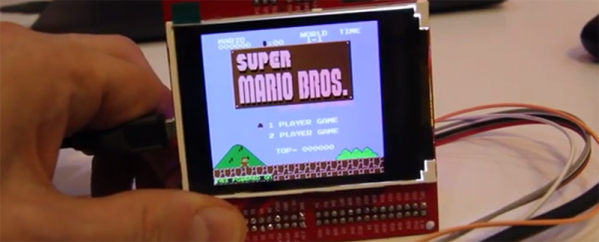
Hackaday fellow, Hackaday Supercon speaker, Espressif employee, and generally awesome dude [Sprite_tm] just ported an NES emulator to the ESP32. It seems Espressif really knows how to sell chips: just give one of your engineers a YouTube channel.

This build began when [Sprite] walked into his office yesterday and found a new board waiting for him to test. This board features the ESP-WROOM-32 module and breaks out a few of the pins to a microSD card, an FT2232 USB/UART module, JTAG support, a bunch of GPIOs, and a 320×240 LCD on the back. [Sprite]’s job for the day was to test this board, but he reads Hackaday with a cup of coffee every morning (like any civilized hacker) and took the links post as a challenge. The result is porting an NES emulator to the ESP32.

The ESP-32-NESEMU is built on the Nofrendo emulator, and when it comes to emulation, the ESP32 is more than capable of keeping the frame rate up. According to [Sprite], the display is the bottleneck; the SPI-powered display doesn’t quite update fast enough. [Sprite] didn’t have enough time to work on the sound, either, but the source for the project is available, even if this dev board isn’t.

Right now, you can order an ESP32; mine are stuck on a container ship a few miles from the port of Long Beach. Supply is still an issue, and now [Sprite] has ensured the ESP32 will be the most popular embedded development platform in recent memory. All of this happened in the space of 24 hours. This is awesome.

Continue reading “Porting NES To The ESP32”

These 20 Projects Won $1000 For Assistive Technologies

For the last seven months, Hackaday has been hosting the greatest hardware competition on Earth. The Hackaday Prize is a challenge to Build Something That Matters, asking hardware creators around the world to focus their skills to change the world.

The results have been spectacular. In five rounds of design challenges, we’ve seen more than 1000 entries and so far eighty of them have won $1000 and a chance to win the Grand Prize: $150,000 and a residency at the Supplyframe DesignLab in Pasadena.

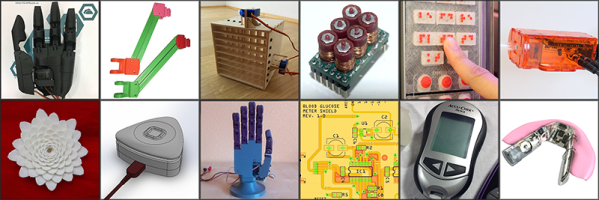
Last week, we wrapped up the last challenge for the Hackaday Prize: Assistive Technologies. We’re now happy to announce twenty of those entries that have been selected to move to the final round and have been awarded a $1000 cash prize. Congratulations to the winners for the Assistive Technologies portion of the Hackaday Prize:


Who Will win the 2016 Hackaday Prize?

The finalists from each round are now being sent to our fantastic panel of judges. One of them will be awarded the Hackaday Prize. In addition to the prestige, they will win $150,000 and a residency at the Supplyframe DesignLab in Pasadena. Four more of the finalists will receive the other cash prizes of $25k, $10k, $10k, and $5.

Find out who will win live at the Hackaday Superconference on November 5th. The greatest hardware conference on the planet — the two-day hardware spectacular with an awesome speaker lineup, great workshops, and a fantastic community — includes the Hackaday Prize part. There’s still time to get a ticket to participate in this hardware spectacular and witness the crowning of the winner of The Hackaday Prize.

Hackaday Links Column Banner

Hackaday Links: October 9, 2016

Atari is back! That’s what some dude says. There are no real details in that post, other than ‘Atari is Back!’

The ESP32 is coming, and it’s going to be awesome. Espressif has just released an Arduino core for the ESP32 WiFi chip. The digitalRead, digitalWrite, SPI, Serial, Wire, and WiFi “should” work. If you’re looking for ESP32 hardware, they’re infrequently available and frequently out of stock. Thankfully, stock levels won’t be the Raspberry Pi Zero all over again until someone figures out how to run an NES emulator on the ESP32.

Tiny, cheap ARM boards would make for great home servers if they had SATA or multiple network interfaces. Here’s a Kickstarter for a board with both. It’s based on an ARM A53 with multiple Ethernets, mini PCIe, enough RAM, and SATA. It’s a board for niche use cases, but those uses could be really cool.

You’re not cool or ‘with it’ until you have a PCB ruler. That’s what all the hip kids are doing. For wizards and dark mages out there, a simple PCB ruler isn’t enough. These rare beasts demand RF rulers. There’s some weird stuff on these rulers, like Archemedian spiral antennas and spark gaps. Black magic stuff, here.

Some dude with a camera in the woods did something. Primitive Technology, the best example of experimental archaeology you’ve ever seen, built a spear thrower. You can throw a ball faster with a lacrosse stick than you can with just your hands, and this is the idea behind this device, commonly referred to as an atlatl. You can hunt with an atlatl in some states, but I have yet to see a video of anyone taking down a deer with one of these.

Think we’re done spamming the Hackaday Superconference yet? YOU’RE WRONG. The Hackaday Superconference is the greatest hardware conference of all time until we do this whole thing again next year. Get your tickets, look at the incredible list of speakers, book your flights, and be in Pasadena November 5-6.

Certification For Open Source Hardware Announced

Today at the Open Hardware Summit in Portland, Alicia Gibb and Michael Weinberg of the Open Source Hardware Association (OSHWA) launched the Open Source Hardware Certification program. It’s live, and you can certify your own hardware as Open Hardware right now.

What Is Open Source Hardware?

Open Source Hardware can’t be defined without first discussing open source software. At its very core, open source software is just a copyright hack, enabled by a worldwide universal computer network. The rise of open source software is tied to the increasing ease of distributing said software, either through BBSes, Usenet, and the web. Likewise, Open Source Hardware is tied to the ease of distributing, modifying, and building hardware.

In the 1980s, there were no services that could deliver a custom circuit board to anywhere on the planet for a dollar per square inch. When open software began, CNC machines were expensive tools, now you can build a very good machine for just a week’s wages. We are currently living at the dawn of Open Source Hardware, enabled by the creation of Open Source design tools that have themselves been used to create physical tools. Inexpensive 3D printers, open source oscilloscopes, circuit board plotters, and the entire hackerspace movement are as revolutionary as the Internet. These devices and the Internet are the foundations for Open Hardware and software, respectively.  The objections to why hardware is incompatible with Open Source no longer apply and small-scale manufacturing techniques are only going to get better.

Continue reading “Certification For Open Source Hardware Announced”

Tiny Smoothies At Maker Faire

For almost the last decade, desktop 3D printing has, at its heart, been centered around 8-bit microcontrollers. The ATmegas and other Atmel chips are good enough to move a few steppers and squirt some plastic. With faster processors, you get smoother acceleration, leading to better prints. Modern ARM devices have a lot of peripherals, allowing for onboard WiFi and Ethernet connectivity. The future is 32-bit print controllers.

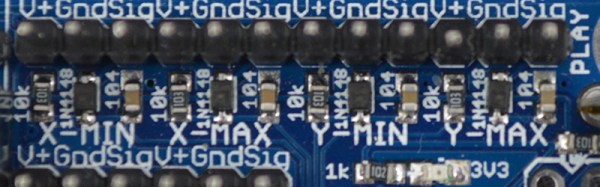
Right now there are a few 32-bit controllers, from the very weird, out-of-nowhere controller for the Monoprice Mini 3D printer to the more traditional SmoothieBoard. Only one of these boards has the open hardware cred for a proper 3D printer controller, and a this year’s Maker Faire, Cohesion3D introduced a few machine control boards built on top of Smoothie that add a few interesting features and techniques.

Continue reading “Tiny Smoothies At Maker Faire”

A Reproduction Vintage Sound Card

Before the AdLib sound card, sound on PCs was in a terrible shape. Since the dawn of IBM, all PCs included a speaker, but this PC speaker was only capable of sounding one note at a time. Chords on the PC speaker produced a weird ‘bubbling’ effect. Just a few years later, 8-bit sound could be created with the Covox Speech Thing, effectively a resistor ladder, with the parallel port on one side, and an 1/8″ plug on the other. These solutions for PC sound sucked.

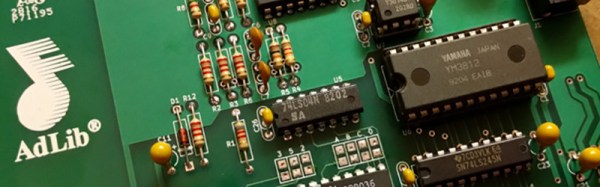
It wasn’t until the first AdLib cards that superior sound showed up on the PC. Recently, [eric] had been fixing up an old IBM XT and quickly realized the original AdLib sound cards were collector’s items and far too expensive for what they were. He decided to build a reproduction Ad Lib. completely compatible and nearly identical to the original 1990 version of the best sound card on the market.

The first Ad Lib sound card is a relatively simple circuit based on the Yamaha YM3012 (OPL2) and YM3014B chips. These chips are frequently available on eBay, and [Sergey] already has a complete circuit for turning these chips into an ISA sound card. While this modern card is compatible with the AdLib Music Synthesizer Card, it doesn’t look like one. [eric] wanted a card that looked like the real thing, and sounded like one, too.

PCB design has come a long way in a generation, and where the AdLib card was once a wonder of modern technology, anyone with enough patience can now design an identical board, send the file off to China, and receive a reproduction of the first successful sound card. All the files are up on Github should you want to build your own. Now all we need is someone making modern 486 motherboards.


DIY Nozzle Socks For Your 3D Printer

If you have a 3D printer, your nozzle and heater block are invariably covered in a weird goo consisting of decomposed and burnt plastic. There’s only one way around this – a nozzle sock, or a silicone boot that wraps around the heater block and stops all that goo from accumulating.

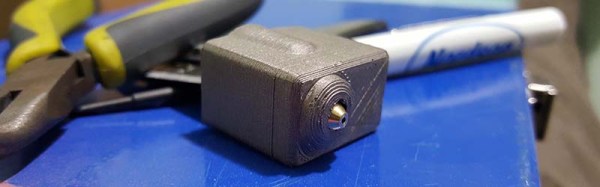
Right now, E3D sells silicone nozzle socks for their normal-sized heater blocks, with a release for their maxi-sized Volcano blocks coming shortly. [Ubermeisters] couldn’t wait, so he designed a 3D printed mold to cast as many Volcano nozzle socks as he could ever need.

The mold itself is taken from the mechanical drawings of the E3D Volcano hotend, printed in Proto Pasta HTPLA. To create the nozzle sock, this mold is filled with a goo made from GE Silicone I, mineral spirits, plaster of Paris, carbon powder, aluminum powder, titanium microspheres, and bronze powder colorant from Alumalite.

The mold is sprayed with release, filled with silicone goo, and slowly brought together. After a few hours, the silicone has cured, can be removed from the mold, and the flash can be cut away from the finished part. The end result is great — it fits the Volcano hotend well, and shouldn’t be covered in melted, burnt plastic in a week’s time.

All the files for the Volcano nozzle sock mold can be found on YouMagine. Alternatively, you could wait another month or two for E3D to release their ‘official’ Volcano nozzle sock.