Hackaday Prize Semifinalist: Playing With PIDs

PID control loops are everywhere, found in flight controllers for drones and the temperature control code for 3D printers. How do you teach PID control loops? [Tim] has a great demonstration for this, and it’s also a semifinalist for the Hackaday Prize.

[Tim]’s Sab3t is an educational tool designed to illustrate how PID control loops work. It’s a robotic table on which a large ball bearing sits perfectly balanced. On this table is a resistive touch screen from a display providing feedback for the location of the ball bearing. By adjusting PID values, the ball bearing either sits stationary on the table or flails wildly around, depending on the values in the PID algorithm being used.

As a teaching tool, it’s great; with a python script displaying a log of the PID values and the position of the ball on the plate, anyone can easily visualize how oscillations happen, what a well-tuned control loop looks like, and have some fun moving the ball bearing around to different locations.


The 2015 Hackaday Prize is sponsored by:

Continue reading “Hackaday Prize Semifinalist: Playing With PIDs”

Hackaday Prize Semifinalist: Conserving Water And Eliminating Daydreaming

[mulcmu], we suppose, frequently wastes a lot of water while daydreaming in the shower. While daydreaming in the shower one day, we suppose again, he came up with the idea of keeping on task while in the shower. Thus was born the shower metronome, [mulcmu]’s entry for The Hackaday Prize.

The goal of the shower metronome is two-fold. First, it reduces the amount of water used in the shower. Secondly, it keeps the user on time for work. The shower metronome does this with a small audio beep provided by a small microcontroller attached to the shower frame or shower curtain.

The guts of the device are an MSP430 microcontroller, a few coin cell batteries, and a hall effect sensor that turns the device on, just like a magnetic door or window alarm. The microcontroller choice is perfect for the application; the MSP430 is extremely low power, and the device only draws 1uA in low power mode. This means the shower metronome will last a while when used only a few minutes a day.

The 2015 Hackaday Prize is sponsored by:

Better Batteries For Electronic Gadgets

We’re not using 9 Volt batteries to power our projects anymore; the world of hobby electronics has moved on to cheap LiPo batteries for most of our mobile power storage. LiPos aren’t the best solution, evidenced by hundreds of YouTube videos of exploding batteries, and more than a few puffy cells in our junk drawer. The solution? LiFePO4, or lithium iron phosphate cells. They’re a safer chemistry, they have low self discharge, and have more recharge than other chemistry of lithium cells.

LiFePO4 cells aren’t easy to deal with if you’re working with breadboard electronics, though. Most of that is because there aren’t many breakout boards for these cells. [Patrick] is working on changing that with his LiFePO4werd USB charger.

The concept is simple: use an off-the-shelf part for LiFePO4 batteries – in this case an MCP73123 – and make a board that charges the batteries with a USB port. It’s exactly the same idea as the many USB LiPo chargers out there, only this one uses a better battery chemistry.

[Patrick] is using a 550mAh battery for this project, but there’s no reason why it couldn’t be upgraded to a 18650-sized cell with more than 2000mAh stuffed inside. Add a boost converter to the circuit, and he’ll have the perfect power source for every portable electronics project imaginable.

Hackaday Links Column Banner

Hackaday Links: September 6, 2015

The MeArm is a cool little robot arm that can be controlled with just about any microcontroller. There’s a new version of it up on Thingiverse.

Here’s something to get kids interested in robotics: the GoBox is a robot kit with multiple ‘missions’ delivered monthly. The robot is based on the Raspberry Pi and Scratch – the Apple II and BASIC of today, I guess.

What happens when a popular electronics YouTuber completely debunks a product? Hundreds of dislikes appear on the YouTube videos he made. Hundreds of dislikes from Vietnam appeared on [Dave Jones]’ videos debunking the Batterizer. In fact, more people from Vietnam disliked the video than viewed it. Yes, weird YouTube dislike farms like this exist, and if you can do it on the Internet, you can also pay people to do it on the Internet.

The ESP8266 is slowly becoming a board that’s as easy to use as an Arduino. Now there’s a board that turns it into an Arduino.

The Vintage Computer Festival Midwest was last week,  and [chris537a] shot a video of all the cool stuff. [vikram4819] put an album up on imgur. Yes, someone was selling a Sparcbook for $300. I’m holding out for a PowerPC ThinkPad, though…

Washington DC area hackers, don’t forget to RSVP for the Hackaday Meetup on Saturday. Bring a hack to show off and spend the evening socializing with the Hackaday community. Check out the announcement post for more info.

Better Racing With Power Wheels

For the last few months, teams across the US have taken old Power Wheels and other electric vehicles meant for children and turned them into racing machines capable of flying around the track at speeds pf over 30 miles per hour. How do you take the plastic chassis of a kid’s toy and turn it into a Power Racer? [Dane] from team Chibi-Atomic-Thing tells us how.

In classic Power Racing Series fashion, this year’s build began with last year’s chassis. At the 2014 NYC Maker Faire, a weld on the steering linkages failed, necessitating some quick work to replace some bad welds. Poor fabrication wasn’t the only shortcoming of last year’s car; the rear axle was fixed, the brakes were terrible, and the gearbox wasn’t quite as good as it could be.

The team had a few months to make the necessary changes for this season’s races. Because they were adding advanced and arcane technology known as a differential this year, a second disc brake holster would need to be fabricated for the other rear wheel. A new motor controller was added, but the team is mum on why exactly they need an eight-speed gearbox when the longest straight on the track is about fifty feet.

The answer to why a tiny electric car needs more gears than a clock is for now, at least, unknown. Hopefully it will be revealed at the next Power Racing Series race at the NYC Maker Faire in a few weeks. Until then, check out the video of the 2015 Detroit race below.

Continue reading “Better Racing With Power Wheels”

Hackaday Prize Semifinalist: Picking Up Litter With Robots

On beaches, in parks, and in [BDM]’s back yard, there’s a lot of liter everywhere. The normal solution to this problem is to hire someone or find some volunteers to pick up all this trash. We’re living in the future, though, and that means robots. For his Hackaday Prize entry, [BDM] is building a robot that picks up trash.

A robot that picks up litter is a very, very interesting problem. It can’t be controlled by a person, or else it would be more efficient to just get out there and kill your back picking up bottles. This means it must work autonomously, and that means identifying litter, picking it up, and disposing of it.

For the identification part of the problem, [BDM] is using computer vision that captures an RGB image and discriminates against natural objects. Right now the computer vision is far from perfect, but it does a very good job, all things considering.

The next biggest problem is picking the trash up and disposing of it. For this, [BDM] has repurposed a Power Wheels and attached a DIY robot arm. It’s not a very powerful arm, and a children’s toy probably isn’t the best platform, but it is the start of something very, very cool.

You can check out [BDM]’s video for the project below.

The 2015 Hackaday Prize is sponsored by:

Continue reading “Hackaday Prize Semifinalist: Picking Up Litter With Robots”

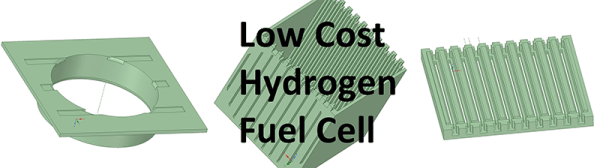
Hackaday Prize Semifinalist: A Low Cost, DIY Fuel Cell

Electronic cars and planes are the wave of the future, or so we’re told, but if you do the math on power densities, the future looks bleak. Outside of nuclear power, you can’t beat the power density of liquid hydrocarbons, and batteries are terrible stores of energy. How then do we tap the potential of high density fuels while still being environmentally friendly? With [Lloyd]’s project for The Hackaday Prize, a low cost hydrogen fuel cell.

Traditionally, fuel cells have required expensive platinum electrodes to turn hydrogen and oxygen into steam and electricity. Recent advances in nanotechnology mean these electrodes may be able to be produced at a very low cost.

For his experiments, [Lloyd] is using sulfonated para-aramids – Kevlar cloth, really – for the proton carrier of the fuel cell. The active layer is made from asphaltenes, a waste product from tar sand extraction. Unlike platinum, the materials that go into this fuel cell are relatively inexpensive.

[Lloyd]’s fuel cell can fit in the palm of his hand, and is predicted to output 20A at 18V. That’s doesn’t include the tanks for supplying hydrogen or any of the other system ephemera, but it is an incredible amount of energy in a small package.

You can check out [Lloyd]’s video for the Hackaday Prize below.

The 2015 Hackaday Prize is sponsored by:

Continue reading “Hackaday Prize Semifinalist: A Low Cost, DIY Fuel Cell”