Duo Basic: An All-Logic Chip Educational Computer

DUO

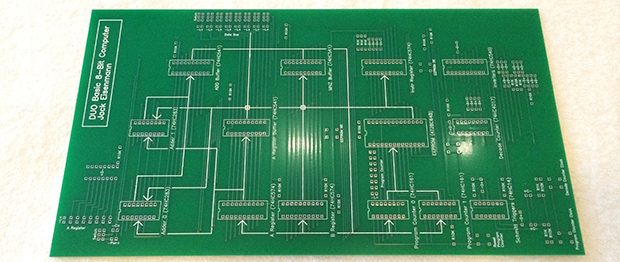
Way back before the days of microcomputers, a few very lucky students first got their hands wet with microcomputer trainers. These simple devices used common logic chips, lights, and switches to perform calculations; basically, a very small and simple computer. [Jack] has just released his DUO Basic 8-bit educational computer, a computer designed entirely around logic chips just as was done in the olden days.

The entire computer except for a single EEPROM giving the computer 256 bytes of ROM, three registers, and two instructions (condition jmp and add). This allows for simple programs to be written just by flipping switches and hitting buttons – it doesn’t get much more ‘bare metal’ than that.

[Jack] has an online assembler and emulator for the DUO Basic along with a few example assembly programs. Of course, all the schematics and block diagrams are available on his site, along with a nice introductory video, shown below.

Continue reading “Duo Basic: An All-Logic Chip Educational Computer”

Assassin’s Creed Hidden Blade

The youngins in the crowd may not remember Taxi Driver, but [Matt]’s fully functional hidden blade from Assassin’s Creed finally does justice to the hidden weapon on a drawer slide idea. It’s got everything you would want – immaculate craftsmanship and a video game reference for that every so necessary blog cred.

[Matt] started his hidden blade build with a drawer slide, mounting an old WWII replica blade to the slider. The blade retraction is spring-loaded, and with a small ring and a bit of wire, the blade gets its automatic draw and retraction.

The arm brace is where this project really shines. [Matt] crafted this out of two pieces of leather, tooled with the Assassin’s insignia and dyed to a deep, jet black

This isn’t the first time we’ve seen an automatic hidden blade from Assassin’s Creed, but [Matt]’s effort is really top-notch. He’s got beautiful leather crafting down pat, and we can only hope his Halloween was filled with parkour and stabbing.

Raspberry Pi Becomes A Universal Translator

hola-me-nombre-david-conroy

We’re still about 150 years away from the invention of the universal translator by [Lt Cdr Sato] of the Enterprise NX-01, but [Dave] has something that’s almost as good: a speech recognition, translation, and text to speech setup for the Raspberry Pi that theoretically allows anyone to speak in sixty different languages.

After setting up all the Linux audio cruft, [Dave] digs in and starts on converting the guttural vocalizations of a meat speaker into something Google’s speech to text service can understand. From there, it’s off to Google again, this time converting text in one language into the writings of another.

[Dave]’s end result is a shell script that works reasonably well for something that won’t be invented for another 150 years. The video below shows the script successfully translating English to spanish, but it should work equally well with other languages such as dutch and latin, as well as less popular language such as esperanto and french.

Continue reading “Raspberry Pi Becomes A Universal Translator”

Adorable Homebrew Waveform Generator

waveform

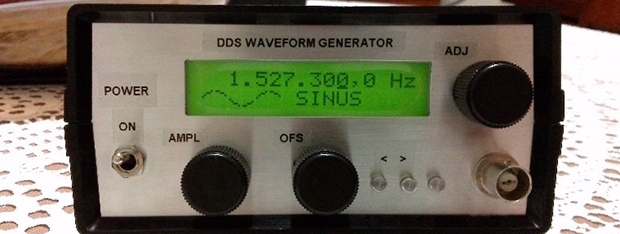
For want of new test equipment, or simply a project, [Enzo] decided he would take a shot at creating his own waveform generator*. Not only is it a great project, it’s also a decent piece of test equipment, with proper signal conditioning, a nice front panel, and a built-in wall transformer.

The guts of [Enzo]’s waveform generator is an AD9833 programmable waveform generator, a neat little chip that can output square and triangle waves fro 0.1 Hz to 3.2 MHz and sine waves from 0.1 Hz to 1.6 MHz. [Enzo] is controlling this chip with a PIC16 microcontroller, with a whole bunch of analog circuitry between the digital domain and the BNC connector on the front panel.

The waveform generator is controlled by a suite of dials and switches on the front panel, giving [Enzo] complete control over his new tool.

* Here’s a Google translation, but good luck with that. Just… get Chrome or something.

Perfect PCBs With An Inkjet Printer

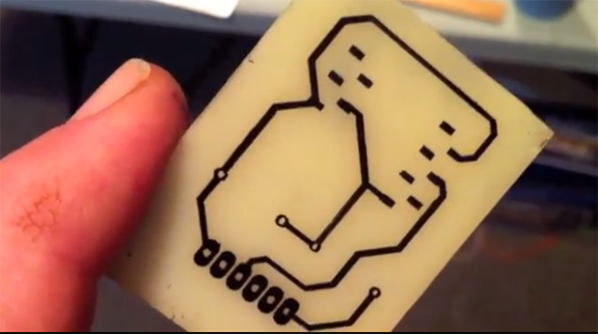
Instead of mucking about fabbing PCBs with the toner transfer method, or making masks for photosensitive boards, the holy grail of at-home circuit board manufacturing is a direct inkjet-to-etch method. [Don] isn’t quite there yet, but his method of producing circuit boards at home is one of the easiest we’ve ever seen.

[Don]’s boards begin by taking the output from Eagle and printing them with an Epson Artisan 50 inkjet printer. By sticking a piece of cardstock in the printer before the copper board, he’s able to precisely align the traces and pads onto the copper board.

When the board comes out of the printer, it’s only covered in ink. While some specialty inks are enough of an etch resist, [Don] comes up with a clever way to make sure acid doesn’t eat away copper in the needed places – he simply dusts on toner from a copier or laser printer, blows off the excess, and bakes the entire board in a toaster oven.

The result, seen above, are perfect traces on a circuit board without the need for ironing sheets of photo paper onto copper boards.

As far as the, “why didn’t someone think of this sooner” ideas go, this one is at the top. [Don] says the method should work  on sheets of aluminum for printing solder paste masks. Impressive work, and now the only thing left to do is getting two-layer boards down pat. For more direct to copper printing check out the hacks we’ve covered in years past.

Continue reading “Perfect PCBs With An Inkjet Printer”

Deconstructing Apollo Flight Hardware

[Fran] has been researching the Saturn V Launch Vehicle Digital Computer – the computer that flew all the Apollo flights into orbit and onwards towards the moon – for a while now. Even though she’s prodded parts of the LVDC with x-rays and multimeters, this is the first time she’s committed to a little destructive testing.

After [Fran] took a flight-ready LVDC spare to the dentist’s office for x-raying and did an amazing amount of research on this artifact from the digital past, there was only so much she could learn without prying apart a few of these small, strange chip packages. Not wanting to destroy her vintage LVDC board, she somehow found another LVDC board for destructive reverse engineering.

This new circuit board was a bit different from the piece in her collection. Instead of the chip leads being soldered, these were welded on, much to the chagrin of [Fran] and her desoldering attempts. After removing one of these chips from the board, she discovered they were potted making any visual inspection a little difficult.

While [Fran]’s attempts at reverse engineering the computer for a Saturn V were a bit unsuccessful, we’ve got to hand it to her for getting this far; it’s very, very likely the tech behind the LVDC was descended from ICBMs and would thus be classified. Documenting the other computer used in every Apollo launch is an impressive feat on its own, and reverse engineering it from actual hardware, well, we can’t think of anything cooler.

Compass Guided Kayak Autopilot

logo

Last July, [Louis] bought a kayak off of Craigslist. It was a pedal-powered device with a hand-operated rudder, and he ended up enjoying his time on the water. [Louis] fishes, though, and it was a bit of a challenge to manage hands free fishing while maintaining a steady course. His solution was an Arduino-powered autopilot that allows him to troll for salmon and Arduino haters with just the push of a button.

In [Louis]’ system, a motor is attached to the steering lever along with a few limit switches. This motor is powered by an Arduino controlled with an LSM303 compass module from Sparkfun.

When the autopilot module is started up, it first checks to see if the compass module is enabled. If not, the system relies on two tact switches to change the position of the rudder. Enabling the compass requires a short calibration of spinning the kayak around in a circle, but after that the steering is dead on.

There are a few things [Louis] would like to add such as a heading display and a bluetooth module for remote control. This setup already landed him a 13 lb salmon, so we’re going to say it’s good enough to catch some dinner.