An Arduino Power Inverter

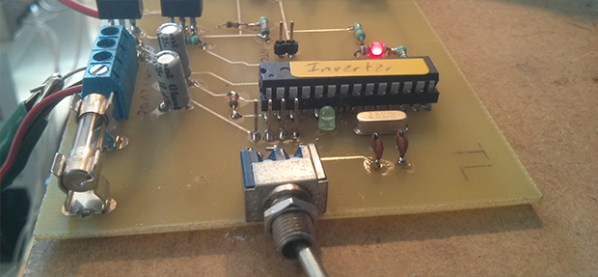
If you’ve got a few solar panels lying around, or even if you want some 120/230 V AC power from a few 12 Volt batteries, you’ll need a power inverter. Sure, you can drop on down to any big box store and pick one of these up, or you can be like [Michael] and build your own (Danish, translation).

[Michael] found himself in the possession of a few halogen light transformers and decided to make use of them by building a DC to AC power inverter. The inverter is fairly simple – just the transformer, a few MOSFETS, and an ATMega0168 for software control that includes a ‘soft start’ feature that prevents power surges on startup.

The circuit is simple enough to etch at home, although a soldermask and a nice insulated enclosure would probably be ideal for this application.

Building A Synth On A Breadboard

synth

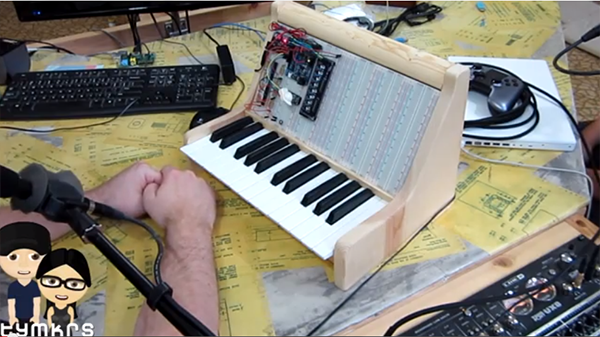
Building an analog synth is a challenge, but with the [Tymkrs] protosynth, it’s easier than ever. It’s a 25-key keyboard attached to a stack of solderless breadboards to make analog synth prototyping a snap.

Earlier, [Tymkrs] acquired a whole bunch of solderless breadboards and decided to put them to use by making a component-level modular synth. The earlier incarnation tied each key on the keyboard to a few wires behind the breadboard and tied them in to a shift register so they could be read with a Propeller dev board loaded up with a Commodore SID emulator. The new version keeps the very clean through-the-back keyboard connector, but this time the [Tymkrs] are adding a few more components that add a sequencer setup and a rotary encoder.

The eventual goal for this really cool breadboard synth is to explore the world of Moogs, Arps, and other analog synths easily on a breadbaord. The [Tymkrs] have already put together a breadboard-compatible low pass and high pass filter. While there’s still a lot of work to be done to make an analog synth a reality, the [Tymkrs] are off to a great start.

Continue reading “Building A Synth On A Breadboard”

A Folding Knife Made From Scratch

thisisaknife


[bobasaurus] over on reddit had a go at making a knife from scratch. It was his first attempt, but we’re thinking the result is fabulous and a wonderful example of what can be done with minimal tools at home.

The blade and folding mechanism was crafted out of an O1 tool steel bar. [bob] didn’t have any fancy machines like a bandsaw to cut these metal parts out; he used a jeweler’s saw and went through many blades in the process.

After the basic shape of the metal parts took form, [bob] turned to the scales. They’re made of a beautiful figured wood, bocote, native to Central America.

One interesting part of [bob]’s knife is the electrochemical etching he did on the blade. After applying a mask for the etching with the toner transfer process, the blade was grounded to a battery charger and a paintbrush wired up to the positive side was dipped in salt water. It’s certainly an easy way to engrave metal without investing in expensive tools or a CNC router.

Finally, the scales were shaped and oiled and the blade and bolster mechanism installed. A lot of work went into this knife, especially with the bare minimum of tools [bob] used. The results are worth it, though, and he ended up with a beautiful knife.

Giving Digital Calipers Bluetooth

[Fede]’s wife uses a pair of digital calipers to take measurements of fruits, leaves, and stems as part of her field research. Usually this means taking a measurement and writing it down in a log book. All things must be digitized, so [Fede] came up with a way to wirelessly log data off a pair of cheap Chinese calipers with a custom-made Bluetooth circuit.

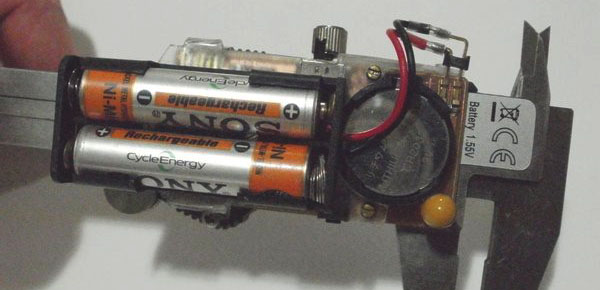
Most of these cheap Chinese digital calipers already have a serial output, so [Fede] only needed to build a circuit to take the serial output and dump it in to an off-the-shelf Bluetooth module. He fabbed a custom circuit board for this, and after seeing the increased battery drain from the Bluetooth module, decided to add an external battery pack.

In addition to etching his own board for sending the serial output of the calipers to a Bluetooth module, [Fede] also put together a custom flex circuit to connect the two boards. It’s just a small bit of brass glued to a transparency sheet etched with ferric chloride, but the end result looks amazingly professional for something whipped up in a home lab.

An Interview With [David] Of Ultimaker

cura

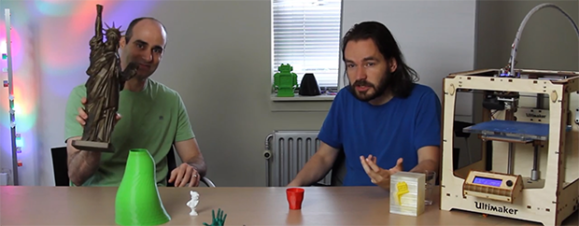
After interviewing the creator of Slic3r and the folks at Shapeways, [Andrew] is back again with his adventures in 3D printer videography and an interview with [David Braam] of Ultimaker

About a year ago, [David] looked at the state of the art in 3D printer control and Replicator G. While Replicator G, along with Pronterface and Repetier-Host both convert 3D models into G-code files as well as control the printer while its squeezing plastic out onto a bed. [David] thought the current state of these RepRap host programs were janky at best, and certainly not the best user experience for any home fabricator. This lead him to create Cura, a very slick and vastly improved piece of host software for the Ultimaker.

Cura isn’t just a fancy front end on an already existing slicer engine; [David] created his own slicing algorithm to turn .STL files into G-code that’s immensely faster than skeinforge. Where skeinforge could take an hour to slice a complex model, Cura does the same job in minutes.

There are also a bunch of cool features available in Cura: you can rotate any part before sending it to the printer, as well as pulling voxels directly from your Minecraft world and sending them to your printer. Very, very cool stuff, and if you’re running a Ultimaker or any other RepRap, you might want to check it out.

Continue reading “An Interview With [David] Of Ultimaker”

We Should Build Mandolins And Violas

Lutherie is the art of turning strips of maple and spruce into beautiful stringed instruments like the violin, cello, viola, as well as guitars, mandolins, and banjos. Just about anyone can make an electric guitar on a bandsaw, but the skill and precision of building acoustic instruments is something to stand in awe of.

[Helen Michetschläger] builds violins, violas, and cellos in her hometown of Manchester, each one a work of art. Hardly any of her tools would seem out of place in the workshop of [Stradivarius]; everything is made by hand. The scroll on the neck is carved by hand, the inlaid purfling on the edges of the top and back are cut with a knife, not a router, and even the finish – one of [Helen]’s specialties – is applied with a light touch.

Violins are fine, but for the dulcet tones we enjoy, you’ll need the most beautiful instrument ever created, the mandolin. [Tom Ellis] has been making mandolins for over 40 years. After working in the shop of another accomplished luthier, he struck out on his own to build mandolins.

[Tom] does the tuning and setup on all his mandolins, but there is a bit more machinery involved in the creation of his pieces; quite a bit of the routine stuff (bridges, for example) are milled on a CNC, but each instrument still has a hand-built touch.

There’s much more to the luthier’s art than can be presented in a pair of 6-minute videos, so if you have something else that showcases some of the larger, more difficult instruments such as an archtop guitar or a double bass, send them in. We’ll put them up.

Long Distance PS3 Controller

back

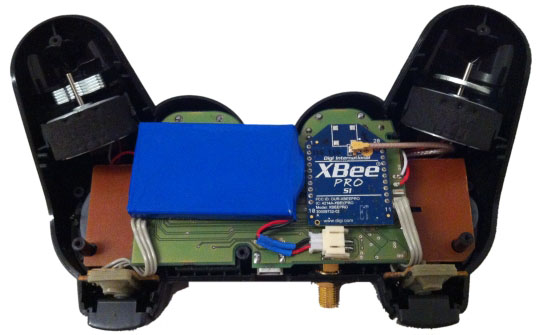
Sony’s DualShock 3 controller can be seen in a number of projects here on Hackaday. There’s a reason for this: it’s easy to sniff the Bluetooth signals coming out of this controller and make any electronics project do your remote control bidding. Bluetooth has a fairly limited range, though, so what happens if you’d like to use this very comfortable and very functional controller over a mile or so? Just replace the mainboard of the controller with a new design using an Xbee radio. It’s a great project from the workbench of [Marcel] and looks to be just the solution for an awesome Xbee remote control.

The Sony DualShock 3 controller is designed around a single main board for the bulk of the electronics and analog sticks with three daughterboards used for every other button on the controller. [Marcel] took the main board out of his controller and stated to reverse engineer the thing, keeping the USB charging, PC communication, force feedback and LED indicators. Instead of Bluetooth as in the original circuit, [Marcel] used a 60mW XBee radio, allowing him to control just anything connected to another XBee radio with a range of up to a mile.

[Marcel]’s new main board is a direct drop in replacement for the original DualShock 3 mainboard, and the only modification to the controller is drilling a small hole for the new antenna. It’s a great piece of kit for RC vehicles of any kind, and it’s fully programmable for whatever robotics project you might have in mind.

Thanks {Roel] for sending this one in.