Lots Of Seven Segment Displays With A Single ATtiny

7seg

These days they’ve been replaced with character LCD displays or even brightly colored graphical displays, but if you’re trying to display data on one of your projects, there’s nothing like the classic red glow of a red seven segment display. [five volts] got his hands on a few ancient segmented displays, but controlling even one took up more microcontroller pins than he was ready to spare. The solution to this problem was to use a shift register and control multiple segment displays with an 8 pin microcontroller.

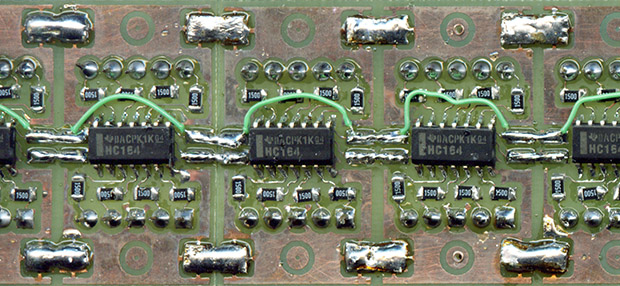
[volts] is using an ATtiny13 to control six seven segment displays. Each display is mounted on a hand-etched board, with a shift register and a handful of resistors soldered to the back. By having the microcontroller shift bits down the line, [volts] created an extremely easy to interface 6-digit segment display, and the entire device can be expanded even more.

The board files and schematics are available on [volt]’s project page. A great project if you’re just starting out to etch your own boards.
16 Core Computer Made Of ATMegas

Your desktop has two, four, or even eight cores, but when’s the last time you’ve seen a multicore homebrew computer? [Jack] did just that, constructing the DUO Mega, a 16 core computer out of a handful of ATMega microcontrollers.

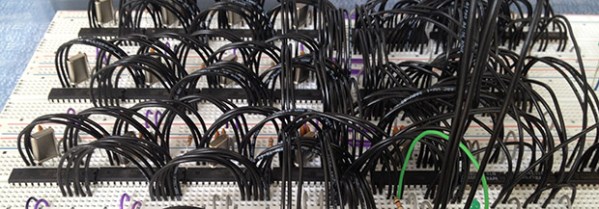
From [Jack]’s description, there are 15 ‘worker’ cores, each with their own 16MHz crystal and connection to an 8-bit data bus. When the machine is turned on, the  single ‘manager’ core – also an ATMega328 – polls all the workers and loads a program written in a custom bytecode onto each core. The cores themselves have access to a shared pool of RAM (32k), a bit of Flash, a VGA out port, and an Ethernet controller attached to the the master core.

Since [Jack]’s DUO Mega computer has multiple cores, it excels at multitasking. In the video below, you can see the computer moving between a calculator app, a weird Tetris-like game, and a notepad app. The 16 cores in the DUO Mega also makes difficult calculations a lot faster; he can generate Mandelbrot patterns faster than any 8-bit microcontroller can alone, and also generates prime numbers at a good click.

Continue reading “16 Core Computer Made Of ATMegas”

A 555 Player Piano

555_timer_automatic_music_player

From simple buzzers to an Atari Punk Console, the simple 555 timer chip is the foundation of a whole lot of interesting lo-fi synth projects perfect for beginners. [Steven] put together a great tutorial for using the 555 timer in a rudimentary synth, and even went so far as to build a simple electronic player piano able to play a song from a sheet of paper with punched holes.

The basic 555 oscillator circuit is very simple – just a few caps and resistors and powered by a few batteries. [Steven] built the simplest 555 circuit, but used a line of graphite drawn on a piece of paper for the resistor controlling the frequency. It’s basically a drawdio built on a breadboard, and easy enough to build for even the most neophyte electronic tinkerer.

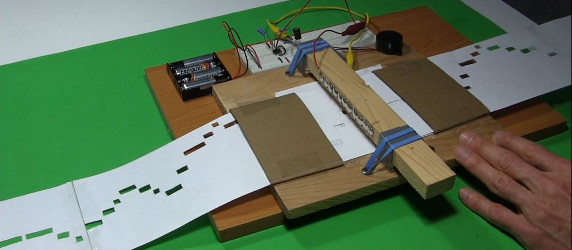
Going one step further, [Stephen] drew a long thick line of pencil graphite on a piece of paper and mounted eleven wire loops attached to the circuit over his improvised resistor. After cutting a few holes in a piece of paper, he was able to create a simple player piano with his 555 synth. It worked well enough to play Greensleeves, and is the perfect project for the budding electronics hacker.

Continue reading “A 555 Player Piano”

Raspberry Pi Bitcoin Miner

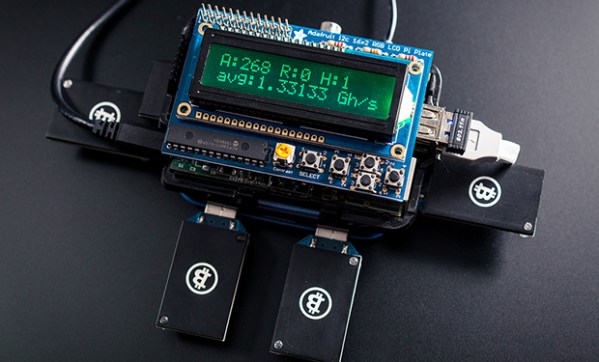
Mining bitcoins is becoming a fool’s errand, but there’s always some new piece of hardware coming out that allows those hard-core miners to keep ahead of the curve. One such piece of hardware are new custom ASIC devices that are just as fast as an FPGA while being much less expensive. A lot of these ASIC devices come in interesting packages that look just like a large USB thumb drive. Of course this is the perfect opportunity to show off what the Raspberry Pi can do by mining Bitcoins at rates comparable to the best graphics used in mining today.

The Raspberry Pi simply doesn’t have enough horsepower to mine bitcoins at any worthwhile rate. There are, however, USB ASIC devices that will mine for you at about the same speed as a high-end graphics card. Since multiple ASIC devices can be controlled through a USB hub, it’s simply a matter of plugging a USB hub into a Raspberry Pi, loading up CGminer, and letting your new PiMiner loose on a mining pool.

The Adafruit Pi Miner uses one of their really cool LCD character displays and keypad to display the current mining rate, accepted shares, and enough information for you to calculate how long it will take to break even with your Pi powered mining rig. How long that will be for this four device rig we’ll leave to the comments section.

Turning A Phone Into A Geiger Counter

geiger

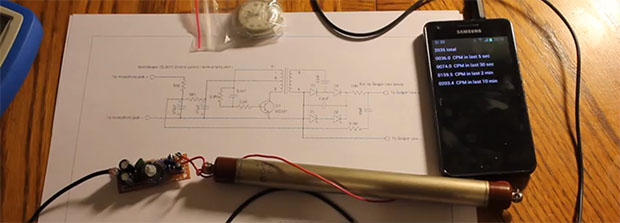
We’re no stranger to radiation detector builds, but [Dmytry]’s MicroGeiger prototype is one of the smallest and most useful we’ve seen.

The idea behind the MicroGeiger comes from the observation that just about every modern smartphone can provide a small bit of power through the microphone jack. Usually this is used for a microphone, but with the right circuit it can be stepped up enough to power a Geiger tube.

[Dmytry]’s circuit uses a hand-wound transformer but keeps the part count low; there’s only a few dozen caps, resistors, and diodes in this build, making the circuit much smaller than the Geiger tube itself.

Since [Dmytry] is powering a Geiger tube with a phone, it only makes sense that he should also record clicks from the tube with an Android app. Right now, the entire project is still in the prototype stage, but everything works and his app can detect radiation from one of [Dmytry]’s sources.

The code and schematics for the MicroGeiger are available on GitHub, with a video of the project in action below.

Continue reading “Turning A Phone Into A Geiger Counter”

A Charming Arduino King Cobra Game

cobra

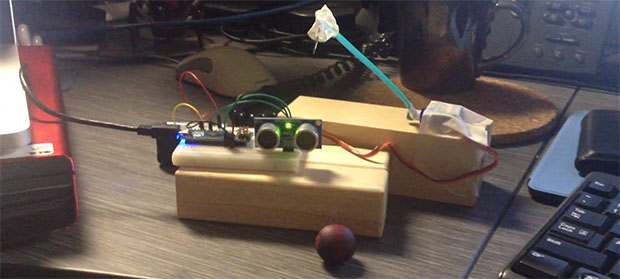
Here’s a fun game from [A.J.]’s lab. It’s a simulated king cobra made from an Arduino, an ultrasonic sensor, and a servo. The aim of the game is to grab a ball in front of the device without being ‘bitten’ by the thumbtack attached to a drinking straw controlled by a servo. You know, just like a real king cobra.

There’s no schematic or build plans for this project, but it looks easy enough to cobble together. Despite its simplicity, this game looks hilariously fun, and could quite possibly provide more entertainment through using the machine rather than simply building it.

No text description of this game can do it justice, so check out the video below. It looks like a lot of fun, and if you already have the parts in a bin somewhere, it’ll make a great weekend build.

Continue reading “A Charming Arduino King Cobra Game”

Outputting Text On A Paper Tape Machine

thegame

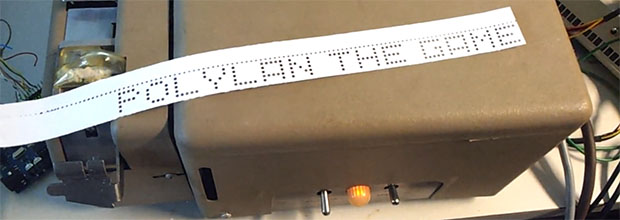
Back before the days of 8 inch floppy disks, storing computer programs was much more primitive than even a stack of punch cards. The earliest general purpose computers used paper tape, a strip of paper with punched holes designating a 0 or a 1. Thankfully for the computer scientists of the day, these paper tapes weren’t created by hand. No, the Friden SP-2 tape punch took care of the duties of punching holes in these tapes. When [Max] rescued one of these tape punch machines from a trash bin, he knew what he needed to do: connect it to an Arduino so he could create his own paper tapes.

[Max] found a veroboard with a bunch of transistors inside the machine that was added by a previous owner. After finding the manual for the machine he connected it to an Arduino, holding each of the eight control pins high to punch the tape, and then holding another pin high to advance the tape. With this, he was able to punch letters instead of binary code into his paper tape.

[Max] also added an Ethernet shield to his Arduino that checks his email. If an email shows up in a special folder, it outputs the subject line to the tape punch machine, giving him an entirely retro ticker tape machine, built with vintage 60s hardware.

There are a pair of videos of [Max]’s tape punch machine in action below, along with a gallery of the glamorous gut shots of this incredible machine.

Continue reading “Outputting Text On A Paper Tape Machine”