Doctor Who-style WiFi

wifi

Spoilers, sweetie…

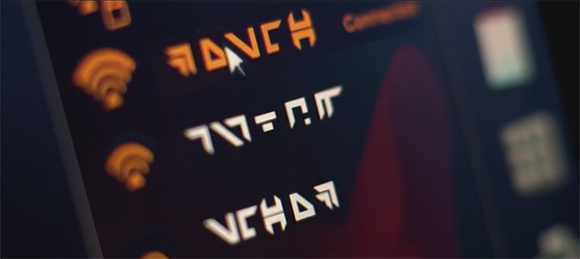
If you didn’t catch the latest episode of Doctor Who, here’s the plot: Random people connect to strangely-named WiFi networks and later have their conciousness uploaded to the Internet with the help of spoonheaded robots. To the non-Whovian that doesn’t make a whole lot of sense, but [Tony Box] figured out a way to replicate the effect with a Linux box and a USB WiFi card, just in time for a great April Fool’s gag.

For the SSID, the folks over on reddit decided the best characters come from the Unified Canadian Aboriginal Syllabics Unicode block. [Tony] then set up a laptop with a USB wifi card with hostapd, and dnsmasq to change the SSID and DHCP leases. nginx serves up a simple web page with a short clip from the episode (of a spoonhead uploading a conciousness).

Here’s what’s really interesting: [Tony] is using a captive portal, so something like the webpage that shows up when you log on to the internet in a coffee shop or hotel. When the victim of this prank logs on to The Great Intelligence’s WiFi, they’re presented with a webpage containing the video of the spoonhead.

You can check out [Tony]’s demo of his build after the break.
Continue reading “Doctor Who-style WiFi”

Building A Wooden Air Raid Siren

siren

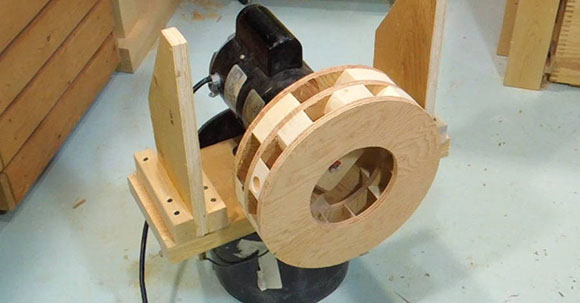
A while back, [Matthias] was working on a dust collector for his shop. Being the master woodsmith he is, he decided to build a dust collection system out of wood. Everything worked out in the end, but in creating wooden impellers and blowers, he discovered his creations made a lot of noise. For this project, instead of trying to quiet his blower, he decided to make one as loud as possible in the form of an air raid siren.

The basic idea behind [Matthias]’ air raid siren is to make two impellers that force air through two stators along the perimeter of the rotor. As the siren spins, the air coming from the impellers is either blocked or passes through the stators, creating an alternating high and low pressure; to be more accurate, it creates a ton of noise. Stack two of these impellers together and you’ve got a two-tone air raid siren made out of wood.

For something that’s spinning very fast, we’re surprised [Matthias] didn’t have more problems with balancing his siren than he did. There are a few useful tricks to be picked up from his tutorial, though: balancing everything on a marble really seemed to help with the build.

As for how loud the siren is, [Matthias] can’t give us a decibel volume. From the video after the break, though, we can tell you it’s really, really loud.

Thanks [Dimitar] for sending this in. [Matthias], it’s alright if you send projects in yourself. You’ve earned the right to say, “I am so cool!”

Continue reading “Building A Wooden Air Raid Siren”

Coding New Parts In Eagle

chip

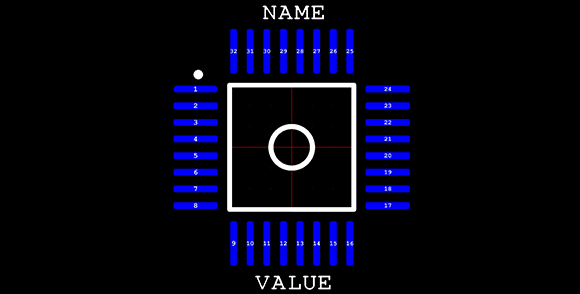
Making new parts in Eagle CAD isn’t the easiest thing in the world, especially if you’re dealing with a package that isn’t in one of the default libraries. Usually, making a new part means digging out a datasheet and drawing a new part in Eagle. A better solution would be to generate new parts with code – define the number of pads, the shape of the pads, the symmetry of the chip, and so forth. [Joost]’s madparts does just that, allowing anyone to create new parts in Eagle by entering numbers instead of drawing lines.

The idea behind madparts is to code new entries in Eagle libraries with Coffeescript. It has instant graphical feedback for the part you’re designing, and is able to import from and export to Eagle libraries. A KiCAD-enabled release is coming soon, but until then, madparts looks like a great way to create your own parts in weird packages in Eagle.

Interview: Another Kickstarter Round For The B9Creator

The Dawn of the 3D Printing Age - Art by Dennis HarrounNearly a year ago, the 3D printing scene saw a few new printers based on a technology other than squirting plastic out of a nozzle. These printers used DLP projectors underneath a vat of UV curing resin to build objects one layer at a time with incredible resolution.
Probably the most successful of these printers is the B9Creator from [Michael Joyce]. His original Kickstarter took in half a million dollars – 10 times his original goal – and still managed to deliver all the kits to backers within 2 weeks of the promised date. Now, [Michael] is running another Kickstarter before taking his printers to select distributors. We played some email tag with [Michael] for an interview discussing the perils of a hugely successful Kickstarter, and the future of the B9Creator ecosystem.

Check out our interview after the break.

Continue reading “Interview: Another Kickstarter Round For The B9Creator”

Centerpieces For A Geeky Wedding

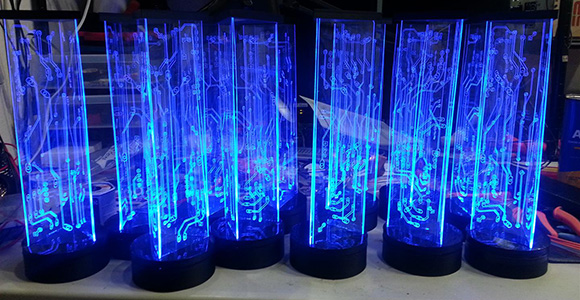
[Bill Porter] is a married man now, and evidently his new wife, [Mara], is awesome. They put together one of the geekiest weddings that included custom side-lit LED centerpieces.

Instead of laser engraving the dozens of plastic panels for each centerpiece, [Bill] tricked [Mara]’s Silhouette Cameo home vinyl cutter – the same one they made their invitations with – into engraving acrylic panels. They’re made out of very thin plastic, but the fact that the couple were able to snap apart the engraved plasic after putting sheets though the machine is very impressive for something that’s generally used for scrapbooking.

As for the base of each centerpiece, [Bill] whipped up a few enclosures on his 3D printer and built a few battery packs out of 18650 lithium ion cells. The nine LEDs in each base were leftovers from a previous project involving LED strips, perfectly suited to run for a few hours in a reception hall.

It’s a great build for a wonderful occasion, and we’re really impressed with the plastic cutting ability of the Sihouette Cameo. Very nice work there.

Business Card Draws [ch00f]’s Logo

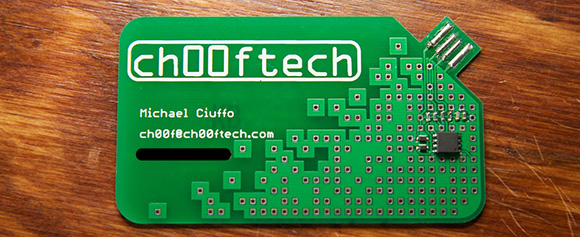
[ch00f] is at it again, expanding the horizons of the art of PCB business cards. This one draws his logo on any computer over a USB port.

The physical design of the card is heavily inspired by [Frank Zhao]’s card; both use an ATtiny85 and the V-USB package to handle the USB protocol and communications. Instead of typing words into a text editor like [Frank]’s, [ch00f]’s card draws the ch00ftech logo in MS Paint or other image editor.

There was a problem with simply emulating the mouse to draw a logo on the screen, though; because different computers have different mouse settings for acceleration, the ch00ftech logo was nearly always distorted. [ch00f] fixed that by emulating an absolute input device, basically turning his business card into a single-function pen tablet.

The logo was traced by hand and put into a few arrays in the firmware. Surprisingly, the logo didn’t take up much space – only 4k of the tiny85’s flash is used. There’s a lot more space for a more complicated drawing, but for now the simple ch00ftech logo (video after the break) will do.

Continue reading “Business Card Draws [ch00f]’s Logo”

Extending Old Games With Reverse Engineering And MAME

For last year’s Toorcamp, the folks over at DorkbotPDX helped out with the Church of Robotron installation. A religion founded on the prophesy of a cybernetic uprising in the year 2084 is a little esoteric even for us, so the Dorkbot crew wanted a way to make playing Robotron: 2084 a little more visceral. Using MAME and a few debugging tools, they were able to read the memory of a machine playing Robotron to extend the game into the physical world. When the player dies, lights go off, alarms sound, and the prophet of the Church of Robotron is pleased.

The setup at the Church of Robotron included a machine running MAME with a Robotron ROM. When events happened in the game, such as lasers firing or a player death, physical events would be triggered. To do this, the Dorkbot team read the memory locations of a game of Robotron at different times and found memory locations tied to in-game events. On their blog they go over using the MAME debug tool to detect a player’s death which can then be translated into physical apparitions for the Church of Robotron.

It’s a very cool hack, and one we wish we had a video of. Having a plastic ghost hit a player while playing Pac-Man seems like an awesome idea, and with the Dorkbot tutorial, it looks fairly easy.