Android Controlled Minecraft Ores

[Ryan] has a friend with a birthday coming up, and being inspired by ever 12-year-olds favorite game, he decided to make a Minecraft ore block with RGB LEDs. The block can change from diamonds to emeralds via commands send from an Android phone.

After a few false starts, [Ryan] eventually had his ore cube laser cut at Acess Space, a hackerspace-ish group in Sheffield. The box was constructed out of 3mm MDF, while the windows were laser cut out of frosted acrylic, while the stone pattern on the cube is one giant custom-made sticker.

With the tedious part of the build out of the way, [Ryan] set to work on the electronics. He used a PIC attached to a few very large RGB LEDs, and a Bluetooth module that allows him to connect his phone to an ore block. Dialing in the right colors took some work, but eventually, [Ryan] had an Android-controlled Minecraft ore block, able to transmutate between gold, iron, diamond, emerald, lapis, and redstone.

You can check out a video of [Ryan]’s ore block in action after the break.

Continue reading “Android Controlled Minecraft Ores”

Turning PCBs Into Art

Designing a circuit, laying out a board, and sending it off to be fabbed is so easy anyone can do it. A lot of people are, in fact, and with the traditional tools like KiCAD and Eagle, a lot of different boards look very, very similar. You could always add some cool silkscreen graphics to your board to make it stand out, but [Saar] has a better solution: it’s called PCBmodE, and it allows you to draw circuits artistically instead of the 45° angles we’ve become so accustomed to.

PCBmodE takes the parts, pads, signals, and vias for boards stored in JSON files and converts them to an SVG representation. The file is then routed (manually, but [Saar] is working on automated routing) and Gerberized so it can be sent off to a production house.

You can grab PCBmodE over on bitbucket, but right now it’s still a very early version. Vias and copper pours are working, but [Saar] has only fabbed this board so far.

Raspberry Pi: The Perfect Machine For Old DOS Games

DOS

There’s a treasure trove of excellent yet ancient games made for DOS that are nearly unplayable on modern computers. Awesome games like the Lucasarts SCUMM adventures, the original Civilization and SimCity, Starflight, the King’s Quest series and even Leisure Suit Larry aren’t played much today because of the near impossibilities of getting them to run on modern hardware or setting up an emulator with proper sound.

[Patrick] has been doing his best to help out classic gamers with an x86 emulator for the Raspberry Pi. It’s designed to be a very capable DOS box with 20 MB of extended memory, a 640×480 display with 256 colors, an ~20MHz 486 emulated CPU, and a Soundblaster 2.0 sound card.

There’s still a lot of work to be done, but outside of finding a 20-year-old computer, emulation on a Raspberry Pi it probably the most authentic DOS gaming experience you’ll get.

Having Fun With Dumb Terminals

terminal

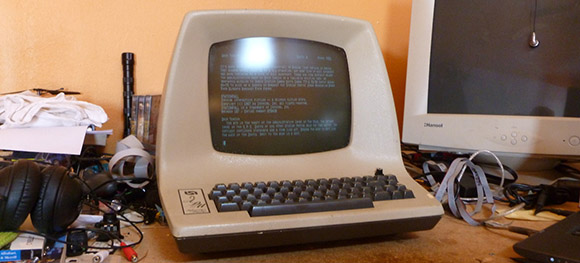
For a long time now, [Morgan] has been wanting an old serial terminal. In a stroke of luck, one of his pals at the Quelab hackerspace scored an awesome ADM-3A terminal from a collector. It’s a historically significant piece of computing and UNIX history, so obviously [Morgan] needed to get it working.

The ADM-3A terminal pre-dates the famous DEC VT-100 terminal, but since [Morgan]’s new acquisition speaks RS-232, he had a good shot at getting it to work with one of his more modern boxes. He’s using a Windows laptop loaded up with FreeBSD in a VM to talk to the terminal. Surprisingly, the only additional hardware required was a USB to serial cable and a DE9-DB25 serial adapter.

It may not be as cool (or as loud) as Quelab’s Teletype ASR-35 they have set up for Zork sessions, but it’s great to see ancient hardware have some
use. Right now, [Morgan] is editing files with vi and of course playing Zork. Seems like there’s plenty of life left in this old dumb terminal. After looking for an old VT-100 for a while now, I’ve got to say I’m pretty jealous.

Giving A CNC Knitting Machine A New Brain

We’re all about big machines that build things for us – laser cutters, CNC mills, and 3D printers are the machines de rigueur for Hackaday.  Too often we overlook the softer sides of fabrication that include textiles and knitting. [varvara] and [mar] are doing their best to bring us the softer side of things with their modification of a Brother knitting machine. They call their build Knitic, and it’s a great way to knit with computer control.

Instead of previous Brother knitting machine hacks we’ve seen, Knitic doesn’t bother with emulating the keypad or controlling the microprocessor already there; this build dispenses with the Brother brain and controls the solenoids and switches of the knitting machine directly with the help of an Arduino and a home-etched shield.

It’s not quite an automated knitting machine – someone still has to run the shuttle across the machine – but the patterns are controlled via a Processing app available on the Knitic github. You can check out [Varvara]’s demo of Kinitic after the break.

Continue reading “Giving A CNC Knitting Machine A New Brain”

Hackaday Links: March 25, 2013

Illegal, yet impressive

cans

Want a soda? Just grab a robot, shove it in a vending machine, and grab yourself one. This video is incredibly French, but it looks like we’ve got a custom-built robot made out of old printers and other miscellaneous motors and gears here. It’s actually pretty impressive when you consider 16 ounce cans weigh a pound.

UNOBTANIUM

chip

Okay, we got a lot of emails on our tip line for this one. It’s a group buy for a programmable oscillator over on Tindie. Why is this cool? Well, this chip (an SI570) is used in a lot of software defined radio designs. Also, it’s incredibly hard to come by if you’re not ordering thousands of these at a time. Here’s a datasheet, now show us some builds with this oscillator.

Chiptune/keygen music anywhere

keygen

[Huan] has a co-loco’d Raspi and wanted a media server that is available anywhere, on any device. What he came up with is a service that streams chiptune music from your favorite keygens. You can access it with Chrome (no, we’re not linking directly to a Raspberry Pi), and it’s extremely efficient – his RAM usage didn’t increase a bit.

Take it on an airplane. Or mail it.

bomb

[Alex]’s hackerspace just had a series of lightning talks, where people with 45-minute long presentations try to condense their talk into 10 minutes. Of course the hackerspace needed some way to keep everything on schedule. A simple countdown timer was too boring, so they went with a fake, Hollywood-style bomb. No, it doesn’t explode, but it still looks really, really fake. That’s a good thing.

Printers have speakers now?

nokia

[ddrboxman] thought his reprap needed a nice ‘print finished’ notification. After adding a piezo to his electronics board, he whipped up a firmware hack that plays those old Nokia ringtones. The ringtones play over Gcode, so it’s possible to have audible warnings and notifications. Now if it could only play Snake.

A Tiny Custom Table Saw

saw

If you’re working with small parts, even the smallest table saw available at Home Depot or Lowes is generally overkill. For cutting up small pieces of wood, metal, and copper-clad board, a micro table saw is a great investment. They’re actually pretty inexpensive, but why just buy one when you can make one that is better than any model on the market?

The bed is constructed out of 1/4″ aluminum plate with a 1/15 horsepower motor bolted to the underside. The fence clamps on to the table with a pair of delrin brackets, while the angle guide is made of delrin and a brass bar that fits into a slot in the table.

The actual blades came from a Proxxon micro table saw (a very good brand from our experience), but comparing this homemade saw to the commercial one provides a few surprises: The Proxxon has a more powerful motor, but the homebrew version has four times the cutting capacity. You can check out this saw cutting a 1/4″ aluminum bar in the video after the break.

Thanks [Hubert] for sending this one in.

Continue reading “A Tiny Custom Table Saw”