64 Rasberry Pis Turned Into A Supercomputer

In retrospect, it was only a matter of time before someone turned a bunch of Raspberry Pis into a supercomputer.

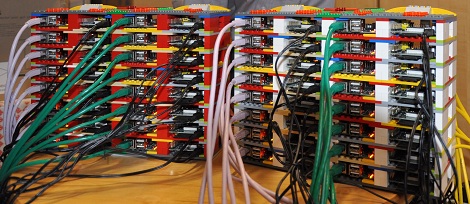
The Raspi supercomputer is the result of a project headed up by University of Southampton professor [Simon Cox]. Included in the team are a gaggle of grad students and [Simon]’s 6-year-old son who graciously provided the material, design, and logistics for the custom LEGO case.

The Iridris-Pi supercomputer, as the team calls their creation, consists of 64 Raspberry Pis, all configured for parallel processing using a lightweight version of MPI. [Simon] was kind enough to put up an excellent guide for turning two (or more) Raspberry Pis into a supercomputer.

The machine has a full 1 TB of disk space provided by a 16 GB SD card in each node. Although the press release doesn’t go over the computational capabilities of the Iridris-Pi, the entire system can be powered from a single 13 A supply.

If you’re wondering what it would take to get a Raspberry Pi supercomputer into the TOP500 list of supercomputers, a bit of back-of-the-envelope computation given the Raspi’s performance and the fact the 500th fastest computer can crank out about 60 TeraFLOPS/s, we’ll estimate about 1.4 Million Raspis would be needed. At least it’s a start.


ATtiny Controlled Magic Eye Tube

In the early days of broadcast radio, the most expensive radio sets were extremely impressive pieces of furniture. With beautifully crafted wooden cases polished to a high shine, these wireless receivers were the focal point of any family room. Some of the most expensive radio sets even included a visual indicator signaling the strength of the reception, something [Marcus] decided to re-engineer using an ATtiny85.

The display tube in question is an EM800 magic eye tube, used in radio sets, stereos, and electronic test equipment as a rudimentary display indicator. By applying a control voltage (from 0 to -10V), the illuminated display can be controlled like a bar graph display.

[Marcus]’ tube display is built around an ATtiny85 microcontroller, using a homemade PCB. It’s a fairly simple build, once the issue of supplying 250 Volts to the EM800’s anode is taken care of.

In the video after the break, you can see the bar display of [Marcus]’s magic eye tube slowly growing and receding, perfect for either displaying the current CPU load on your computer or anything else a dynamic bar graph display would be used.

Continue reading “ATtiny Controlled Magic Eye Tube”

Generating Random Numbers From White Noise

Even though rand() may be a good enough random number generator for making a video game, the patterns of random bits it spits out may not be sufficient for applications requiring truly random data. [Giorgio] built his own random number generator, and after many statistical tests it ended up being random enough for a few very complex calculations.

Previously, we saw [Giorgio] generate random numbers with a Chua circuit, but for all the complexity of building an electronic strange attractor there’s actually a much simpler source of random data: a white noise generator.

[Giorgio]’s random number generator for this project is just a pair of resistors, with an op-amp buffer, amplifier, and current switch to turn analog data into a digital output of random 1s and 0s. [Giorgio] sampled this data by plugging the digital out into one of the GPIO pins of a Raspberry Pi and recording the data with s small script.

To verify his sequence of bits was actually random, [Giorgio] performed a few tests on the data, some more reliable in determining randomness than others.

Because every project needs a few awesome visualizations, [Giorgio] plotted each sequence of bits as either a black or white pixel in a bitmap. The resulting image certainly looks like television static, so there are no obvious problems with the data.

[Giorgio] also performed an interesting Monte Carlo simulation with his megabytes of random data: By plotting points on a plane (with a range from 0,0 to 1,1), [Giorgio] can approximate the value of π by testing if a point is inside a circle with a radius of 1. The best approximation of pi using 10,000 points of random data came out to be 3.1436

Of course [Giorgio] put his random data through a few proper statistical tests such as rngtest and dieharder, passing all the tests of randomness with flying colors. An interesting build that shows a small glimpse of how hard generating really random numbers actually is.

Drag And Drop Code Onto This ARM Dev Board

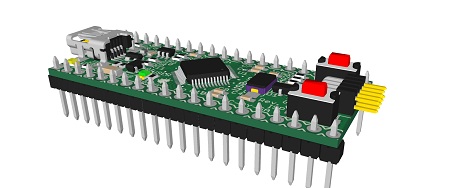
On the continuing list of homebrew ARM dev boards we’ve seen over the past few months, [Squonk42]’s USBug is one of the best we’ve seen. Like many other ARM boards, it breaks out a member of the Cortex M0/M3 family into a 40-pin DIP, but unlike all the others, [Squonk] designed it so you can drag and drop code onto the microcontroller just like a USB thumb drive.

[Squonk]’s trick relies on a certain breed of NXP LPC11xx/LPC13xx microcontrollers. These chips feature a ROM-based mass storage, meaning you can compile code on your desktop and simply shuffle it over to the USBug, no external programmer required. Here’s the relevant app note (PDF in a zip file. Double whammy).

Of course, the USBug features the I/O you’d generally expect from the current crop of Cortex-M3 devices, all while serving up 64 kB of Flash and 12 kB of RAM.

[Squonk] says he’d like to put the USBug on Kickstarter, but unfortunately he’s not a US citizen. In the spirit of Open Hardware, perhaps some maker-based electronics manufacturer will pick up where [Squonk] is forced to leave off.

Log Guitar Uses Tube As A Bridge, Actually Is The Blues

In the never ending quest to replicate the tone of depression-era blues records, [Valve Child] managed to build the most backwoods guitar ever seen.

The body of [Valve Child]’s slide guitar was taken from the limb of a red gum tree felled during a wind storm. After taking a chainsaw, router, and sander to the guitar, [Valve] sealed it with linseed oil.

The real beauty of this build comes from the bridge and electronics: the pickup is made from six stacks of magnets encased in hot glue and wound with enamel wire. The bridge of the guitar is actually made from a 6GM8 dual triode. Not only does this provide the guitar with a wonderful brassy sound, the tube serves as a wonderful low-tech preamp when powered by a 6 volt battery.

The three strings on the guitar are tuned DAD, perfect for the likes of [Robert Johnson], or, for the younger kids, [Jack White]. Surprisingly, [Valve Child]’s guitar actually sounds really good. as heard in the video demo after the break.

Continue reading “Log Guitar Uses Tube As A Bridge, Actually Is The Blues”

Preserve History And Dispose Of Asbestos

If you’ve ever visited Gettysburg, the turning point of the American Civil War, you’ve probably seen this illuminated topographical map. For years, it was housed in one of the many visitor centers in Gettysburg and demonstrated the progress of the 3-day battle with an amazing 1960s-era visualization using a 30 foot by 30 foot topographical map and many, many light bulbs. Even the coolest museum exhibits are eventually made obsolete, so this masterpiece of battlefield education is now up for sale. The starting price for this auction? Five dollars.

We’re going to be honest. We talked about using Hackaday’s influence (and funding to buy toys such as an AR Drone and the Oculus Rift) to put a project together to save this gigantic map. It’s got everything we love in a large-scale project: giant things weighing several tons, cool representations of data, and vintage electronics. Really, restoring this map is the perfect project for any (very) ambitious hacker. It also helps I live a half hour away from Gettysburg.

There’s a problem, though: the map is literally covered in asbestos. Also, it takes up four shipping containers and weighs 12 and a half tons. Basically, you’re bidding on a GSA auction to be responsible for a hazardous waste disposal project.

Now that our dreams of doing something really cool with five dollars have come crashing down, we’re turning it over to Hackaday readers. If you run an asbestos disposal company and are around South Central PA or Maryland, there may be some people who want to get in touch with you. Drop a note in the comments.

Really, we’d really just like someone to scan this 30-foot square map with a Kinect and a high-resolution camera, and maybe get our hands on a video of the hourly show when this map was still in operation. It should be possible to dig up some topographical data and replicate this map fairly easily… maybe someone should start a Kickstarter to build a smaller, non-asbestos laden copy?

Typewriter Is USB Keyboard, Also Awesome

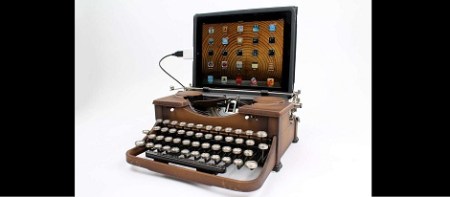
If you’re a brooding author putting the finishing touches on the next Great American Novel™ while sipping a latte in Starbucks, a MacBook is far too common to impress uncultured proles guzzling caramel macchiatos. No, to impress the next [Joyce] or [T. S. Eliot] sitting at the table next to you, you’ll need something much more hip, like a kit to turn a typewriter into a USB keyboard.

This kit to turn an old Underwood into a USB keyboard comes from the drawing board of [Jack Zylkin], member of Philly hackerspace Hive 76. [Jack] managed to make the process of turning an old typewriter into a keyboard a relatively painless process.

[Jack] created a sensor board loaded up with 74HC595 shift registers that easily mounts to the frame of just about any typewriter. When a key on the typewriter is struck, the mechanical levers strike metal strips soldered to the sensor board. An ATMega microcontroller records these keypresses and sends them over a USB port just like any other USB keyboard.

Modifying a typewriter into a USB keyboard is one of those projects we’d dread; you’d think there would be far too much futzing about with a lot of small electrical contacts and dirty mechanical devices. [Jack] actually managed to put together a very nice kit to turn a typewriter into a keyboard here.

You can pick up a kit over at [Jack]’s etsy store, but doing the same thing with a bit of perf board isn’t out of the question. Awesome video after the break.

Continue reading “Typewriter Is USB Keyboard, Also Awesome”