Automating Household Devices With Google Calendar

[Shane] is building a new house and wants some, “subtle home automation” as he calls it. His first project is hooking up a small heater to the Internet, and judging from his demo video everything is going swimmingly.

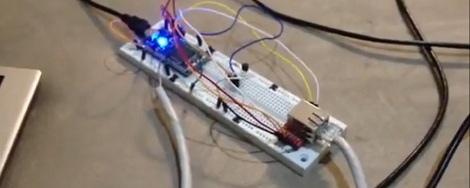
[Shane]’s project is built around an mbed microcontroller that connects to the Internet via an Ethernet connection. The mbed has a temperature controller and a solid state relay to turn the heater on an off; simple enough, but we really like how easily [Shane] connected his project to Google Calendar.

After looking over the Google API, [Shane] was understandably overwhelmed. He figured out that by syncing the mbed’s clock to network time and sending a GET request for one minute in the future, the mbed would always know what was scheduled with a minimal delay.

Now, all [Shane] does to turn on his heater is schedule a time and temperature in Google Calendar. He can do this from across the globe or country and makes for a really slick part of a home automation system.

Continue reading “Automating Household Devices With Google Calendar”
Homebrew Solder Pot Is Too Dangerous Even For Us

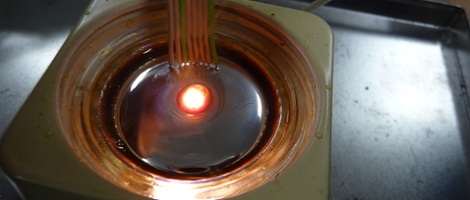
[rue_mohr] is building a hexapod robot, and that meant he needed to tin a whole bunch of ribbon cables with solder. Using a soldering iron for this task would take far too long, so he built a homebrew solder pot to tin all those wires quickly. While [rue] was able to get solder on all those wires quickly, we need to question his method – he used a halogen light and reflector to melt all that solder.

The build began with a recycled halogen light fixture. After taking apart the entire assembly, [rue] reassembled it into something resembling a solder pot; a concave reflector and halogen light bulb sit perfectly flat on the table, ready to accept pieces of solder.

After throwing the switch and putting a few bits of solder in the reflector, the solder pot surprisingly worked. [rue] was able to quickly tin his ribbon cables, and the halogen bulb and reflector didn’t break yet.

This is one of the least safe solder pots we’ve ever seen – the bulb could easily explode, and melted solder could come pouring out of the reflector at any time. [rue] is aware of the safety implications and make sure to wear a pair of goggles. If it works though, we really can’t complain.

Check out the video of [rue]’s solder pot (with an awesome temperature indicator light right in the middle of a pool of solder) in action after the break.

Continue reading “Homebrew Solder Pot Is Too Dangerous Even For Us”

Detecting ASCII Art Across The Internet

As a web developer and designer, [Victor] has a habit of putting a very nice ASCII signature in an HTML comment at the top of every web page he designs. He was inspired by seeing others do this,  and this piqued his curiosity to see who else was doing this. His idea was to scan through a chunk of the Internet and see what other web pages had ASCII signatures in an HTML comment. With a lot of very clever work, [Victor] managed to grab some interesting ASCII art that would have been missed without looking at the source of millions of web pages.

After gathering a list of the top million top-level domains from Alexa, [Victor] wrote a script to download the HTML for all the pages in parallel. After that, it was just an issue of detecting the ASCII art in all the HTML files. There were a few earlier ASCII art detection algorithms, but nothing that suited [Victor]’s use case. The best result came from only looking at the first comment (otherwise the signatory wouldn’t want you to find it with a quick glance at the source) that were at least 3 lines long and 40 characters wide. After discarding everything with HTML tags in it, [Victor] had an awesome gallery of the ASCII art from webpages all around the Internet.

What did he find? Well, there’s far too many ASCII signatures for [Victor] to put up on his webpage, but he did provide a nice sample of what he found. They’re mostly logos, although there is a Hypnotoad and Aperture Science sentry turret in there.

If you’d like to try out [Victor]’s script, he made everything available on GitHub.

A Camera That Describes A Picture For You

[Matt]’s Descriptive Camera looks just like any other point and shoot camera, albeit a little more boxy and homemade-looking. It even works just like the Polaroids of yesteryear – snap a picture and in a few minutes you’ve got a reproduction in your hands. Unlike any other camera before, [Matt]’s camera doesn’t give you an image. [Matt]’s camera gives you a description of the picture you took, printed out on  easily-scrapbooked thermal receipt paper. Yes, mankind is now that meta.

To build the hardware of his camera, [Matt] took a BeagleBone single-board Linux computer and attached a webcam and a thermal receipt printer. The real magic is in the artificial artificial intelligence that is Mechanical Turk. [Matt]’s camera sends his picture up to the Internet where some random stranger describes his picture. This description is sent back and printed on the receipt paper.

Even though [Matt] is spending $1.25 to have a single picture described on Mechanical Turk, there’s probably not another camera as retro-meta-fabulous-fantastic out there.

A Blanket That Detects Its Own Orientation

If you want to capture a 3D model of a physical object, you could use a Kinect, a couple of lasers, constructive light, or even a simple touch sensor mounted on a robotic arm. Those are all expensive devices, and somewhat unnecessary now that you can just throw a blanket over an object and get a 3D model instantaneously.

The project is called IM BLANKY and it’s supposed to reproduce 3D shapes by simply throwing it over an object. The petals in the flower motif are pieces of conductive fabric that serve as contacts for the electrified tassel in the center of each flower. When the blanket is thrown over an object, the tassel is pulled by gravity, makes contact with one of the six conductive petals and sends a tilt switch to a microcontroller.

While we’re not too sure about the resolution IM BLANKY will provide with only 20 tilt sensors, but we imagine this could be used for a few medical applications.

via dvice

Making Old Organs More Portable With MIDI

In the 60s 70s and early 80s, roadies would lug hundreds of pounds of musical equipment around to gigs. Although the 8×10 Ampeg bass cabinet wasn’t fun in the least, the absolute worst was the Hammond organ. These behemoths of tonewheel organs sounded great, but moving them was a pain. For better or worse, portable MIDI keyboards caught up with the sound quality of these old electromechanical monsters. Everything is still not right with keyboard players; a good set of organ foot pedals is still hard to come by. To solve this problem, [Jeremy] converted his old Hammond A-100 organ pedals to MIDI giving him all the feel and aesthetics of an ancient instrument without all the heft.

To transform the ancient A-100 bass pedals into a keyboard, [Jeremy] turned to the HighlyLiquid MIDI CPU. This small board provides a few dozen pins to wire up to switches and potentiometers. A new switch assembly was built for the bass pedals using a momentary push button switch under each key. These buttons are wired up to the MIDI CPU, and everything worked out wonderfully.

Although there’s no video of the newly portable Hammond organ in action (something off Zeppelin I, [Jeremy]…) there is a great Flickr photoset of the entire build. Awesome work, [Jeremy]

Report From RoboGames 2012

Last week we reported on the upcoming 2012 Robogames competition would be held in San Mateo, California. Nobody from the Hackaday staff could make it this year, but luckily [Sabrina Merlo] from the Make: blog was able to provide a full report of the spectacle of fire, sparks and pierced metal this year.

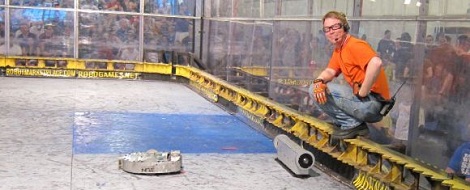
For anyone who remembers the wonderful Battlebots TV show from 10 years ago, the main event is very familiar: two competitors face off with the remote-controlled extensions of themselves in a Lexan enclosed arena. The resulting battle is an orgy of flames sparks and mortally wounded robots. Yes, there are a ton of wedge robots, but most of them had very interesting weapon designs.

Off the main stage, there are also more traditional robotics competitions. Sumo robots try to push each other out of a ring, robot soccer tries to demonstrate a mechanistic Pelé, and foot-tall MechWarriors battle in the streets of a miniaturized city.

There were also a lot of not-really-battling robots like a robotic foosball table. It sounds like everyone had a blast, so we might be hitting up the bay area this time next year.