Gigantic Liquid Crystal Display Is Like A Giant Calculator

Some say he turns on his soldering iron by saying, “Flame on!.” He deadbug solders – QFP packages. All we know is he’s called [stig] and he sent in an awesome an awesome video of a new display at the Nature Research Center in Raleigh, North Carolina. It’s a 10 foot by 90 foot LCD display that uses 6 inch square glass panels containing the same liquid crystals you’d find in a calculator.

The display/installation is called Patterned by Nature and is built using 3600 pieces of LCD privacy glass. When a voltage is applied to the glass it changes from clear to opaque. While this technology has been around for decades (just look at your calculator), only in the last few years has LCD privacy glass come down in price to make a project like this economical.

The gigantic display was created in part by Sosolimited, an art studio who has made a similar project before. The display hanging in the atrium of the Raleigh Nature Research Center is amazingly efficient for its size  drawing only 75 watts.

If you’d like to try your hand at a similar build, we wish you luck; this LCD glass is still somewhat expensive but perhaps in a few years the price will come down enough that we can play Tetris on the side of a building.

Continue reading “Gigantic Liquid Crystal Display Is Like A Giant Calculator”
A Papercraft Resistor Calculator From Adafruit

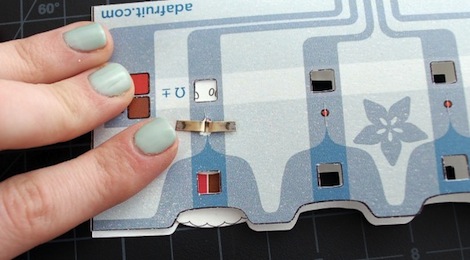
The Adafruit blog just posted a neat papercraft resistor calculator. If you haven’t yet learned the horribly offensive mnemonic for resistor color codes, now’s your chance to have a cheap and portable resistor value reference.

This papercraft resistor calculator is the latest in the family of Circuit Playground tools that include a fabulous electronic reference app we reviewed some months ago. Instead of an Android or iOS device, the papercraft resistor calculator runs on its own mechanical computer; a series of four printed disks and some paper fasteners.

If you’d like to print out your own resistor calculator, Adafruit put up the PDF on GitHub and posted the Illustrator file on Thingiverse for easy editing. It’s not the old-school cool of a slide rule, but we could easily see this resistor calculator being useful if you’re ever lucky enough to teach electronics to children. At least then you won’t have to share that offensive mnemonic.

Pedal Powered Hydrofoil Looks Like A Lot Of Fun

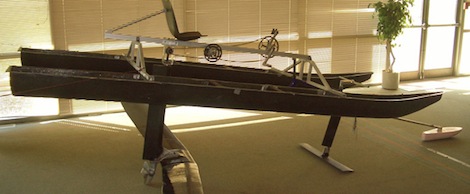
After reading a bicycle-powered hydrofoil build we posted a few days ago, [James] sent in the project that earned him an iron ring from Dalhousie University in Nova Scotia, Canada. It’s a pedal-powered hydrofoil made of carbon fiber and a Titanium drive shaft [James] and five other students in a mech eng senior design class built in 2005.

The Halifoil, as the team called it, is based on a recumbent design and uses twin carbon fiber hulls to keep the rider out of the water when not pedaling. The use of carbon fiber foils and Titanium drive shaft keep the weight down so the rider can easily accelerate to a speed where the hulls come out of the water.

Compared to the last hydrofoil we posted, [James]’ build is much heavier, but one is much better suited to sitting in the middle of a lake, then pedaling to the shore while flying above the water.

Even though the project is several years old, it’s still a very cool build. [James] was kind enough to post the videos of his build residing on the Dalhousie servers on YouTube; you can check those out after the break.

Continue reading “Pedal Powered Hydrofoil Looks Like A Lot Of Fun”

Zen Rock Garden Table Uses Magnets And Sand

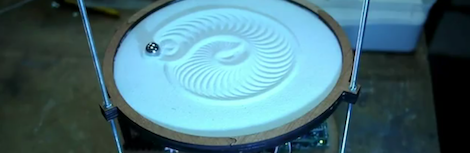
[Nick] is working on a prototype of a coffee table sand plotter that draws patterns in sand a lot like a zen rock garden.

[Nick]’s zen rock garden uses a magnet to draw a ball bearing across the sand in interesting patterns. The build uses 3D printed gears and laser cut parts to rotate the table around and move the magnet along a radius of the circle. During the first test of the prototype, the ball bearing jerked around but this problem was solved by adding a piece of foam under the sand. Power is supplied through a slip ring in the base, and the table is controlled through Bluetooth.

Speaking of magnet-and-ball-bearing zen coffee tables, we ran across this video of a more professional-looking prototype that was the basis for a successful Kickstarter campaign. Like [Nick]’s prototype, the entire build relies on magnets and a ball bearing to move sand around in patterns. Because this zen table uses an XY axis instead of [Nick]’s polar setup, drawing logos is a lot easier math-wise, lthough it doesn’t look quite as cool as a circular rock garden.

After the break you can see these zen rock garden coffee tables in action.

Continue reading “Zen Rock Garden Table Uses Magnets And Sand”

Modeling An Object With Internal IMUs

[Joseph Malloch] sent in a really cool video of him modeling a piece of foam twisting and turning in 3D space.

To translate the twists, bends, and turns of his piece of foam, [Joseph] used several inertial measurement units (IMUs) to track the shape of a deformable object. These IMUs consist of a 3-axis accelerometer, 3-axis gyroscope, and a 3-axis magnetometer to track their movement in 3D space. When these IMUs are placed along a deformable object, the data can be downloaded from a computer and the object can be reconstructed in virtual space.

This project comes from the fruitful minds at the Input Devices and Music Interaction Lab at McGill University in Montreal. While we’re not quite sure how modeled deformable objects could be used in a user interface, what use is a newborn baby? If you’ve got an idea of what this could be used for, drop a note in the comments. Maybe the Power Glove needs an update – an IMU-enabled jumpsuit that would put the Kinect to shame.

Continue reading “Modeling An Object With Internal IMUs”

Micro Star Wars Arcade Game Is A Work Of Art

No, it’s not just another MAME cabinet build. [Le Chuck] over on the arcadecontrols.com forum built a fully functioning 1/6 scale replica of the classic 1983 Atari arcade game Star Wars.

The hardware is a CAANOO Linux-based portable media player running an emulation of the classing 1983 Star Wars video game. When [Le Chuck] turns his cabinet on, MAME4All boots up and goes directly into the game.

Because there are no 1/6 scale arcade parts, [Le Chuck] needed to fabricate most of his build from scratch. The case is basswood, along with the very-accurate light up coin slot doors. The joystick for the game was a bit tricky; the Star Wars game used an X Z joystick modeled after the yoke in the cockpit of an X-wing. To build this joysitck, [Le Chuck] took apart a few pots and crafted the joystick out of thin sheet metal. The controls operate exactly like the original, only in 1/6 scale.

After the break you can see the video of this incredible build in action.

Continue reading “Micro Star Wars Arcade Game Is A Work Of Art”

Incredible Home Made Miniature Engines

On the heels of a small stirling engine we featured, an astute Hackaday reader sent in a few awesome builds from HMEM, the home model engine machinist forum.

First up is a fantastic looking stirling engine made entirely from scratch. The build is modeled on a Moriya Hot Air Fan, but instead of making a fan spin around, [IronHorse] put a flywheel on the engine. It also uses propane instead of an alcohol or other liquid fuel lamp for the heat source.

Next up is a pee-wee sized V8 engine by [stevehuckss396]. Unlike the model engines we’re used to, this one runs on gasoline. The engine started out as a 3 x 3 x 5 inch block of aluminum. This thread goes on an amazing 85 (!) pages and makes for great afternoon reading, but here’s a video of the engine in action.

Last is [keith5700]’s amazing 1/4 scale V8. Not only is this [keith]’s first project, he also completed this entire project on manual mills and lathes. There’s an electric starter thrown in there, and the pictures are simply incredible.

Thanks to [Norberto] for sending this one in, and if you’ve got an example of amazing machining skill, send it on it to the tip line.