See In The Dark With This Bracelet Build

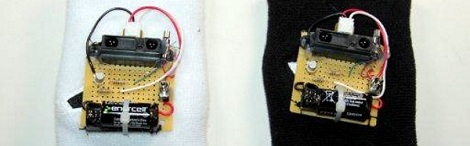
Even though she’s only in 8th grade, [Hannah Prutchi] is turning into a very respectable builder. She designed SharkVision, a wearable distance sensor that is meant to help the blind find objects they might bump into.

The SharkVision gets its name from shark’s ability to ‘see’ prey in their surroundings by sensing the local magnetic field. Instead of building her own Ampullae of Lorenzini, [Hannah] decided to take the easy route and use a few infrared sensors mounted to a bracelet. Whenever something is picked up by the proximity sensor, a voltage is applied to a pager motor telling the wearer they’re about to run into something.

[Hannah] and her classmates have successfully tested the SharkVision bracelet by walking around their classroom with eyes closed. They didn’t bump into anything, a fact [Hannah] attributes to neuroplasticity. We think it’s a neat build, but we’re wondering if this could be given to a population of blind people.


Monitoring Software Builds With A Traffic Light

[JD] at isotope11 was looking for a way to get instant feedback whenever a developer broke a piece of software they were working on. After finding a 48 inch tall traffic light, he knew what he had to do. Now, the entire development team knows the status of their code from a traffic light hanging in the corner.

isotope11 runs a continuous integration server to do the quality assurance on their software projects. It’s a lot more flexible than the ‘compile and pray’ setup we’re used to, but then again C isn’t very well suited to test-driven development. When one of [JD]’s developers breaks a piece of code, the CI server will send a warning to an Arduino where all the electronic magic happens.

To light the traffic light, [JD] used a few relays to drive the 120 volt bulbs in the traffic light. The traffic light is very easy to read – red means something is broken, green means everything is alright, and yellow means a test suite is being run.

Check out the video of [JD]’s TDD visualization after the break.

Continue reading “Monitoring Software Builds With A Traffic Light”

Hackaday Links: February 12, 2012

This is why digital picture frames were invented

[Petros] sent in this video of his visualization of Van Gogh’s Starry Night. He did this with openFrameworks and also made a version that reacts to sound. Is anyone else reminded of that one scene in Vincent and the Doctor?

A boat’s a boat, but a mystery box can be anything

[Rick] wanted to build a lock pick training station for the Eugene Maker Space, but he needed a way to make it interesting. What could be better than a mystery box? When you pick the deadbolt, open the box up and you’ll get a prize. Just make sure you put something of yours in the box for the next person.

3D printer prints its own case

Because the 3d printer community isn’t segmented enough, [Sublime] decided to design a new one. Here’s where it gets cool: the Tantillus can print its own case, and can ‘daisy chain’ to another Tantillus so only one set of electronics are needed. Interesting ideas afoot.

A diamond says I love you, but a duct tape rose says I’ll fix that for you

Valentine’s Day is coming up, so if you haven’t already made dinner reservations, you’re probably up the creek. How about making a duct tape rose for that special person in your life. Bonus: a dozen costs $3, and they won’t die in a week.

Using keypads over serial or SPI

[Leniwiec] sent in a tutorial on connecting keypads to a microcontroller with a serial or SPI interface. If you want to build a calculator, this is your chance. We’d use this for an Apollo Guidance Computer, though.

Get Tons Of MIDI Knobs And Buttons With The Chomp

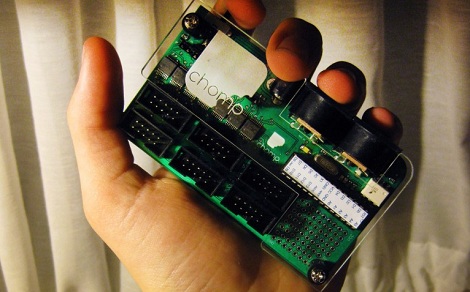
Although MIDI was originally designed for 1 MHz computers with 64 kB of RAM, it’s still an industry standard almost 30 years after its introduction. Even for electronic artists armed with a microcontroller, MIDI is old hat if you want to connect a few buttons up to a music workstation. What if you wanted to connect dozens of buttons and knobs to a bunch of MIDI hardware, though? Enter Chomp, the Configurable Hardware Open-source MIDI Platform.

[Max Justicz], an awesome pseudonym if we’ve ever heard one, built a MIDI controller that allows for 48 inputs for buttons, knobs, and any other electrical connection imaginable. The board is powered by an Arduino-fied ATMega328 and connects to your sensors through 2×5 ribbon cables.

If you’ve ever thought about building a monome MIDI controller, [Max Justicz] has started a Kickstarter campaign to put a few hundred Chomps out into the wild. It seems like a great way to build some controllers or simply to send stuff to MaxMSP. Either way, the Chomp is sure to be useful.

Plotting Pictures With Light

Flashing LEDs for a persistence of vision display are on bicycle wheels, alarm clocks, and even light painting sticks to draw images in the air. What if you wanted to plot an image in the air (translation) with a single LED? That’s what [acorv] did after taking a cue from a polar plotter.

Like the polar plotter and Drawbot, [acorv]’s build began with a pair of stepper motors and fishing line (translation). [acorv]’s brother upped the stakes a bit and suggested replacing the marker with an LED and taking long exposure photographs. Armed with a DSLR and a lot of patience, a few experimental pics were taken. To plot the image, the Lightbot flashes its LED as it goes across the plot area. The process of building an image pixel by pixel takes a while – eight minutes for this image – but the brothers were encouraged enough to take their rig outside.

After setting up the polar plotter between two tripods, [acorv] and his brother made this image in the dead of night. It’s an interesting spin on the POV LED builds we’ve seen before. Check out [acorv]’s Lightbot slowly drawing something after the break.

Continue reading “Plotting Pictures With Light”

ElectroDroid – Your Android Electronic Reference App

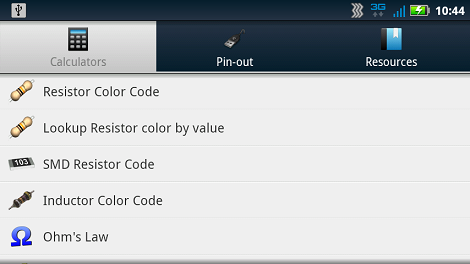
Earlier this week, fellow Hack a Day-er [Mike Nathan] reviewed Adafruit’s new iPhone/iPad app Circuit Playground. The comments on [Mike]’s review turned to suggesting ElectroDroid as an alternative to Circuit Playground. Surprisingly,  Hack a Day authors actually pay attention to the comments, so I’ve decided to throw my hat into the ring and offer up my review of ElectroDroid. For purposes of full disclosure, I have to add that I paid the $2.59 donation for a copy of ElectroDroid without ads, and have had no contact with the developers.

Continue reading “ElectroDroid – Your Android Electronic Reference App”

Playing Video Games For A College Application

As a senior in high school, [Owen] has been waiting to hear from the colleges he applied to for months now. Some of his applications wanted a mid-year report to see if he didn’t come down with senioritis. [Owen] realized these colleges allowed additional materials beyond a high school transcript, so he built a tiny video game that shows his electrical and programming skills.

The Demomite, as [Owen] calls his build, is an amazing piece of work. The entire system is based around an ATtiny2313 with a measly 2kB of program memory. Aside from a graphic LCD from Sparkfun and a repurposed NES controller, there isn’t much else to the build. As a study in minimalism and simplicity, [Owen] gets a big congrats from us.

The entire game fits in the 2kB of flash on the ATtiny, mostly due to coding the entire thing in assembly. You can check out [Owen]’s time-lapse construction video, software demo, and the video he sent to colleges after the break.

Continue reading “Playing Video Games For A College Application”