Self-tuning Piano Can Tune Itself, Can’t Tuna Fish

At Hack a Day, we don’t throw the term genius around lightly. We’re obligated to bestow that title on [Don Gilmore] for his amazingly simple self-tuning piano. To appreciate [Don]’s build, you need to realize that just because a piano has 88 keys, that doesn’t mean it has 88 strings. Treble notes have three strings per key while tenor and bass notes have one or two strings each. This usually comes out to more than 200 strings per piano, and [Don] can bring them all up to tune in under a minute.

[Don]’s system needs to perform two functions. The first one is sustaining the strings so the computer can ‘hear’ the strings. He does this with a magnetic sustainer that is a lot like an E-Bow. To bring the strings up to the right pitch, there are small heaters underneath the pin block. Running a little bit of current through these heaters allows [Don] to decrease the tension of each string and lower the pitch.

This tech reminds us of the Gibson Robot Guitar, a self-tuning guitar that does it’s trick with motors in the tuners. The Gibson didn’t do well on the sales floor, given that everybody and their mom can tune a guitar. Pianos, though, are another story. [Don] is looking for investors to bring his idea to market, and we hope to see it on the floor of a music shop sometime in the future.

Continue reading “Self-tuning Piano Can Tune Itself, Can’t Tuna Fish”
Printrbot Files In The Wild

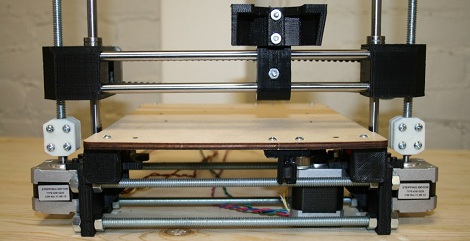
After a few months of eager waiting, [Brook Drumm] has finally released the files for his paradigm-shifting 3D printer, the Printrbot. If you didn’t order one of these during the Kickstarter, you can now print your own set of parts.

[Brook] gave his Printrbot to the world last November with the promise of being extremely cheap, extremely easy to build, and having a relatively high print quality. The simplicity of the Printrbot was amazing, which probably led to the Printrbot getting $830k worth of funding on the initial Kickstarter. Although the files for the 3D printed parts are out in the wild now, there still aren’t any instructions on how to build it apart from a Flickr slideshow.

[Brook] promised to release the files for the Printrbot much earlier, but we’re guessing he’s been busy printing and assembling  the 1200 Printrbots that were claimed in his Kickstarter. While we’re on the subject of cheap 3D printers, [Richard Sum], the English gent behind the SUMPOD sent in a link of one of his $600 printers milling MDF and extruding for seven hours straight. We’re on the cusp of Star Trek-style replicators here, people.

Build Your Own Self-driving Car

If you’ve ever wanted your own self-driving car, this is your chance. [Sebastian Thrun], co-lecturer (along with the great [Peter Norvig]) of the Stanford AI class is opening up a new class that will teach everyone who enrolls how to program a self-driving car in seven weeks.

The robotic car class is being taught alongside a CS 101 “intro to programming” course. If you don’t know the difference between an interpreter and a compiler, this is the class for you. You’ll learn how to make a search engine from scratch in seven weeks. The “Building a Search Engine” class is taught by [Thrun] and [David Evans], a professor from the University of Virginia. The driverless car course is taught solely by [Thrun], who helped win the 2005 DARPA Grand Challenge with his robot car.

In case you’re wondering if this is going to be another one-time deal like the online AI class, don’t worry. [Thrun] resigned as a tenured professor at Stanford to concentrate on teaching over the Internet. He’s still staying at Stanford as an associate professor but now he’s spending his time on his online university, Udacity. It looks like he might have his hands full with his new project; so far, classes on the theory of computation, operating systems, distributed systems, and computer security are all planned for 2012.

Converting Transparency Sheets To An LCD Monitor

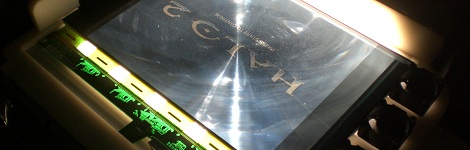
Apparently, there’s some sort of sporting event being televised this weekend that has been historically used as an excuse to buy a big-screen TV. [Joel] wanted a huge-screen TV on the cheap, so he converted an overhead projector to something he can use with his XBox.

Using a bare LCD panel with an overhead projector is a decades-old hack we’ve covered before. The basic idea is fairly simple, but we’ve never seen anything that could be considered a semi-permanent build. [Joel] started his project by picking up a surplus overhead projector for $25 and routing a cutting board to mount the LCD in. The bulb in the projector added a lot of heat, so three small fans are used to blow air between the projector glass and the LCD display.

[Joel] started off looking at the LumenLab DIY projector project, but considered that to be a terrible amount of work with a fairly high initial investment. If you don’t count the few LCDs [Joel] burned through while building his project, his projector was built for under $100. We’re loving the result and are sure it will be much appreciated at [Joel]’s LAN parties.

Using Routers As Displays

Have you ever seen an LED display made out of routers? [Sean] took eight Netgear routers and made an 8×4 display out of them. Because that wasn’t cool enough, a very small version of Conway’s Game of Life was added to the build.

Each router is running a copy of OpenWrt, a Linux distro meant for limited hardware. Instead of an 802.11 protocol, each router runs the B.A.T.M.A.N. advanced mesh protocol. This protocol allows each router to communicate with all the other routers.

Instead of each router receiving data from a master, the routers calculate each step in the Game of Life independently.  Once the routers communicate their initial states, each router is responsible for displaying its four LEDs for each new generation. In the video after the break, you can see [Sean]’s routers calculating random Game of Life boards. Sadly, we didn’t notice a GoL oscillator being randomly generated, but with a 4×8 play field even a Glider wouldn’t last very long.

Continue reading “Using Routers As Displays”

Measure Radiation With Military Surplus

It’s really amazing what you can find at military surplus shops. [David] just built a radiation detector out of a DT-590A scintillation probe originally made to test if Air Force bases were contaminated with Plutonium. Who says nothing good came out of massive nuclear arsenals?

DT-590A / PDR-56 Gamma ray probes were made obsolete by the US Air Force a few years ago and they’re trickling into military surplus stores around the country and the Internet. [David] found the manual for this probe and put together a little circuit to drive this x-ray sensor. The build uses an ammeter as a simple dial, and includes a piezo speaker for the prerequisite Geiger counter ‘clicks.’

[David] also threw up a post on converting this x-ray probe into a general purpose Gamma probe, effectively making it a Geiger counter for the really dangerous radiation. You could always use your smart phone for the same task, but recycling military hardware imparts a good bit of geek cred.

Kinect For Windows Released

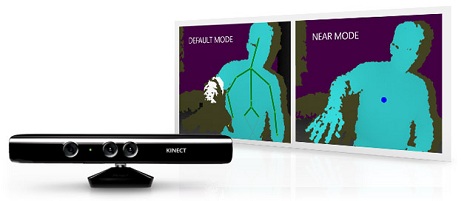
Even though we’ve seen dozens of Kinect hacks over the years, there are a few problems with the Kinect hardware itself. The range of the Kinect sensor starts at three feet, a fact not conducive to 3D scanner builds. Also, it’s not possible to connect more than one Kinect to a single computer – something that would lead to builds we can barely imagine right now.

Fear not, because Microsoft just released the Kinect for Windows. Basically, it’s designed expressly for hacking. The Kinect for Windows can reliably ‘see’ objects 40 cm (16 in) away, and supports up to four Kinects connected to the same computer.

Microsoft set the price of Kinect for Windows at $250. This is a deal breaker for us – a new Kinect for XBox sells for around half that. If you’re able to convince Microsoft you’re a student, the price of the Kinect for Windows comes down to $150. That’s not too shabby if you compare the price to that of a new XBox Kinect.

We expect most of the builders out there have already picked up a Kinect or two from their local Craigslist or Gamestop. If you haven’t (and have the all-important educational discount), this might be the one to buy.