DIY Signal Generator Probe

A signal generator is a handy bit of kit and with the right components, it’s pretty easy to build one. Fabricating a proper signal generator probe is another matter entirely. [Frank]’s DIY signal generator probe does exactly what it claims to, and is very cheap to boot.

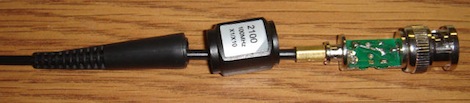
After [Frank] made a simple signal generator with a few parts he had lying around, he needed a probe. Not wanting to deal with poking loose wires around his circuits, he decided to modify a scope probe. Six dollars and two weeks later, [Frank] had a suitable scope probe on his doorstop shipped from halfway around the world.

The strain relief on the probe was removed, and the resistors and trim cap on the PCB was desoldered. All that was left to do was solder a piece of wire from the BNC jack to the probe lead. The strain relief was put back on and clearly labeled for use as a signal generator probe. Not bad for 10 minutes of work.

Resurrecting An XT

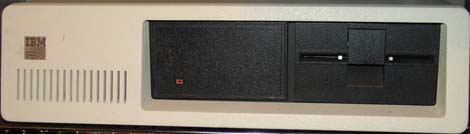
The best laid plans of mice and men oft go awry. At least that’s what we’d tell ourselves if we couldn’t find a 30-year-old computer monitor. [Andrew] picked up an old IBM XT on eBay recently and tried to get the video working. He hasn’t seen any success yet, but the way he goes about solving this problem is very clever.

[Andrew] was stuck with a cool old computer with no way to output anything onto a screen. The XT had an MDA port but neither his TV nor his VGA monitor would accept MDA frequencies. As a workaround, [Andrew] connected an Arduino to the XT keyboard port. On the factory floor, IBM workers used the XT keyboard to load code onto the machines while POSTing. He was able to change the frequency of the MDA CRT controller to CGA frequencies, and with the help of some small components got some video working.

The Hsync and Vsync are still off, and [Andrew] hasn’t been able to get the machine to finish POSTing, but he figures he can use the XT keyboard port for bidirectional communication. He’s written a very small kernel to test out a few things, but unfortunately the XT’s power supply died recently. Once [Andrew] replaces that, we’re sure he’ll get his box up and running.

Sustainability Hacks: Bio-diesel Motorcycle Speed Record

Sometimes you don’t need a lot of horsepower to win a speed record. In a fluke of no one else competing in the alt fuel class,  [John]’s biodiesel motorcycle set a new land speed record at the LTA event last summer.

[John]’s bike is a junkyard 1978 Kawasaki KZ400. The stock engine was replaced with a Chinese knock off of a Yanmar air-cooled diesel motor. The fuel is regular old vegetable oil. From the looks of the exhaust, we’re assuming [John]’s garage has a rich french fry smell to it.

Compared to highway speeds, [John]’s runs for a land speed record are a little absurd – a nice bonus when you’re the only driver in your class. The first pass of 42 mph was a little disappointing, so [John] removed the fender, tail light and brakes. After all the unnecessary weight was removed, the top speed – and new record – was 56.5 mph.

Converting a diesel car to run on french fry oil is great and a lot better for the environment than burning liquefied dinosaurs. In any event, a green motorcycle is a lot better than 2000 pounds of automobile moving less than 200 pounds of person. Check out a few of [John]’s land speed runs after the break.

Continue reading “Sustainability Hacks: Bio-diesel Motorcycle Speed Record”

Page-turning Book Scanner Roundup

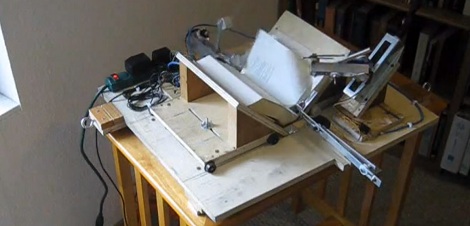
[Daniel] at diybookscanner.org posted a roundup of the best automatic book scanner builds to date. A lot of the comments on our last coverage of book scanners were summed up by [Spork] with, “No automatic page turning = no use.” Turning a page in a book with a robot is really hard, though, and these builds do a really amazing job at automating very tedious work.

First up is [jck57]’s servo actuated auto scanner. From the video, this build is very good and we caught it skipping only one page. Check out the video in action and the overview.

Next up is the Berlin Hackerspace c-base’s vacuum box scanner. The video shows a large diamond-shaped box with a vacuum cleaner hose attached to the top. The box is pressed down into the binding of the book where the vacuum picks up the next page. The build is a manual version of this very expensive machine, but does have the bonus of not poking a centuries-old book with robotic manipulators.

[dtic] was one of the first people to look into automatic page turning. His prototype (video here) uses servos, but has a very simple construction. The downside is that the book can only scan one side of the book at a time; to get other side, the user would have to turn the book upside down and scan it again.

Project Gado was an unsuccessful Kickstarter campaign whose goal was to develop a scanner to archive photos at Johns Hopkins University. The build used a vacuum-powered suction cup to lift pages onto a flatbed scanner. It’s a lot slower than some of the other builds, but we think there would be less of a risk of skipping a page.

As for processing the images captured by a digital camera, [Steve]’s book scan wizard handles a lot of the necessary post processing tasks. Converting everything to a PDF, changing the DPI, and putting all the pages in order can be done with [Steve]’s app. Download here.

Turning a page of a book is a very hard problem – books are designed for hands, not grippers. If you’ve got a book scanner build you’d like to show off, send it in on the tip line. We’ll be sure to put it up.

Sustainability Hacks: Thin Client Server

It’s not environmentally friendly, but most of us run a small home server 24 hours a day. A small server is a useful tool to have that unfortunately wastes a lot of energy. [kekszumquadrat]’s thin client home server is actually a passable LAMP box that doesn’t draw a ton of power.

[kekszumquadrat] started looking at the SheevaPlug when beginning his quest but was a little concerned about the power supply failing. Looking for alternatives, he ran across a lot of cheap thin clients on eBay. The price was right and everything runs Linux, so a few days later he had an HP t5710 thin client on his doorstep.

This little computer came a copy of an embedded version of XP on a flash drive connected to the IDE port. Ditching that “operating system”, [kekszumquadrat] connected a USB hard drive and installed Arch Linux. After a few updates and package installations, he had a useful machine connected to the Internet.

Compared to the 7 Watts the SheevaPlug draws, the 15 W thin client is an energy hog. Compared to our improvised servers, [kekszumquadrat] is doing a remarkable job. Recycling old hardware never hurt anyone, either.

Spamming A Label Printer With #cookiehammer

[John] has always loved stock ticker machines. These machines are highly collectible, so short of finding one that wasn’t hurled from a Manhattan skyscraper in 1929, a stock ticker is out of reach for the casual enthusiast. There is another way to get a stock ticker-like device though: hack a label printer to print out stuff from Twitter.

The build is really quite simple. A Dymo thermal label printer was modified to accept standard 2.25″ point of sale receipt paper. Now that the printer can shoot out line after line of text, [John] wrote a little bit of Ruby code using a Twitter API, RMagick for graphics processing and a Dymo printer driver.

Every 30 seconds, the code does a Twitter search for a specific hashtag and prints those tweets. #cookiehammer was the first thing that came to mind, so it stuck. Right now there’s a few tweets for #cookiehammer, but we expect [John] will have to put a new roll of paper in his printer fairly soon.

It may not be as informative as a stock ticker machine, but we think [John]’s twitter printer build sure beats watching CNN. Check out the walk through after the break.

Continue reading “Spamming A Label Printer With #cookiehammer”

Recreating The First PC

If you’re looking for a simple Ardunio project, why not replicate the first personal computer?

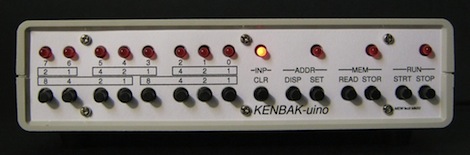
After discovering the Arduino, [Mark] realized recreating really old computers would be a fun project. An Altair 8800 was on the table, but the sheer number of blinkenlights, switches and the Intel 8080 CPU made that a fairly difficult project. After a bit of searching, [Mark] discovered the Kenbak-1, widely regarded as the first personal computer. The Kenbak also had the added bonus of having a very minimal I/O compliment and was built entirely with TTL components.

Since the Kenbak-1 is an extremely simple computer, [Mark]’s build ended up being fairly minimal. The schematic is only an ATmega328, a few shift registers and a real-time clock for a few added features the OG computer didn’t have. The completed build is programmed by pushing buttons to enter machine code into the mega’s RAM and then executed. [Mark] has a few programs already figured out – a program that counts in binary, a ‘Cylon eye’ and a BCD and binary clock. While the Kenbak-uno doesn’t have the awesome vintage case of the original, it’s still a remarkable build.

Check out the videos after the break for a walk through.

Continue reading “Recreating The First PC”