VGA Out On A Maple Board

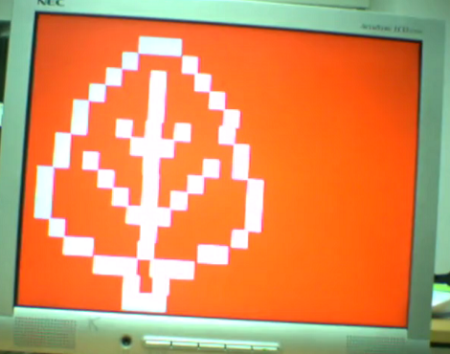
The team at Leaf Labs just released a new library to demonstrate the VGA capabilities of their Maple dev board. Although it’s only a 16 by 18 pixel image, it shows a lot of development over past video implementations on the Maple.

The Maple is a great little Ardunio-compatible board with a strangely familiar IDE. We’ve covered the Maple before. Instead of the somewhat limited AVR, the Maple uses an ARM running at 72MHz, making applications requiring some horsepower or strict timing a lot easier.

We’ve seen a few projects use the increased power, like a guitar effects shield. It’s possible the Maple could be made into a game console that would blow the Uzebox out of the water, but we’re wondering what hackaday readers would use this dev board for.

Watch the video after the jump to see how far the Maple’s VGA capability has come after only a few months, or check out Leaf Lab’s Maple libraries.
Continue reading “VGA Out On A Maple Board”

Snap-together PCB Mill

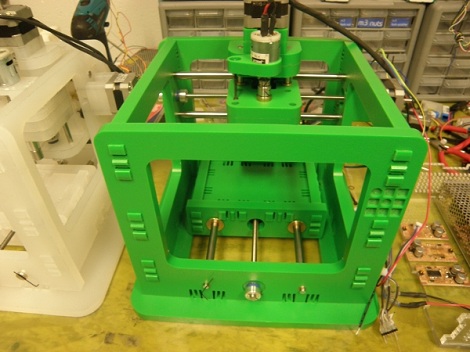
[Jonathan Ward] came up with the MTM Snap, a snap-together pcb mill as part of the Machines That Make group at MIT.

We covered [Jonathan]‘s previous work made out of half-inch plywood, but the new iteration of his PCB includes a clever snap-together mechanism instead of screws and bolts. Although the MTM Snap looks a lot like3d printers such as a reprap, the similarities end with the off-the-shelf stepper motors. Instead of using motor drivers and control electronics from a reprap, the project uses custom stepper drivers, controlled by a bare Arduino.

We’re really impressed with the results of the MTM Snap compared with what is possible on a reprap-derived milling machine like a makerbot or wolfstrap. We’re thinking that’s due to the mass of this project compared to the printed ABS parts of the ‘common’ 3d printers, but any MEs are more than happy to correct that notion.

Check out the video after the break to see the machine in action and a great view of the snap-fit mechanism.

Continue reading “Snap-together PCB Mill”

Hidden Device Distorts News On Wireless Networks, Brews Beer, Is Time Machine

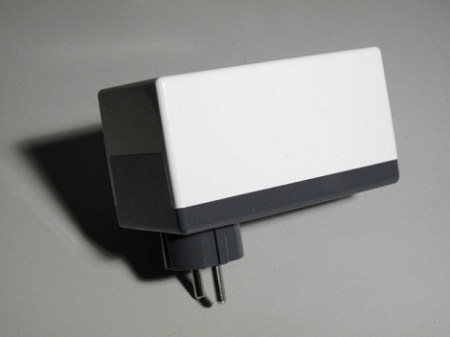
We covered the Newstweek, a wall-wart sized box that injects fake news stories over public WiFi connections last February, but now there’s a great walk through and it seems our doubts about this project were disproved.

The Newstweek uses ARP spoofing to change the text displayed on several news sites. After doing some field research, placing and configuring the device, there’s a simple web frontend that configures the man-in-the-middle hack. Right now, the Newstweek only allows a few news sites to be targeted, but the team is working on allowing anyone to add their own targets.

Aside from the relatively simple build, we’re wondering about the social engineering aspects of the Newstweek. In our previous coverage of the Newstweek, we couldn’t decide if this was a social commentary art project, or a real device. It looks like it’s both now. Would hackaday readers succumb to injecting, “President Bacon addressed the nation last night…” or would you do the responsible thing and put the “(D)s” and “(R)s” in their proper places?

The Newstweek team posted a video of a short demonstration, but check out the video after the break for the “incredibly geeky and thorough demo.”

Continue reading “Hidden Device Distorts News On Wireless Networks, Brews Beer, Is Time Machine”

64-bit OS Written Entirely In Assembly

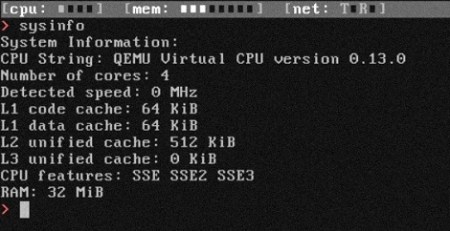
The folks at Return Infinity just released a new version of their BareMetal OS, a 64-bit operating system written entirely in assembly.

The goal of the BareMetal project, which includes a stripped-down bootloader and a cluster computing platform is to get away from the inefficient obfuscated machine code generated by higher level languages like C/C++ and Java. By writing the OS in assembly, runtime speeds are increased, and there’s very little overhead for when every clock cycle counts.

Return Infinity says the ideal application is for high performance and embedded computing. We can see why this would be great for really fast embedded computing – there are system calls for networking, sound, disk access, and everything else a project might need. There’s also ridiculously small system requirements – the entire OS is only 16384 bytes – lend itself to very small, very powerful computers.

With projects that are computationally intensive, we think this could be a great bridge between an insufficient AVR, PIC or Propeller and a full-blown linux distro. There’s just some questions about the implementation – we feel like we’ve just been given a tool we don’t even know when to use. Any hackaday readers have an idea on how to use an OS stripped down to the ‘bare metal?’ What, exactly, would need 64 bits, and what hardware would it run on?

Check out the Return Infinity team calculating prime numbers on their BareMetal Node OS after the jump.

Continue reading “64-bit OS Written Entirely In Assembly”

Tracking Eye Movement By Measuring Electrons In The Eye

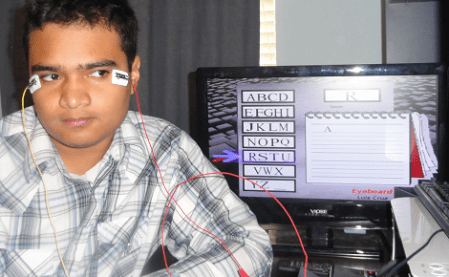
[Luis Cruz] is a Honduran High School student, and he built an amazing electrooculography system, and the writeup (PDF warning) of the project is one of the best we’ve seen.

[Luis] goes through the theory of the electrooculogram – the human eye is polarized from front to back because of a negative charge in the nerve endings in the retina. Because of this minute difference in charge, a user’s gaze can be tracked by electrodes attached to the skin around the eye. After connecting eye electrodes to opamps and a microcontroller, [Luis] imported the data with a Python script and wrote an “eyeboard” application to enable text input using only eye movement. The original goal of the project was to build an interface for severely disabled people, but [Luis] sees applications for sleep research and gathering marketing data.

We covered [Luis]’ homebrew 8-bit console last year, and he’s now controlling his Pong clone with his eye-tracking device. We’re reminded of a similar system developed by Atari, but [Luis]’ system uses a method that won’t give the user a headache after 15 minutes.

Check out [Luis] going through the capabilities of his interface after the break. Continue reading “Tracking Eye Movement By Measuring Electrons In The Eye”

Hacked Phone Runs Zork, Gets Lamp

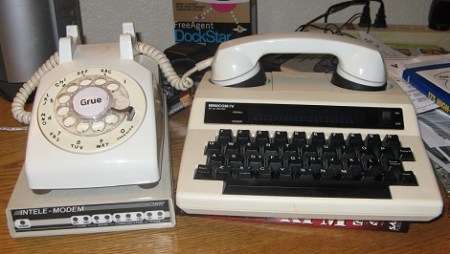
A few months ago, [Ulysses] had a project in mind that would run Zork on a TDD. Although it was a bit of a struggle getting the project ready in time for the Bay Area Maker’s Faire, the accompanying build blog tells us it was more than worth the effort.

After hooking up the guts of the phone to an Arduino Pro, A modem was modified so the acoustically coupled TDD could be interfaced. Although the TDD display is only one line, [Ulysses] is transmitting the text at only 45.5 baud, So even the slowest reader could keep up with the story. For running the actual code, initial attempts at using an Arduino Pro, and then Arduino Mega proved unsuccessful because of the limitations of sram in these AVRs. After discarding the idea of running Zork on an Arduino, the project was finished with a single board FitPC computer mounted inside the phone.

The code of the project runs Zork on a port of the Infocom Z-code Interpreter Program, or ZIP. A lot of interactive text adventures were put out in the Z-code format, so we’re guessing it would be trivial to have this project run Leather Goddesses of Phobos, or the amazing Hitchhiker’s Guide to the Galaxy. It’s a very nice project, and we could easily see ourselves sitting down with this project, a two liter bottle of Shasta, and an all-Rush mix tape on a Saturday night.

Shoehorning RS-232 Into A Minitel Terminal

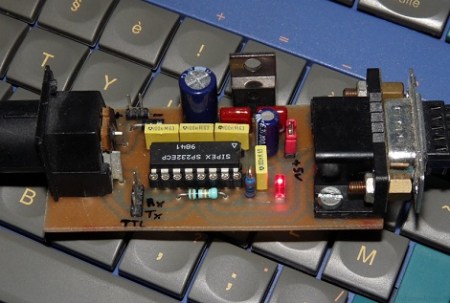
In the early 80s, millions of terminals were handed out to French telephone subscribers. Nearly 9 million of these Minitel dumb terminals were in use at one time, and with that degree of ubiquity, we’re surprised we haven’t heard of them before. These boxes were usually connected to the outside world through their internal 1200bps modem, but [O. Blt] came up with this build (Google Translate link) so he could connect to a local machine with an RS-232 port.

After digging up the pinout for the Minitel’s DIN-8 port, [O. Blt] designed a little board around a MAX232 chip scavenged from an old motherboard. Of course there was a need to get the terminal to do something, so [O. Blt] used the Minitel as a display and remote control for Winamp. The project was successful, but not very useful – at 1200 bps, the refresh is very, very slow.

American readers may remember connecting to the Minitel network with their Apple ][s and C64s with CommunityLink, but this service was driven out of the market by the giants of pre-web dial-up, Prodigy and Compuserve. In any case, after seeing the AZERTY and alphabetic keyboard layouts of these old boxes gives us a feeling of nostalgia for a time before everything dealing with computers was standardized.