Turning A Router Into An APRS Gateway

[Chris Kantarjiev] is an amateur radio enthusiast (call sign K6DBG) and does a lot with the APRS. We think his build, turning a WRT54gl router into an APRS gateway will be very useful for the APRS tracker builds we’ve been covering.

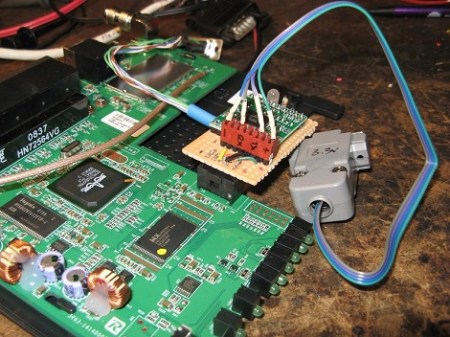
Setting up an Internet Gateway, or igate, on APRS usually requires a ‘real’ computer. [Chris] didn’t like that idea, so he took aprs4r, igate software for embedded devices, and pruned it down to fit on the 4MB of flash and 16MB of RAM in the WRT.

The actual APRS hardware is connected though headers soldered onto the WRT54gl’s board which go to a small PIC-Based TNC. [Chris] argues that the APRS ‘backbone’ is great, but there aren’t enough nodes on the network for full coverage. We thing this would be a great way to put cheap hardware out in the wild to cover those gaps in the APRS network.

Check out the video for a rundown of the modded WRT54g after the break. If you’re interested amateur radio, Field Day is coming up in just 2 weeks. Find a local club and check out what’s possible with amateur radio.
Continue reading “Turning A Router Into An APRS Gateway”

IOIO Now Supports Android Open Accessory

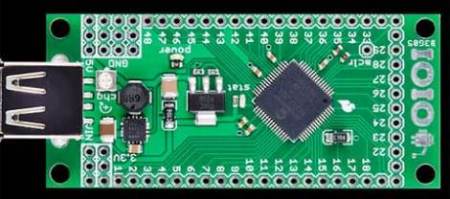
After the announcement of the Android Open Accessory ADK, [Ytai] decided he should get the the ADK running on the IOIO Android breakout board.

The first batch of Android ADK boards sold for about $400. While that price has come down considerably, the IOIO is still cheaper and smaller. [Ytai] put the source and all the technical info on his wiki.

Interestingly, this beta build is a little more capable than the Google offering. The IOIO supports the Android Debug Bridge, so it’s able to work with any Android device made since the beginning of time. The IOIO will try to communicate with the device using the Open Accessory standard because of the much better throughput and latency, but will seamlessly fall back to ADB if the device doesn’t support Open Accessory. Open Accessory boards are only comparable with devices running Android 2.3.4 and higher, so it looks like we’ve got a standard breakout board for the $99 Android tablets that fly off the shelves during Christmas.

[Ytai] has gotten a few of his projects on Hack a Day, like his PICMAN prototyping setup and his awesome 2 foot POV globe, so we’re happy to see this very skilled builder finally get his Hack a Day hat trick and enters the ranks of giants like [Sprite_tm]. If you’ve got a great build, send it in and you might be able to join the pantheon of great builders.

Capturing Video With An Arduino

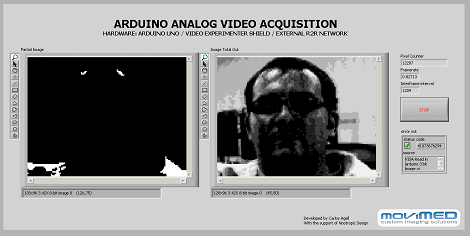
[Carlos Agell] sent in a tip where he captured images from an analog camera with an Arduino.

We’ve seen a few AVR/Arduino hacks that generate video, although overclocking is necessary if you want to do anything beyond a Breakout clone. [Carlos]’ hack bucks that trend and now he can capture video with an Arduino.

The project captures individual frames from NTSC video at a resolution of 128×96. Although the Arduino isn’t powerful enough for real-time capture, [Carlos] managed this by capturing only thresholds and sending them over to a computer running a program coded in LabVIEW. The PC program reassembles the images of the thresholds and produces a tiny image in 3-bit grayscale.

[Carlos] used the Video Experimenter shield which is impressive in it’s own right. The Video Experimenter is able to do object tracking and edge detection, so we’re wondering when we’ll see robots with computer vision running off an Arduino. Check out a demo of the nootropic design video experimenter shield after the break.

UPDATE: Carlos wrote a sketch in Processing that does the same thing as his LabVIEW program.

Continue reading “Capturing Video With An Arduino”

Apple ][ Converted Into USB Keyboard

Sometimes it’s apparent that there is no practical use for something featured on Hack a Day, but we don’t know if [Andrew Filer]’s Apple ][ USB keyboard qualifies for this.

After reading through the very thorough documentation available in electronic and dead tree formats, [Andrew] decided that Apple ][ would make a great USB keyboard. Unlike modern keyboards, vintage computers like the TRS-80, Commodore 64, and the Apple ][ return the 7-bit ASCII value of the key instead of a scan code. The ASCII codes generated by the keyboard were sent through a Teensyduino running [Andrew]’s keyduino sketch.

Modern PS/2 keyboards use MAKE and BREAK scan codes sent from a microcontroller that reads the keyboard matrix. For example the MAKE code for the letter ‘A’ is 1C, while the BREAK code is F0 1C. There is a reason for this design, but for the DIYer, interfacing a keyboard becomes a challenge without a separate microcontroller. We’re thinking [Andrew]’s keyduino could be a great way to put a keyboard in a project, but we’re not about to tear up our Apples and C64s to get a keyboard.

RFID Record Player

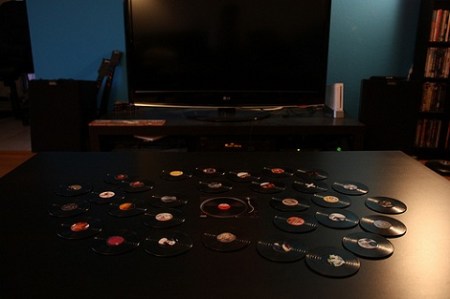
Like most of us at Hack a Day, [Bertrand Fan] has a huge collection of digital music that was all obtained through legal channels. Missing the physical process of choosing and playing an album, [Bertrand] built an RFID record player to get rid of the paradox of choice that arises when thousands of albums are at your fingertips.

The records are repurposed Christmas ornaments with RFID disk tags pasted under the label. These records are read by a RedBee RFID reader and sent to a Popcorn Hour media server, but we’re guessing this could be easily adapted to any HTPC.

The only limitation we see is the fact that the RFID chip is hard coded to individual songs. We think it would be easier to have the RFID chip store an album’s CDDB discid, but feel free to leave a comment and say how you would catalog thousands of albums on RFID tags.

We’re a little tired of skipping though our music collection like a portable CD player from 1990, so we’re pretty impressed that [Bertrand] came up with something that would get us to sit down and listen to our Terabytes of FLAC-encoded music. Check out the video after the jump for a demo of the RFID record player.

Continue reading “RFID Record Player”

DIY Digital Bench Power Supply

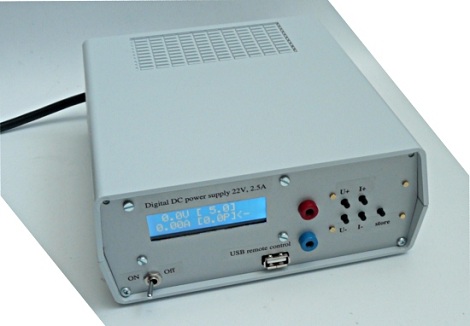
[Guido Socher] built himself a great little bench power supply that’s able to put out 30 Volts at 2 Amps.

Instead of taking the easy way out by putting a few taps on an ATX power supply, this project was built around a generic 24 Volt laptop power brick. An ATmega8 generates a PWM signal that is sent though a low-pass filter, allowing everything to be very precisely controlled. This DC signal is then sent through a BD245 power transistor to bring everything up to the desired output. [Guido Socher] included a USB port for computer control of everything, and the final project is something we’d be happy to have on our bench.

We’ve seen a few computer power supplies converted into a bench power source, but we’re impressed with [Guido Socher]’s build log. It’s not often we see a hack that goes over the theory of operation, and the end product is very nice (and functional) too.

Portable SID Plays Chiptunes

[Markus] on the DangerousPrototypes forum came up with a great little SID player.

The SID was (is?) the awesome sound generation chip inside the Commodore 64, and along with Game Boys and NESs laid the foundation for the chiptune scene. We’re happy to finally see a small SID player that doesn’t resort to SID emulation or a relatively huge MIDIbox.

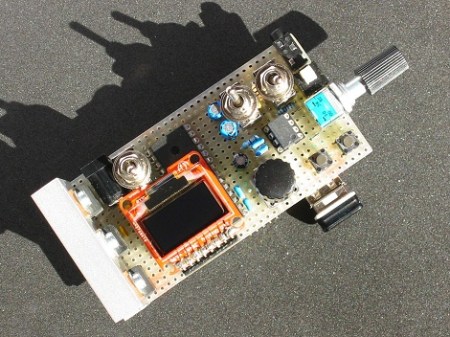
The SID player itself is a shield on a CUI32 PIC dev board. The PIC32 emulates the 6510 and 6526 CPU and CIA chips found in the Commodore 64. A small USB memory stick stores the High Voltage SID Collection and the file system is navigated with an OLED screen. [Markus] says that the player draws 370 mA, so he runs it off a small wall wart. Still, we’re wondering if it’s possible to run this off of an SD card with a SwinSID so power draw can be reduced and a fully portable SID player can be realized.

We’ve got a touch of nostalgia for chiptune and demoscene music right now, so we’re going to listen to some [Nelly Furtado] [Janne Suni] right now, but you can check out the video demo [Markus] posted after the break.
Continue reading “Portable SID Plays Chiptunes”