Official Android Open Accessory Development Kit – It’s An Arduino

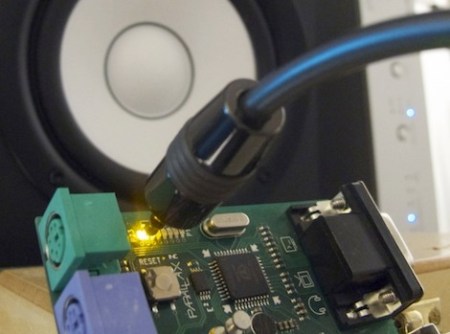
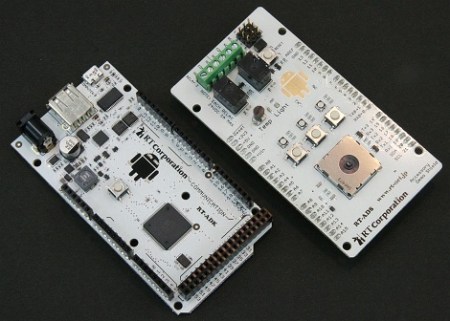
A new development kit for android was unveiled at the Google I/O 2011 developer conference that officially supports the Arduino.

It looks like Google took a cue from Circuits@Home, because the interesting part of this dev kit is the fact that the shield can be put into USB Host mode. That’s great for phones and tablets that can’t act as a USB host themselves. Google will also release the APIs for this Android/Arduino mashup for 3.1, but it will thankfully be backported to Gingerbread.

We covered the IOIO breakout board for Android last month, but the Google board will be based off of the Arduino Mega 2560, a far more capable device. Interestingly, it appears this board is available now for about $400 USD. We’re not so sure a hobbyist will be buying it at that price.

While this board doesn’t do anything you couldn’t do before with a bluetooth shield, it’s great to see a company supporting all the builders out there.
Synkie: The Modular Synth For Video

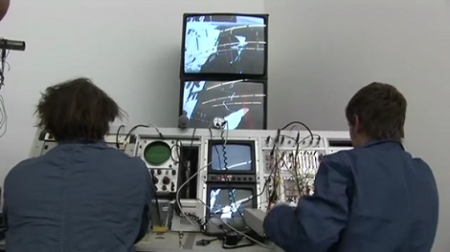
The folks at [anyma] have been working on an analog video processor called Synkie for a while now, and we’re amazed a project this awesome has passed us by for so long.

Like a Moog or Doepfer synth, the Synkie was developed with modularity in mind. So far, [anyma] has built modules to split and combine the sync and video signals, and modules to invert, add, subtract, mix, filter and amplify those signals. The end result of all this video processing produces an output that can look like a glitched Atari, art installation, and scrambled cable station all at the same time.

The Synkie’s output reminds us of the original Doctor Who title sequence, and actually this idea isn’t far off the mark – both use video feedback that will produce anything from a phantasmagoric ‘flying through space’ aesthetic to a fractal Droste effect visualization. We’re impressed with Synkie’s capabilities, but we’re astounded by the [anyma] crew’s ability to control a video signal in real time to get what they want.

Check out a video of the Synkie after the jump. There’s also more footage of the Synkie in action on the Synkie Vimeo channel.

Continue reading “Synkie: The Modular Synth For Video”

Rebecca Black Running Accessory Also Promotes Running For Everyone Within Earshot

Last Friday, Friday we caught wind of [gvillenave]’s running accessory inspired by Rebecca Black, and we we we so excited, we so excited to bring this to you on Saturday, which comes after Friday.

[gvillenave] came up with the idea of using a song on the annoyance level of “Friday” to encourage a runner into keeping up a good pace. The concept is simple: if the wearer is running fast, the song will speed up. If the wearer is slowing down, the song will slow down and extend the agony.

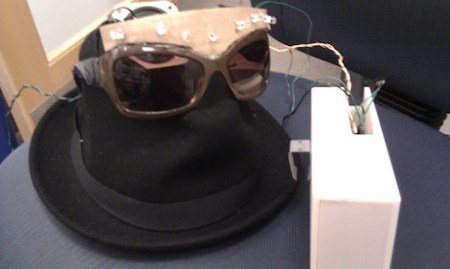
The build uses an Arduino and [ladyada]’s wave shield coupled to an accelerometer. [gvillenave] included the code, and also wired up some LEDs to a pair of sunglasses that blink more often as the runner’s speed increases. The wave shield has a 3.5mm jack for headphones, but [gvillenave] graciously wired a speaker in, “so that you can annoy people around you, and not just yourself.” All this is packaged in a very nice 3D printed enclosure making for a great looking project.

There’s no word on the effectiveness of the negative reinforcement aspect of [gvillenave]’s build, but we suspect it will help her get down to the bus stop a little faster every morning.

Digital Audio On The Parallax Propeller

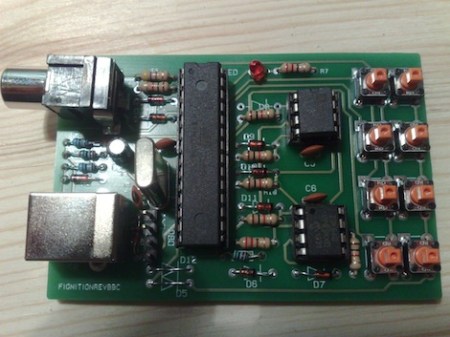
[Beth] had the idea for transmitting digital audio over S/PDIF on a Propeller a few years ago, but only just got around to a writeup. For that, we thank her.

The writeup has a marvelous walkthrough of the S/PDIF protocol and the problems associated with with generating the signal. S/PDIF is a relatively resource-intensive protocol – the signal is clocked at 64x the audio sample rate. That signal is doubled for biphase mark code, keeping everything in sync. [Beth] says the microcontroller would neet at least 24 MIPS of processing power just to generate the S/PDIF signal – processing audio would be another task altogether. Because of the processing power needed, and the weird clock rates needed, [Beth] decided to go with the Propeller. The implementation uses only one core of the Propeller, leaving another seven cores available for sound synthesis or even a visualization over VGA.

[Beth] admits this could be done with just about any microcontroller (although it would need to be clocked at a multiple of 4.096 MHz for a 32kHz audio stream), but we really appreciate the work that went into bit-banging this signal.

Video of [Nick] at Gadget Gangster playing around with digital audio on a Propeller after the break.

Continue reading “Digital Audio On The Parallax Propeller”

BBC Covers An Old-school Hacker

Yesterday, the BBC posted an article on [Julian Skidmore]’s AVR-based homebrew computer.

[Julian]’s project uses an AVR and a derivative of Forth to recreate the capabilities of the 8-bit computers of yesteryear. With 8kB of RAM, [Julian] got a TV-out up and running, and even included code for a Lunar Lander game.

We’re happy for [Julian] getting some notoriety as an old-school solder monkey, but we’re wondering why the BBC is covering a project not unlike the something that could be seen on hackaday once a week. Could it be the first inkling of respect for the hacker and DIY community in the general public’s eye?

In any event, we love the initiative shown in [Julian]’s quote at the bottom of the BBC article: “Building the machine is a way to learn the essentials of what a computer is all about.” If you want to understand something, you’ve got to build it yourself. Truer words…

DIY Lightbox Repurposes Useless Scanner

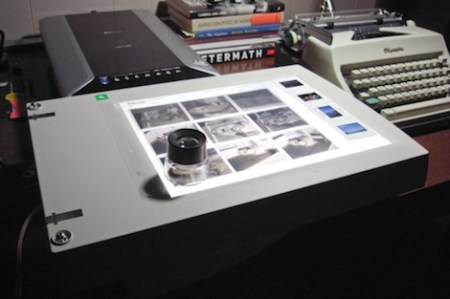
[James] didn’t like losing detail when scanning in photographic negatives, so he repurposed an old scanner and turned it into a lightbox.

The Flickr set of the build shows [James] installing a compact fluorescent bulb in the body of the scanner. Aluminum foil reflects the light, and the scanner glass is painted white for diffusion. [James] is quite happy with the result, and is amazed by the detail seen in the negatives under magnification instead of scanning.

We’re trying to figure out [James]’s though process in deciding to build a light box, and the best we can come up with is the hackaday mantra of, “Of course I can do that myself.” Even though he seems happy with his project, we’re wondering how hackaday readers would improve it. Maybe several dozen red, green, and blue LEDs to adjust the color temperature? Post your ideas in the comments.

Beat707 Takes It’s Cue From A Vintage Drum Machine

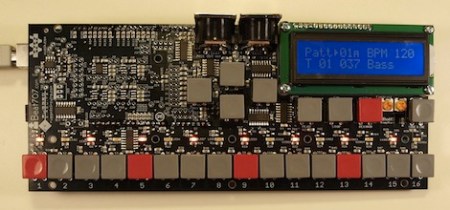
We always like musical hacks at hackaday, so we were pleased to see the team at [Beat707] come out with their Beat707 MIDI groove box.

The Beat707 takes it’s inspiration from the venerable Roland TR-707. Like the Roland, the Beat707 can save songs and has MIDI In and Out. Unlike the TR-707, the Beat707 doesn’t have an audio out – it’s purely MIDI based. Don’t think of that as a drawback, though. Just connect the Beat707 to your favorite softsynth and start jamming out.

The Roland TR-707 was heavily used by acts like the Chemical Brothers, Aphex Twin, and the Cocteau Twins. Because of this history, the popularity of the TR-707 has exploded over the past few years, and getting a hold of a real TR-707 has been an expensive proposition. While rebuilds of vintage synths like [Ladyada]’s TB-303 clone, the x0xb0x have been around for a while, we’re pleased that more projects are paying their dues to the great music machines of the 1980s.  Do any hackaday readers want to tackle an 808 or 909 for their next project?

Video of the Beat707 after the break.

Continue reading “Beat707 Takes It’s Cue From A Vintage Drum Machine”