Canon Temporarily Abandons Smart Ink Cartridges

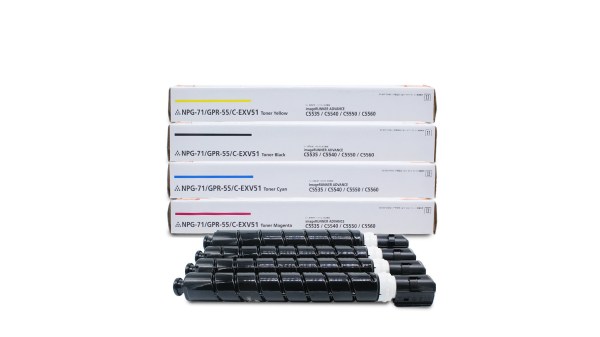
An unexpected side effect of the global semiconductor shortage came to light this week — Japanese printer manufacturer Canon announced they are temporarily going to provide consumable ink and toner cartridges without microchips. Furthermore, they provided instructions for consumers on how to bypass the printer’s logic, allowing it to function even when it incorrectly thinks the ink or toner is low. Included in the announcement (German), the company stated what most people already knew:

There is no negative impact on print quality when using consumables without electronic components.

It’s well known that many printer companies make their profit on the consumable cartridges rather than the printers themselves. And most printers require consumers to only use factory original cartridges, a policy enforced by embedded security ICs. Use a third-party ink cartridge and your printer will likely refuse to print. There are legitimate concerns about poor quality inks damaging the print heads. But with reports like this 2003 one from the BBC noting that 17% to 38% additional good quality pages can be printed after the consumable is declared “empty”, and that the price per milliliter of inks is seven times the cost of vintage champagne, one can reasonably conclude that these DRM-protected consumables are more about on ensuring profits than protecting the hardware.

For now, this announcement applies to German customers, and covers the Canon imageRunner family of multi-function printers (the complete list is in the company announcement above).
Reusable Booster Rockets, Asian Roundup

The Space Shuttle’s solid rocket boosters were reusable, although ultimately the overall system didn’t prove cheaper than expendable launches. But given the successes of the Falcon 9 program — booster B1051 completed its 11th mission last month — the idea of a rocket stage returning to the launch site and being reused isn’t such a crazy proposition anymore. It’s not surprising that other space agencies around the world are pursuing this technology.

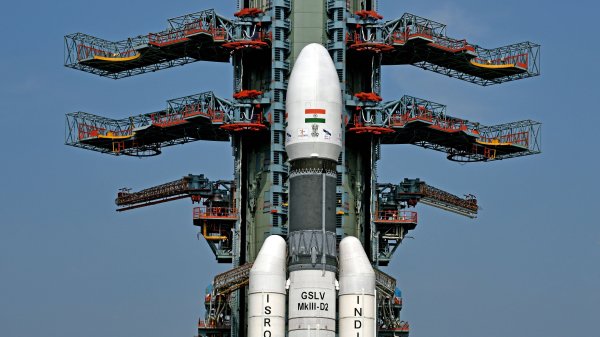
Last year the India Space Research Organization (ISRO) announced plans for a reusable launcher program based on their GSLV Mark III rocket. The Japan Aerospace Exploratory Agency (JAXA) announced last Fall that it is beginning a reusable rocket project, in cooperation with various industries and universities in Japan. The South Korean space agency, Korea Aerospace Research Institute (KARI), was surprised in November when lawmakers announced a reusable rocket program that wasn’t requested in their 2022 budget. Not in Asia, but in December France’s ArianeGroup announced a reusable rocket program called Maïa.

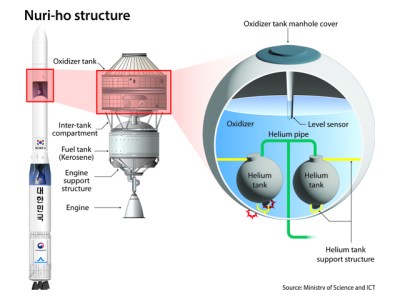
Speaking of South Korea’s rocketry program, we wrote about the Nuri rocket in October which failed to reach orbit because of a problem in the third stage. Kari recently completed a review of all the data, and concluded the problem was with the anchors of the helium tanks which are located inside the oxidizer tank.

Apparently the changing buoyancy of the submerged tanks with altitude wasn’t completely accounted for in the design of the mounting brackets. When they ultimately failed, the resulting broken piping caused a LOX leak and the subsequent 46-second premature engine shutdown. The next scheduled launch in May 2022 will very likely be delayed.


Facial Recognition For Covid-19 Tracking In Seoul

The city of Bucheon, population 830,000, is a satellite city southwest of Seoul and part of the greater metropolitan area and the site of a pilot program to apply AI facial recognition and tracking technologies to aid Covid-19 epidemiological investigators. South Korea has been generally praised for its rapid response to coronavirus patient tracking since the beginning of the outbreak. People entering public facilities enter their information on a roster or scan a QR code. Epidemiologists tracking outbreaks use a variety of data available to them, including these logs, electronic transaction data, mobile phone location logs, CCTV footage, and interviews. But the workload can be overwhelming, and there are only a fixed number of workers with the required training available, despite efforts to hire more.

As contract tracing has been done to-date, it takes one investigator up to an hour to trace the movements of one patient. When the system goes online in January, it should be able to trace one patient in less than a minute, handling up to ten traces simultaneously. Project officials say there is no plan for this system to expand to the rest of Seoul, nor nationwide. But with the growing virus caseloads and continued difficulties hiring and training investigators, it’s not unexpected that officials will be turning to these technologies more and more to keep up with the increasing workload.

Like the controversy surrounding the recent facial recognition project at Incheon International Airport, people are becoming concerned about the privacy implications and the specter of a Big Brother government that tracks each and every move of its citizens — a valid fear, given the state of technology today. The project planners note that the data is being legally collected and its usage subject to strict rules. Korean privacy law requires consent for the collecting and storage of biometric data. But there are exceptions for situations such as disease control and prevention.

Even if all the privacy concerns are solves, we wonder just how effective these AI systems will be for tracking people wearing masks. This is not an issue unique to South Korea or even Asia. Many countries around the world are turning to such technologies (see this article from the Columbia School of Law) and are having similar struggles striking the balance between privacy and public health requirements.

[Banner image: “facial-recognition-1” by Electronic_Frontier_Foundation. Thanks for all you do!]

Threaded Wires Save Phone Numbers

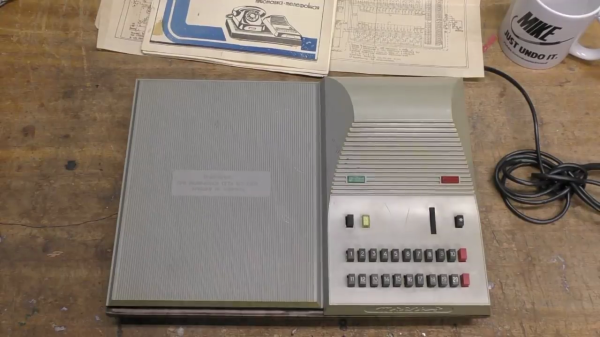
If you thought programming your 1990s VCR was rough, wait until you see this Russian telephone autodialer that [Mike] took apart over on the mikeselectricalstuff YouTube channel (video below the break). [Mike] got this 1980s Soviet-era machine a few years ago, and finally got around to breaking into it to learning what makes it tick. The autodialer plugs into the phone line, much like an old-school answering machine. It provides the user with 40 pre-set telephone numbers, arranged in two banks of 20, and a speaker to monitor the connection process. It uses pulse dialing — no touch tones. What’s surprising is how you program the numbers. Given that this was build in the 1980s Soviet Union, he wasn’t expecting a microcontroller. But he wasn’t expecting transformer core “rope” memory, either.

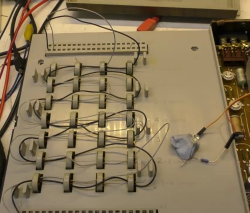
The phone normally sits on a platform on the left side of the machine. Raising up the platform exposes a bank of toroidal cores, arranged in seven rows of four. Each row corresponds to a dialed digit, and the four cores used to encode a single digit. At the top and bottom of the programming board are two 40-pin connectors, each pin corresponding to one of the preset phone numbers. A bunch of patch wires would have been provided, and you program each number by threading a long wire through the appropriate cores, connecting it at the top and bottom connectors much like a modern solderless breadboard. It’s also interesting to see the components and construction technique of this circuit board. For example, the diodes have the strip on the Anode end, not the cathode as we’re normally used to today. The transistor cans are mounted upside down like dead spiders.

Continue reading “Threaded Wires Save Phone Numbers”

Robot Delivery To Your Door

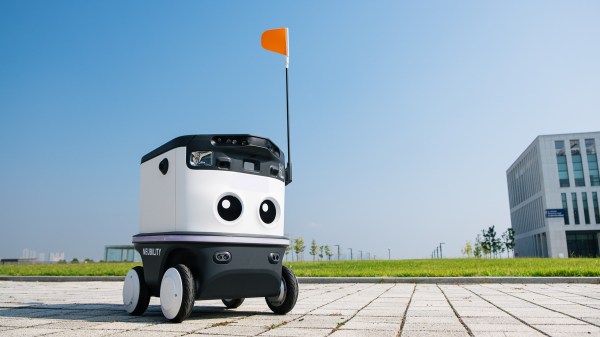
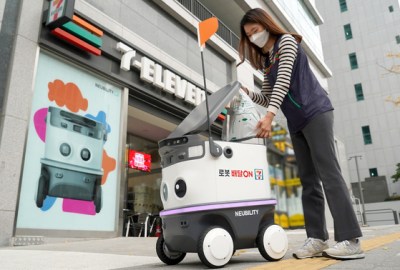
While online shopping was already very popular in South Korea, it has become even more so as people stay home more during the pandemic. Several robotic delivery services have launched around the city, such as 7-Eleven using the Neubie robot by Neubility, the GS25 convenience store using LG’s CLOi ServeBot, and the Baemin food delivery service using the Delidrive robot.

Love it or hate it, in the dense population of big cities like Seoul the vast majority of people live in apartment complexes. This lends itself well to these robot delivery projects. In fact, many of these pilot projects are only available in one apartment complex, which can consist of ten to twenty 15+ story buildings. Training your robot to navigate the sidewalks, operating the doors, calling the elevators, and buzzing the customer’s home intercom is an easier task when dealing with only one campus.

Some projects are more ambitious, like another Neubility system operating on the Yonsei University Songdo City campus. You can order fried chicken and have it delivered by a Neubie robot, which comes to your address along the sidewalk at a brisk 5 to 6 km/h. There are some issues, however. First of all, government regulations haven’t quite kept up with the technology. These services are basically operating case-by-case, temporary waiver basis. They are not allowed to operate on the streets, and when driving on the sidewalks they have to avoid bumping into people.

We wrote about a prototype RC truck delivery system last year, and covered Amazon drones and Automating Freight Delivery as well. These all show promise, but are not mainstream yet. The vast majority of your orders are still delivered by a person. Will these automated delivery services eventually replace humans? Let us know your thoughts in the comments below.

Modern Toilet Generates Energy

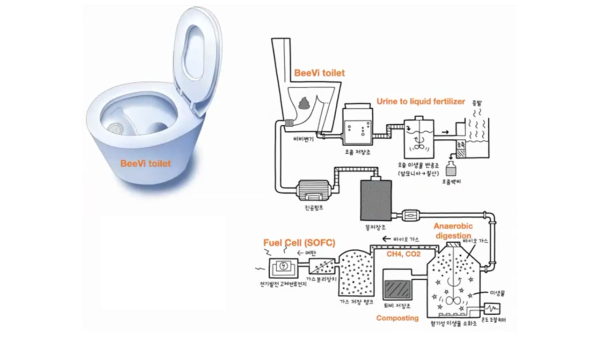
Environmental Engineering [Prof Jaeweon Cho] at South Korea’s Ulsan National Institute of Science and Technology specializes in water and waste management. He has developed an energy-generating toilet called BeeVi (pronounced beevee) that recycles your waste in three ways. Liquid waste is processed in a microbial reaction tank to make a liquid fertilizer. Solid waste is pumped into an anaerobic digestion tank, which results in methane gas used to power a silicone oxide fuel cell to make electricity. The remaining solids are composted to make fertilizer. The daily waste from one person is about 500 g, which can generate about 50 L of methane.

The BeeVi toilets, located on the UNIST campus, pay students in a digital currently called Ggools, or Honey Money in English. Each deposit earns 10 Ggools, which can be used to purchase coffee, instant noodles, and other items (one Ggool is equivalent to about $3.00 value). The output from this pilot project is used to partially power the building on campus, and to fertilize gardens on the grounds. If you want to learn more, here is a video lecture by [Prof Cho] (in English).

Waste management is an area of research around the world. The Gates Foundation has been funding research into this field for ten years, and has held a number of expos over the years highlighting innovative solutions, most recently being the 2018 Reinvent the Toilet Expo in Beijing. We wrote a piece about the future of toilets last year as well.

Continue reading “Modern Toilet Generates Energy”

DIY Infrared Calculator Printer

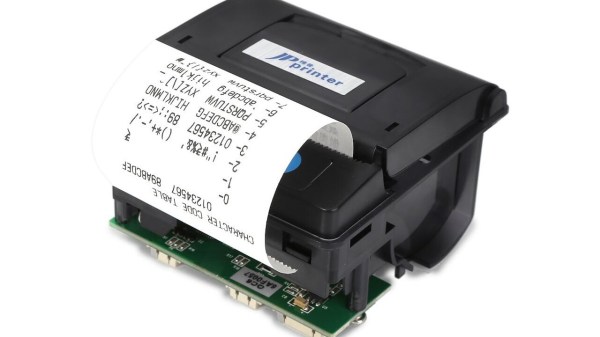
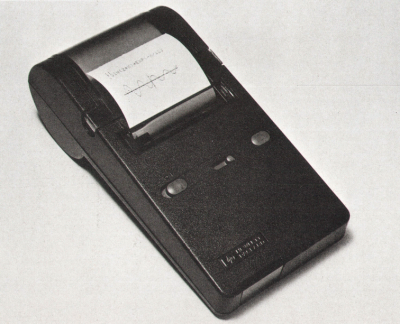
[Ziggurat29] had been playing around with infrared protocols, and realized he had a spare point-of-sale printer kicking around in his junk box. So he decided to whip up his own calculator infrared printer by bolting on an STM32 Blue Pill module and an IR receiver. [Ziggurat29] initially thought such a homemade printer would be cheaper than a commercial HP 82240 IR printer, even a used one. In hindsight, these point-of-sale printers can be pricey. If you don’t have one laying around, it may be cheaper to buy one, but not as fun as building it yourself.

It used to be commonplace for calculators to have a printing mechanism — even entirely mechanical adding machines often had them. As electronic calculators became the norm, the printer began to fade away. Back in 1987, HP introduced a portable calculator printer, the HP 82240A (see HP Journal Oct 1987). The calculator could print using a one-way infrared protocol which came to be known as Redeye. This made good sense, since not every one needs a printing calculator. As well, if you had one of these printers, it could be used with multiple calculators. Later in 1991, HP added a bi-directional infrared link called SIR beginning with the HP 48SX calculator (see HP Journal Jun 1991), allowing calculators to communicate with each other or with an IR-equipped PC. Finally HP and other companies teamed up in 1995 to create the IrDA standards you are probably more familiar with. But a bunch of Redeye and SIR devices are still floating around, and even some modern calculators like SwissMicros offerings can still output to these printers.

If you want to make your own IR printer, be sure to check out [ziggurat29]’s Hackaday.io project. Also [Martin Hepperle] has an excellent writeup on an Arduino-based project on his site. We also covered a reverse project way back in 2011, an adaptor that prints over IR from wired serial signals. Have you found a printing calculator, or a standalone printer like this, to be useful in your workflow? Let us know in the comments below.