Single Bit Computer From Vacuum Tubes

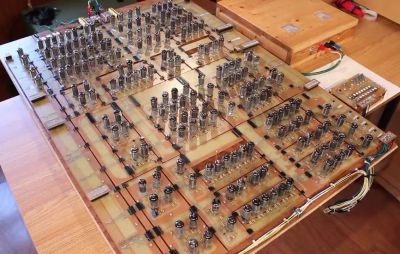
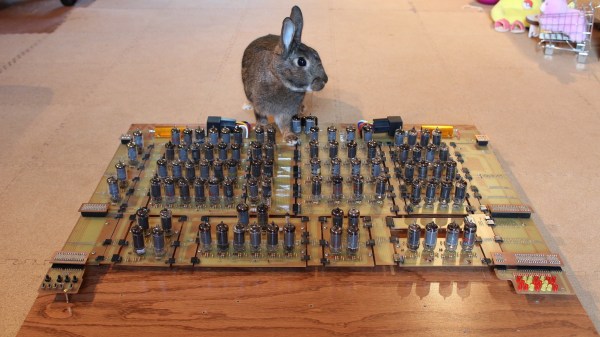
Culminating a year-long project, [Usagi Electric] aka [David] has just wrapped up his single-bit vacuum tube computer. It is based on the Motorola MC14500 1-bit industrial controller, but since [David] changed the basic logic unit into an arithmetic-logic unit, he’s dubbing it the UE14500. Built on a wooden panel about 2.5 x 3 rabbit lengths excluding power supply. [David] admits he has cheated a little bit, in that he’s using two silicon diodes instead of a 6AL5 dual diode tube in his universal NOR gate on which the computer is based — but in his defense he notes that plenty of vacuum tube computers of the era used silicon diodes.

The tube he uses in the NOR gates is the 6AU6 miniature pentode, which he selected because of its availability, price, and suitability for low voltage. [David] runs this computer with two power supplies of +24 and -12 VDC, rather than the hundreds of volts typically used in vacuum tube designs. The modules are constructed on single-sided copper-clad PCB panels etched using a milling machine. The video below the break wraps up the 22-part series, where he fixes a few power supply issues and builds a remote front panel for I/O, and gives a demo of the computer in operation. Alas, this only completes one fourth of the project, as there are three more building blocks to build before the whole system is complete — Program Control (magnetic tape), RAM Memory bank, and a serial input/output module. We look forward to seeing the whole system up and running in the future.

We just wrote about the MC14500 a few days ago, and we’ve also covered [David]’s vacuum tube implementation of a 555 timer among other of his vacuum tube projects, several of which are featured on his Hackaday.io page.

Continue reading “Single Bit Computer From Vacuum Tubes”

Taste The Television: TTTV

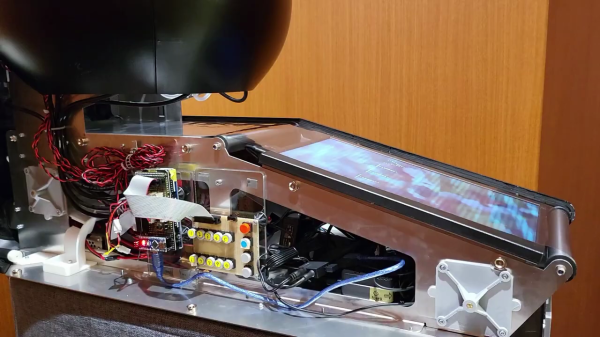
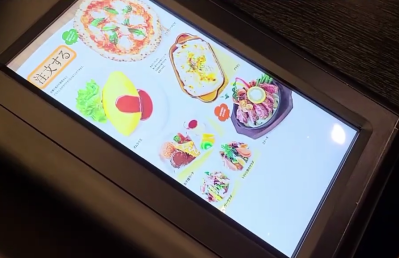
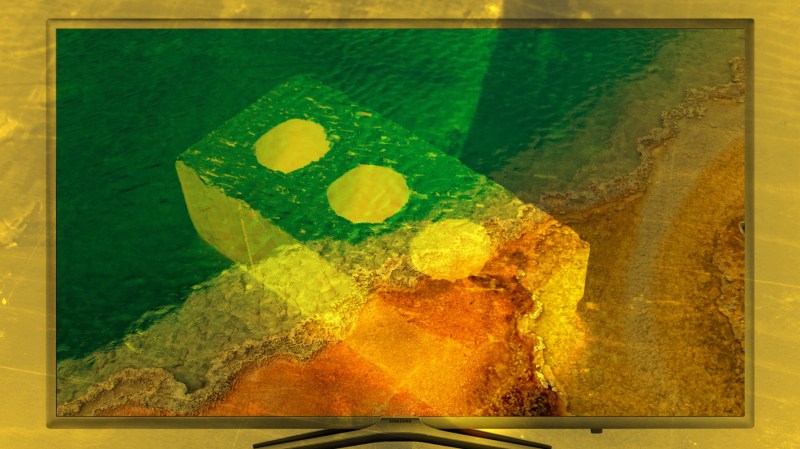
Associate Professor [Homei Miyashita] from Meiji University’s School of Science and Technology in Tokyo has developed a new technology for reproducing taste on a television or monitor, a system called Taste the TV (TTTV). The team of researchers used taste sensors to sample a variety of foods, and came up with a palette of 10 different aerosol flavors which can be combined in various ratios. The taste is generated in a staging area at the top of the screen onto a thin plastic film, which is then scrolled down into position.

Possible applications shown in the video below the break include cooking programs, restaurant menus, and wine tasting events. We’re not quite sure how popular this would be to consumers. Tele-tasting a cooking show with friends would be inconvenient, if not unsanitary. We’re also not aware that current video interface protocols such as HDMI or ATSC include any provisions for senses other than sight and sound. If you have access to scholarly journals, [Prof Miyashita] research paper on TTTV is available in the 34th Annual ACM Symposium on User Interface Software and Technology.

We’ve written about a couple of taste-generating projects before, see here and here.

Continue reading “Taste The Television: TTTV”

Seoul Introduces Self-Driving Taxis

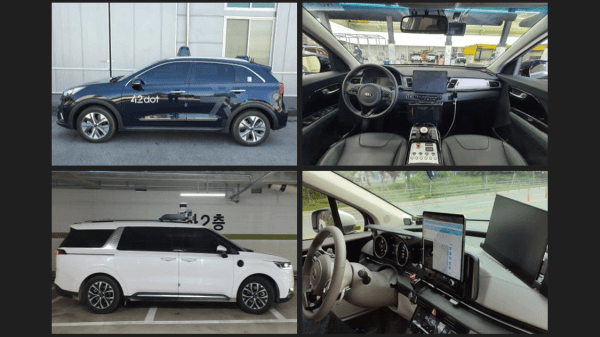
Last year the Seoul city government passed an ordinance enabling the commercial operation of autonomous passenger-carrying vehicles. A six square kilometer region in the Seoul neighborhood of Sangam, near the 2002 World Cup Stadium, was designated as a pilot program test bed. This area encompasses 24 streets totaling 31.3 km. Two companies were selected, and the pilot program launched a few weeks ago. Currently there are three vehicles and passengers can ride for free during this introductory phase. Three more taxis and a bus will be added within this year, with plans for 50 in this region by 2026. For the time being, these cars require a standby driver who takes control in an emergency and in school zones. Check out the short news report (in English) below the break.

There was a smaller autonomous driving test program in the city of Sejong which we wrote about back in January, and [Alfred Jones] gave a keynote presentation at the 2020 Hackaday Remoticon on the challenges of designing self-driving vehicles if you want to learn more on this topic.

Continue reading “Seoul Introduces Self-Driving Taxis”

Korean Facial Recognition Project Faces Opposition

It was discovered last month that a South Korean government project has been providing millions of facial images taken at Incheon International Airport to private industry without the consent of those photographed. Several civic groups called this a “shocking human rights disaster” in a 9 Nov press conference, and formally requested that the project be cancelled. In response, the government has only promised that “the project would be conducted at a minimum level to ensure personal information is not abused”. These groups are now planning a lawsuit to challenge the project.

Facial information and other biometric data aren’t easily altered and are unique to the individuals concerned. If this data were to be leaked, it would constitute a devastating infringement upon their privacy. It’s unheard of for state organizations — whose duty it is to manage and control facial recognition technology — to hand over biometric information collected for public purposes to a private-sector company for the development of technology.

The program itself wasn’t secret, and had been publicly announced back in 2019. But the project’s scope and implementation weren’t made clear until a lawmaker recently requested documents on the project from the responsible government agencies. The system, called the Artificial Intelligence and Tracking System Construction Project, was a pilot program set to run until 2022. Its goals were to simplify the security and immigration screening of passengers, improve airport security, and to promote the local AI industry in South Korea. If the project proves successful, the plan is to expand it to other airports and ports in the country.

Current systems at the airport do one-to-one facial recognition. For example, they try to determine whether the face of the person presenting a passport matches the photo in the passport. The goal of this new project was to develop one-to-many matching algorithms, which can match one face against the plethora of faces in an airport, track the movement of a face within the airport, and flag “suspicious” activities which could be a security concern.

The groups protesting the project note that the collection and sharing of these images without the travelers’ consent is prohibited by the Personal Information Protection Act, the South Korean law which governs such things. Under this act, a project like this would ordinarily require consent of the participants. But the government’s interpretation relies on an exception in the act, specifically, Article 15 Section 3, which states:

A personal information controller may use personal information without the consent of a data subject within the scope reasonably related to the initial purpose of the collection

Basically they are saying that since the images were collected at the security and immigration checkpoints, and that the project will be using them to improve the security and immigration checkpoints, no consent is required.

  • Foreigners: 120 million individuals, face image, nationality, gender, age
  • Korean citizens: 57.6 million individuals, face image, nationality, gender, age
  • Other: unknown number of individuals, images and videos of atypical behavior and travelers in motion

The breakdown of the numbers above reveals that 57 million Korean citizens are in the data set, a bit surprising to many since the collection of biometric data on Korean citizens at immigration is prohibited by law. The project circumvented this by only collecting data from citizens who participate in the automated Smart Entry service, a voluntary program which uses fingerprints and facial recognition. It’s interesting to note that the number of passengers using Incheon airport since May 2019 (the program was announced 30 Apr 2019) is only 62 million, so the average passenger appears approximately three times in the data set.

Are there any similar programs in your region? How do they handle the issue of consent, if at all? Let us know in the comments below.

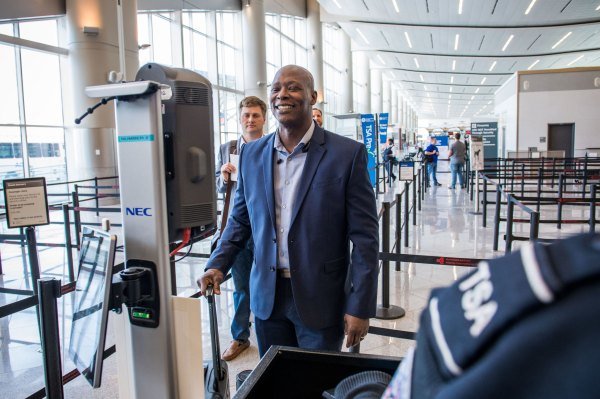
[Banner image: “Customer uses facial recognition as identification at TSA security checkpoint” by DeltaNewsHub, CC BY 2.0  — Yes, it’s from another country with similar problems, but much less public outcry. Discuss in the comments!]

HPi95LX Puts Linux In Your Palm

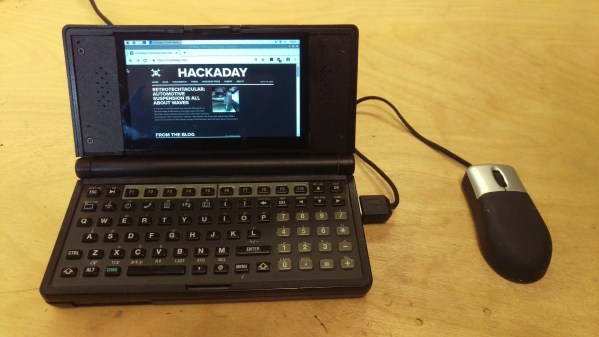
A few decades ago, palmtop computers were mostly based on MS-DOS, and while many users tried to mimic the UNIX experience, the results were mixed. Fast forward to the present and business-card-sized Linux computers modules abound. Canadian tinkerer [Rune Kyndal] decided to make his own Linux palmtop by sacrificing an old HP-95LX and replacing the guts with a Raspberry Pi Zero and a color LCD screen. We’re impressed with the rich set of features he has crammed into the limited volume of the case:

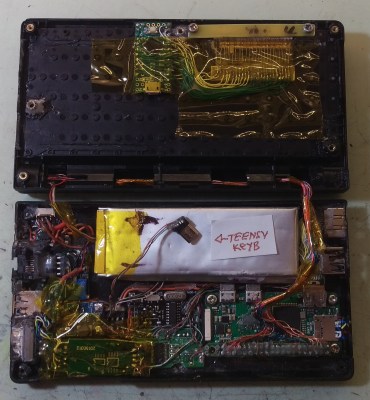
Inside View: Everything fits, barely
  • Raspberry Pi Zero W
  • Color LCD, 4.3 inch, 800×480 w/Backlight
  • Capacitive touch screen (not connected yet)
  • Stereo speakers + microphone
  • Ethernet 10/100
  • USB 2.0, 2 each
  • RS-232, DE-9 connector
  • microSD card
  • HDMI
  • IR dataport
  • Webcam (TBD)
  • LiPo Battery w/Charger

One problem that any palmtop faces is how to make a usable keyboard, and HP had one of the better designs. The keys are the same famous style as used in HP calculators. And while no human with normal hands could touch-type on it, the keyboard’s layout and tactile feel was well-suited to “thumb typing”. [Rune] made a good decision by keeping the original keyboard.

While fully functional, this is more of a proof of concept than a polished project. [Rune] primarily used bits and pieces that he had laying around. [Rune] says if he did it again, he would replace all the hot-glued accessory parts with a custom PCB, which is probably good advice. If you want to make your own, check out the project comments for some suggestions.

Samsung Bricks Smart TVs

Earlier this Fall, a Samsung warehouse in South Africa was robbed and the thieves got away with a quantity of smart televisions. Samsung proceeded to implement a little-known feature called “TV Block” which is installed on all of their TV products. The serial numbers of the stolen TV sets are flagged in their servers, and if one of these sets tries to connect the internet in the future, it will recognize that it is stolen and proceed to brick itself, disabling all television functionality.

So while this real-life scenario makes sense, it is a bit alarming to realize the implication of such a feature — the manufacturer can reach into your TV and disable it from afar. One can assume that Samsung won’t abuse this capability, because acting otherwise would harm their reputation. In a press release, Samsung announced that any consumers whose sets were incorrectly bricked can have their sets un-bricked after demonstrating proper ownership.

Despite such good intentions, the mere existence of such a feature is worrisome. What someone hacks the system and begins bricking TVs all over the world willy-nilly? If you are concerned about this possibility, one option of course is to never connect your TV set to the internet. But in that case, it might be better to just buy a “dumb” television set instead.

Anti-theft immobilizers are not new — one system was patented over 100 years ago to thwart car thieves. Car stereo systems have also long featured technology that renders them unusable when stolen. Although this robbery brought Samsung’s “TV Block” to consumers’ attention, we wonder if other manufacturers have similar anti-theft systems which aren’t well publicized. If you know of any, please share in the comments below.

Retrotechtacular: Office Equipment From The 1940s

If you can’t imagine writing a letter on a typewriter and putting it in a mailbox, then you take computers for granted. But that’s just the tip of the iceberg. More niche applications begat niche machines, and a number of them are on display in this film that the Computer History Archives Project released last month. Aside from the File-o-matic Desk, the Addressograph, or the Sound Scriber, there a number of other devices that give us a peek into a bygone era.

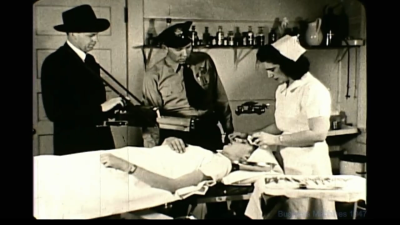
One machine that’s still around, although in a much computerized form, is the stenograph. Not so popular these days is the convenient stenograph carrier, allowing a patient’s statement to be recorded bedside in the hospital immediately after a car accident. Wire recorders were all the rage in 1947, as were floppy disks (for audio, not data). Both media were used to time-shift dictation. Typing champions like Stella Pajunas could transcribe your letters and memos at 140 WPM using an electric typewriter, outpacing dot matrix printers but a snail’s pace compared to a laser jet.

Continue reading “Retrotechtacular: Office Equipment From The 1940s”