Japan To Launch Wooden Satellites

We may have wooden satellites in just a few years, according to an announcement this month by Kyoto University and Sumitomo Forestry, organizations whose combined roots go back 550 years.

Wood’s place in high-technology has a long track record. During World War 2, wooden boats were used for minesweepers, the Spruce Goose was designed to circumvent wartime material restrictions, and Britain’s plywood-built De Havilland Mosquito had a very low radar cross section. In this century, a man in Bosnia has even built a Volkswagen Beetle out of oak.

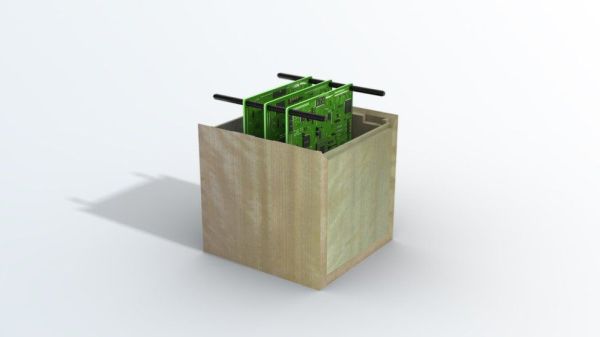
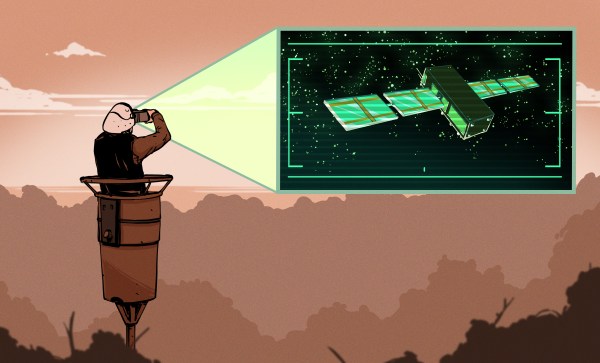
The newly-announced aerospace project, led by retired astronaut and engineer Prof Takao Doi, plans to launch satellites built from wood in order to reduce space debris and hazardous substances resulting from re-entry. We’re somewhat skeptical on the hazardous substances angle (and we’re not alone in this), but certainly as a way to help ensure complete burn up upon re-entry, wood is an interesting material. It also achieves a great strength to weight ratio and as a renewable resource it’s easy to source.

Prof Doi has been studying the use of wood in space for several years now. Back in 2017 he began basic research on the usability of timbers in space (pg 16), where his team experimented with coniferous (cedar and cypress) and hardwood (satinwood, magnolia, and zelkova) trees in vacuum environments. Based on successes, they predicted wooden satellite launches in the mid 2020s (their announcement this month said 2023). Sumitomo engineers have not released what kind of wood(s) will finally be used on the satellite.

You might remember Astronaut Doi from an experiment aboard the ISS where he successfully demonstrated flying a boomerang in space (video below), and he’s also discovered two supernovae in his spare time. We wish him good luck.
Continue reading “Japan To Launch Wooden Satellites”

Twenty Seconds At 100 Megakelvins

The Korea Superconducting Tokamak Advanced Research (KSTAR) magnetic fusion reactor claimed a new record last month — containing hydrogen plasma at 100 megakelvins for 20 seconds. For reference, the core temperature of the Earth’s Sun is a mere 15 megakelvins, although to be fair, it has been in operation quite a bit longer than 20 seconds.

South Korea is a member of the International Thermonuclear Experimental Reactor (ITER) team, a worldwide project researching the science and engineering of nuclear fusion. One of their contributions to the effort is the KSTAR facility, located in the city of Daejeon in the middle of the country (about 150 km south of Seoul).

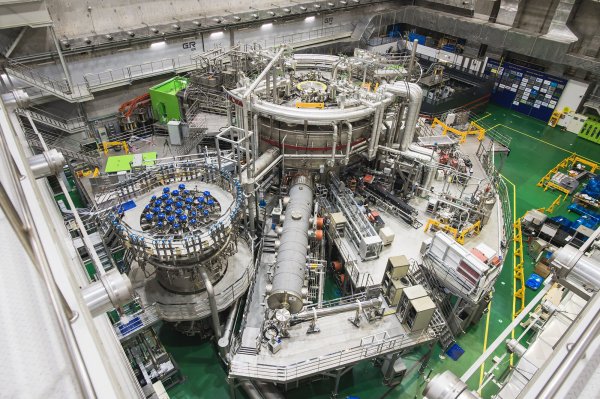
It is a tokamak-style fusion research reactor using superconducting magnets to generate a magnetic flux density of 3.5 teslas and a plasma current of 2 megaamperes. These conditions are used to confine and maintain the plasma in what’s called the high-confinement mode, the conditions currently favored for fusion reactor designs. Since it went into operation in 2008, it has been creating increasingly longer and hotter “pulses” of plasma.

For all the impressive numbers, the toroidal reactor itself is not that huge. Its major diameter is only 3.6 meters with a minor diameter of 1 meter. What makes the facility so large is all the supporting equipment. Check out the video below — we really like the techniques they use in this virtual tour to highlight key components of the installation.

Continue reading “Twenty Seconds At 100 Megakelvins”

The Wichinsky Bagelmatic

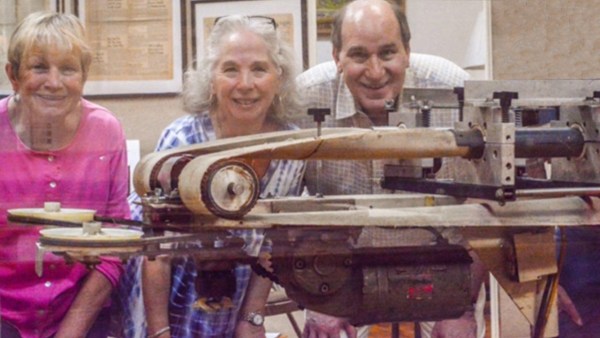
Reader [Eric Mockler] brought Louis “Lebel” Wichinsky to our attention, a colorful inventor he ran into some years back in the Borscht Belt of Upstate New York. Described as a Mel Brooks doppelgänger, Lebel was born the son of a baker in Hurleyville NY. During WW2 he served in England where he lodged with two brothers who also owned a bakery. When his British friends suggested he should build a bagel machine because “you Yanks can do anything”, he accepted their challenge and began working on a design. Despite taking a detour through Israel as an aircraft mechanic on his journey home, he finally succeeded in 1964 after 20-some years of tinkering. A patent followed in 1968, despite discovering that someone else had independently invented similar device.

Continue reading “The Wichinsky Bagelmatic”

Modified Yost Tames Pinout Plethora

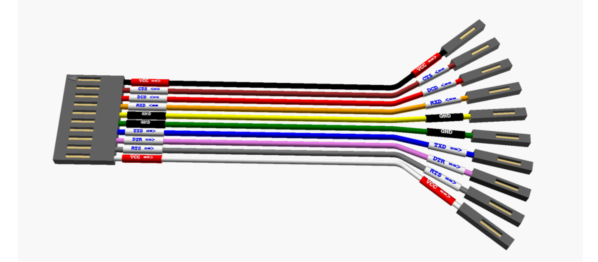
Every hacker has an assortment of USB to TTL-serial adapters kicking around in their lab, and we have all been annoyed that each one has a different pinout. You layout a PCB or breadboard for the Sparkfun flavor (GND, CTS, VCC, TXD, RXD, DTR), but when you begin troubleshooting all you can find is a CH340 board (GND, +5V, TXD, RXD, DTR, +3.3V). You have to jumper everything, and it becomes a mess. It wasn’t much better back in the days of RS-232 level signaling, either. While the pinouts were consistent, there were other headaches. Did the connection need a NULL modem adaptor? And if you were unlucky, you might need a DB-25 to DE-9 adaptor, and the really unlucky might need one or more gender changers. Surely there’s a better way.

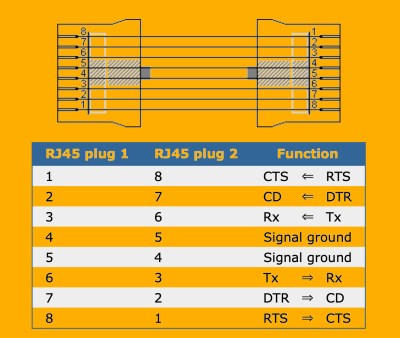
It turns out there was a better way, although it didn’t seem to have become as popular as one might expect. Back in 1987 [Dave Yost] formalized an interconnection scheme using RJ45 plugs and jacks while at Berkeley.  The signals were arranged in a mirrored fashion so that each cable is always a crossover — just plug two cables back-to-back if you really need a straight thru connection.

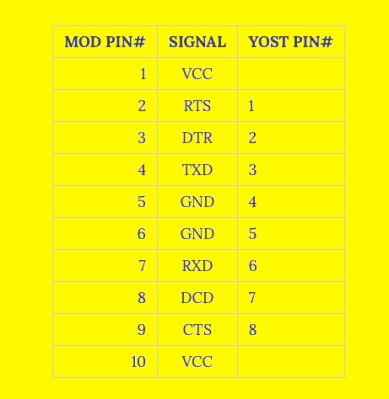
Even though he was dealing with RS-232 serial, nothing prevents us from using this scheme for logic level signaling. For example, consider the following 1×10 header pinout, where the original 8-pins are expanded to 10 to allow for power:

This is an extreme example, and can obviously be shrunk depending on how much handshaking, if any, or power is desired. Such a pinout lets you switch between DCE and DTE by simply flipping the connector around. And if a Dupont-style header slips off too easily in your applications, you could always use an RJ connector. This still doesn’t solve the Tower of Babel pinout problem with the USB-TTL adaptors. But standardizing on a serial pinout such as this for your projects and making cables or kludging your TTL adaptors will make serial debugging less painful.

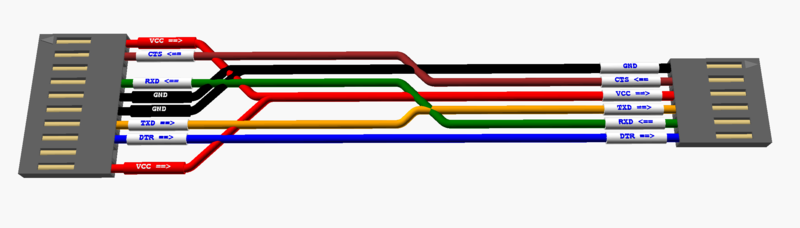
Yost to Sparkfun Adaptor Cable

Back when he released this scheme in 1987, [Dave] pontificated:

“Maybe one day before the year 2,000, the world will have a new, simple, high-speed, flow-controlled, standard type of connection for point-to-point applications currently using RS-232, with an adaptor available to talk to old, RS-232 equipment.”

Let us know your thoughts in the comments below.

The First Real Palmtop

Back before COVID-19, I was walking through the airport towards the gate when suddenly I remembered a document I wanted to read on the flight but had forgotten to bring along. No worry, I paused for a bit on the concourse, reached into my pocket and proceeded to download the document from the Internet. Once comfortably seated on the plane, I relaxed and began reading. Afterwards, I did a little programming in C on a shareware program I was developing.

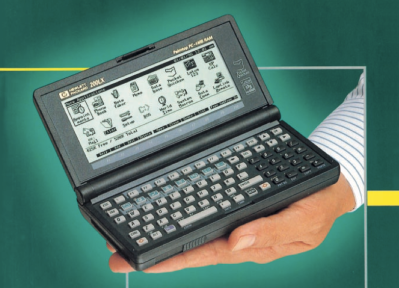
Today this would be an ordinary if not boring recollection, except for one thing: this happened in the 1990s, and what I pulled out of my pocket was a fully functional MS-DOS computer:

Introducing the HP-200LX, the first real palmtop computer. I used one of these daily up until the mid-2000s, and still have an operational one in my desk drawer. Let’s step back in time and see how this powerful pocket computer began its life. Continue reading “The First Real Palmtop”

Tracking Satellites: The Nitty Gritty Details

If you want to listen to satellites, you have to be able to track them as they pass over the sky. When I first started tracking amateur satellites, computing the satellite’s location in the sky was a part of the challenge. Nowadays, that’s trivial. What’s left over are all the extremely important real-world details.  Let’s take a look at a typical ham satellite tracking setup and see how it all ties together.

Rotators for Steering

The popularity of robotics, 3D printing, and CNC machines has resulted in a deluge of affordable electric motors and drivers. It’s hard to imagine that an electric motor for rotating an antenna would be anything special, but in fact, antenna rotators are non-trivial engineering designs. Most of the challenges are mechanical, not electrical — the antennas that they drive can be huge, have significant wind loading and rotational inertial, and just downright weigh a lot. A rotator design has to consider bearings, weather exposure, all kinds of loads, not just rotational. And usually a brake is required to keep the antenna pointed in windy conditions.

There’s been a 70-some year history of these mechanisms from back in the 1950s when Cornell Dubilier Electronics, the company you know as a capcacitor manufacturer, began making these rotators for television antennas in the 1950s. I was a little surprised to see that the rotator systems you can buy today are not very different from the ones we used in the 1980s, other than improved electronic controls. Continue reading “Tracking Satellites: The Nitty Gritty Details”

Tunes You Can Eat

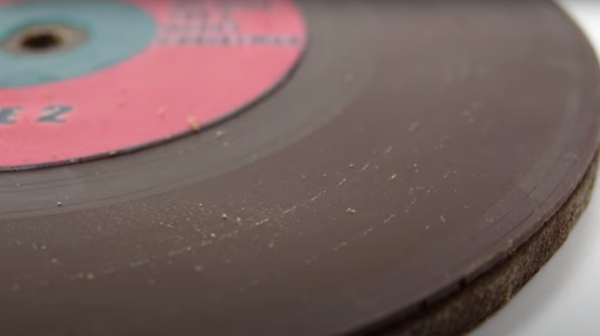
This week retro-gadget collector and video blogger [Techmoan] featured perhaps the most delicious audio recording format that we know of — a chocolate gramophone record. (Video, embedded below.) Compared to his typical media format explorations, the chocolate record is of quite recent vintage. He first heard of them back in 2015 when Tasmanian artist [Julia Drouhin] offered chocolate recordings as part of her art project. The one that [Techmoan] finally obtained was from a UK chocolatier who offers them with custom labelling and your choice of two songs. There are some pointers in the video about how to playback your chocolate disk without ruining it (use the lightest stylus tracking force as possible). These disks are recorded at 45 RPM on one side only, and are about the same size as a standard single. But being about five times thicker, they pack a lot more calories than your typical phonograph disk.

No reflection on the Tewkesbury Town Band, but this is probably the lowest fidelity recording media ever, but at least you can eat it when you’re done listening — label and all. We hope the Mission Impossible movie producers are paying attention so we can see the secret audio briefing being eaten instead of going up in smoke next film.

Continue reading “Tunes You Can Eat”