A Flashlight Powered By Your Hot Little Hands

We are smack-dab in the middle of our Energy Harvesting Challenge, and [wasimashu] might have this one in the palm of his hand. Imagine a compact flashlight that doesn’t need batteries or bulbs. You’d buy a 10-pack and stash them everywhere, right? If there’s nothing that will leak or break or expire in your lifetime, why not have a bunch of them around?

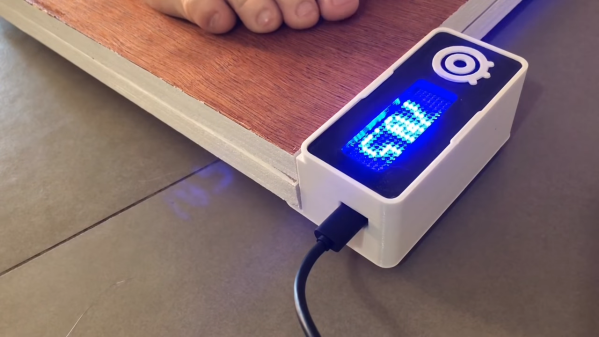
Infinity uses nothing but body heat to power a single white LED. It only needs a five-degree temperature difference between the air and your hand to work, so it should be good in pretty much any environment. While it certainly won’t be the brightest light in your collection, it’s a whole lot better than darkness. Someday, it might be the only light around that works.

As you might expect, there’s a Peltier unit involved. Two of them, actually. Both are embedded flush on opposite sides of the hollow aluminum flashlight body, which acts as a heat sink and allows air to pass through.  After trying to boost the output voltage with a homemade feedback oscillator and hand-wound transformers, [wasimashu] settled on a unipolar boost converter to reach the 5V needed to power the LED.

[wasimashu] has made it his personal mission to help humanity through science. We’d say that Infinity puts him well on the way, and can’t wait to see what he does next.

A Cartoon-ifying Camera For Instant Absurdism

We take photographs as a way to freeze moments in time and to capture the details that get blurred by our unreliable memories. There is little room for interpretation, and this is kind of the whole point.

[Dan Macnish]’s latest project, Draw This, turns reality into absurdity. It’s a Raspberry Pi-based instant camera that trades whatever passed in front of the lens for a cartoon version of same. Draw This uses neural networks to ID the objects in the frame, and then draws upon thousands of images from Google’s Quick, Draw! dataset to provide a loose interpretation via thermal printer. Seems to us like the perfect camera to take to DEFCON (or any other part of Las Vegas).

If you have a Raspi3, a v2 camera, and a thermal printer, you can make your own crowd-sourced, cartoonified memories using the code in [Dan]’s repo. Still into recording reality? You can use Pi cameras to see in the dark or even explore a body of water.

Driftwood Binary Clock Is No Hollow Achievement

It’s about time we had another awesome clock post around here. [Mattaw] has liked binary clocks since he was 0 and decided to make one in stunning fashion by using driftwood, nature’s drillable, fillable enclosure.

That beautiful wiring job on the RGB LEDs was done in 18g copper. To keep the LEDs aligned during soldering, he drilled a a grid of holes just deep enough to hold ’em face down. There’s an IR remote to set the time, the color, and choice of alarm file, which is currently set to modem_sound.mp3.

Under the wood, there are a pair of Arduino Nanos, an mp3 decoder board, and an RTC module. Why two Nanos, you ask? Well, the IR interrupts kept, uh, interrupting the LED timing. The remote feature was non-negotiable, so [mattaw] dedicated one Nano to receive remote commands, which it streams serially to the other. Here’s another nice touch: there’s an LDR in one of the nooks or crannies that monitors ambient light so the LEDs are never too bright. Don’t wait another second to check it out—we’ve got 10 videos of it after the break.

Believe it or not, this isn’t the first binary clock we’ve seen.  This honey of a clock uses RGB LEDs to tell the time analog style.

Continue reading “Driftwood Binary Clock Is No Hollow Achievement”

R/C Rocket-Beest Burns Up Fuses Out There Alone

We’re beginning to think the “S” in [Jeremy S Cook] stands for strandbeest. He’ll be the talk of the 4th of July picnic once he brings out his latest build—a weaponized, remote-controlled strandbeest that shoots bottle rockets. There are a bank of money shots up on Imgur.

This ‘beest is the natural next step after his remote-controlled walker, which we featured a month or so ago. Like that one, the locomotion comes from a pair of micro gear motors that are controlled by an Arduino Nano over Bluetooth. The pyrotechnics begin when nitinol wire cleverly strung across two lever nuts is triggered. All the electronics are housed inside a 3D-printed box that [Jeremy] designed to sit in the middle of the legs. We love the face plate he added later in the build, because those gumdrop LED eyes are sweet.

Can you believe that this vehicle of destruction began as a pile of innocent, pasta-colored pieces of kit? We dig the camouflaged battleship paint job, ’cause it really toughens up the whole aesthetic. And really, that’s probably what you want if you’re driving around a spindly beast that can just shoot rockets whenever. Let’s light this candle after the break, shall we?

Continue reading “R/C Rocket-Beest Burns Up Fuses Out There Alone”

Sunny Custom Keyboard Illuminates The Past

Ever wonder why keyboard number pads and telephone dials have reversed layouts? Theories abound, but the most plausible one is that, shrug, it just happened that way. And now we’re stuck with it.

Well, that answer’s not good enough for [Jesse], so he punched up his own keyboard design that combines the golden years of function-rich Sun and IBM keyboards with Ma Bell’s DTMF number arrangement. That’s right, Sundial has 24 function keys total, and the number pad matches Ma Bell’s all the way down to the asterisk/zero/octothorpe pattern on the bottom row. How do we know what the unlabeled ones are, you ask? It’s all mapped out in this layout editor. We love that it has all the key lock indicator lights, because that practice should’ve never faded out in the first place.

Though inspired by this beautiful unicorn of an Arduino keyboard we covered a few months ago, the Sundial uses a Teensy 2.0 to translate [Jesse]’s Cherry MX clone-driven wishes into software commands. It’s also painstakingly hand-wired, so here’s the build log for you to drool over. Just cover up your keyboard first.

Pool Ball Return System Chalked Up To Ingenuity

Do you play pool? If so, you probably take the automatic ball return systems in bar and billiard hall tables for granted. [Roger Makes] was tired of walking around his home table to collect the balls every time he wanted to play, so he designed a time-saving ball return system.

Instead of falling into the little netted baskets that came with the table, the balls now drop into 3D-printed pockets and ride along dowel rod rails into a central collection box, which is suspended by straps beneath the rack-em-up end of the table. The rails themselves are fortified with ABS ribs that keep the balls from falling through.

Pool is all about geometry, and this really hit home when [Roger] was trying to merge the funnel part of the pocket with the exit chute in the design phase. He covered all the angles with a modular design that lets the chute rotate freely, which takes a lot of stress away from the dowel rods. We’ve got the video cued up after the break, so don’t bother with getting out your film canister full of quarters.

We can’t wait to see what [Roger Makes] next. Maybe it’ll be something like this OpenCV score-keeping system.

Continue reading “Pool Ball Return System Chalked Up To Ingenuity”

Apple Coin Bank Plants The Seed Of Saving

Consider the piggy bank. Behind that innocent, docile expression is a capitalistic metaphor waiting to ruin your fond memories of saving for that BMX bike or whatever else it was that drove home the value of a dollar. As fun as it is to drop a coin in a slot, the act of saving your pennies and learning financial responsibility could be a bit more engaging.

It seems like [gzumwalt] feels the same way. He’s designed a coin bank for his grand-kids that takes a more active role in the deposit process—it straight up eats the things. Put a coin on the platform and the upper half of the apple’s face is pushed open by an arm that pulls the coin inside on its return path.

Continuing with the money-saving theme, [gzumwalt] didn’t use a micro or even a 555. No, the core of this project is a pair of micro lever switches, a small gear motor, and 4.5V DC. When a coin hits the platform, the first switch engages the motor. The motor drives a 3-D printed mechanism modeled after Hoeckens’ linkage, which converts rotational motion to (nearly) straight-line motion. The second switch stops the cycle. Confused? You can sink your teeth into it after the break.

Don’t worry, the kids don’t have to slice up the apple when it’s time to go to the candy store, ’cause there’s a screw-in hatch on the bottom. This is because [gzumwalt] is a wizard of 3-D printing and design. Not convinced? Check out his balloon-powered engine or his runs-on-air plane.

Continue reading “Apple Coin Bank Plants The Seed Of Saving”