E-Dermis: Feeling At Your (Prosthetic) Fingertips

When we lose a limb, the brain is really none the wiser. It continues to send signals out, but since they no longer have a destination, the person is stuck with one-way communication and a phantom-limb feeling. The fact that the brain carries on has always been promising as far as prostheses are concerned, because it means the electrical signals could potentially be used to control new limbs and digits the natural way.

A diagram of the e-dermis via Science Robotics.

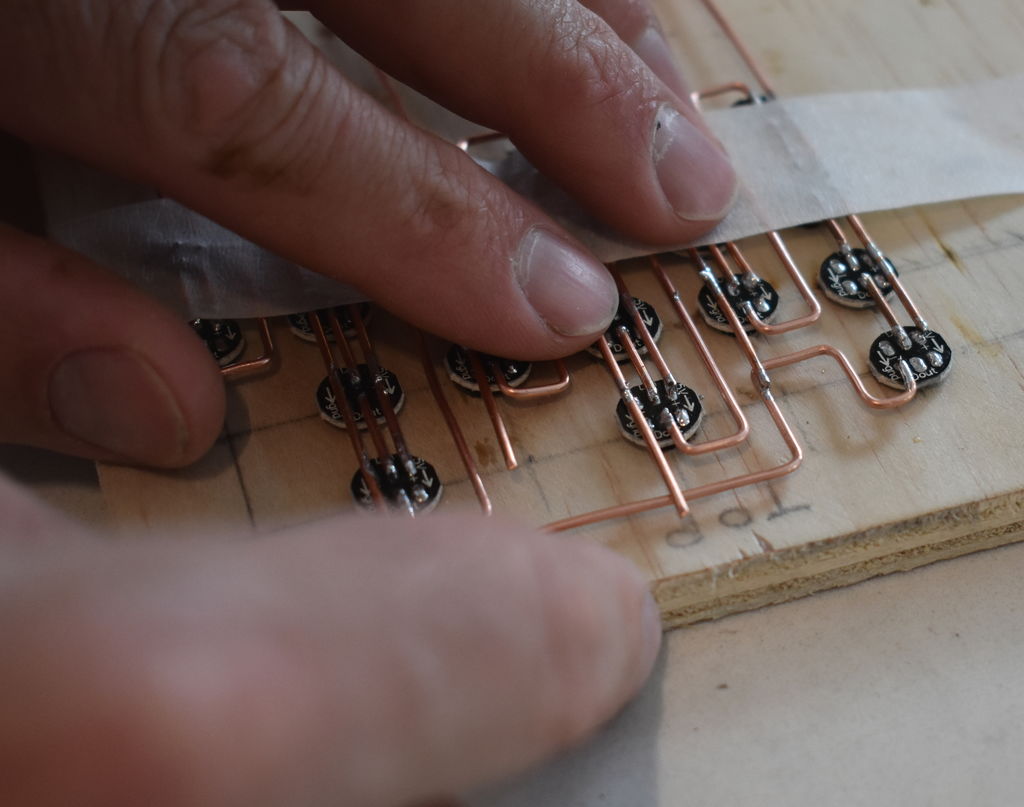
It’s also good news for adding a sense of touch to upper-limb prostheses. Researchers at Johns Hopkins university have spent the last year testing out their concept of an e-dermis—a multi-layer approach to expanding the utility of artificial limbs that can detect the curvature and sharpness of objects.

Like real skin, the e-dermis has an outer, epidermal layer and an inner, dermal layer. Both layers use conductive and piezoresistive textiles to transmit information about tangible objects back to the peripheral nerves in the limb. E-dermis does this non-invasively through the skin using transcutaneous electrical nerve stimulation, better known as TENS. Here’s a link to the full article published in Science Robotics.

First, the researchers made a neuromorphic model of all the nerves and receptors that relay signals to the nervous system. To test the e-dermis, they used 3-D printed objects designed to be grasped between thumb and forefinger, and monitored the subject’s brain activity via EEG.

For now, the e-dermis is confined to the fingertips. Ideally, it would cover the entire prosthesis and be able to detect temperature as well as curvature. Stay tuned, because it’s next on their list.

Speaking of tunes, here’s a prosthetic arm that uses a neural network to achieve individual finger control and allows its owner to play the piano again.

Thanks for the tip, [Qes].

Roll Your Own Trackball Mouse

What do you do when you’re into trackball mice, but nothing out there is affordable or meets all your murine needs? You build one, of course. And if you’re like [Dangerously Explosive], who has a bunch of old optical mice squeaking around the shop, you can mix and match them to build the perfect one.

The mouse, which looks frozen mid-transformation into a rodential assassin, is a customized work of utilitarian art. Despite the excellent results, this project was not without its traps. [Dangerously] got really far into the build before discovering the USB interface chip was dead. Then he tried to sculpt a base out of Plasticine and discovered he’d bought the one kind of clay that can’t be baked. After trying his hand at making homemade salt dough, he painstakingly whittled a base from scrap pine using a drill and a hacksaw.

Every bit of this mouse is made from recycled bits, which, if you pair that with the paint job and the chosen shade of blinkenlights, makes this a green mouse on three levels. One of the two parts of this mouse that isn’t literally green, the cord, is still ecologically sound. [Dangerously] wanted a really long tail, so he scavenged a charger cable built for fruity hardware and threaded it through a hollowed-out piece of purple paracord.

We love the thumb-adjacent scroll wheel and the trackball itself, which is a ping pong ball painted black. The cool part is the guide it rolls around in. [Dangerously] spent a long time hand-whittling the perfect size hole in a particularly wide mouse palm rest. All that plastic shaving paid off, because the action is smooth as Velveeta.

[Dangerously] certainly designed this mouse to fit his preferences, and ergonomics seem a bit secondary. For a truly custom fit, try using whatever passes for Floam these days.

Lawn From Hell Saved By Mower From Heaven

It’s that time of year again, at least in the northern hemisphere. Everything is alive and growing, especially that narrow-leafed non-commodity that so many of us farm without tangible reward. [sonofdodie] has a particularly hard row to hoe—his backyard is one big, 30° slope of knee-ruining agony. After 30 years of trudging up and down the hill, his body was telling him to find a better way. But no lawn service would touch it, so he waited for divine inspiration.

And lo, the answer came to [sonofdodie] in a trio of string trimmers. These Whirling Dervishes of grass grazing are mounted on a wheeled plywood base so that their strings overlap slightly for full coverage. Now he can sit in the shade and sip lemonade as he mows via rope and extension cord using a mower that cost about $100 to build.

These heavenly trimmers have been modified to use heavy nylon line, which means they can whip two weeks’ worth of rain-fueled growth with no problem. You can watch the mower shimmy down what looks like the world’s greatest Slip ‘n Slide hill after the break.

Yeah, this video is two years old, but somehow we missed it back then. Ideas this fresh that tackle age-old problems are evergreen, unlike these plots of grass we must maintain. There’s more than one way to skin this ecological cat, and we’ve seen everything from solar mowers to robotic mowers to mowers tied up to wind themselves around a stake like an enthusiastic dog.

Continue reading “Lawn From Hell Saved By Mower From Heaven”

DIY Talkbox Gives You More Bounce To The Ounce

Back in the 70s, you couldn’t swing a macrame plant hanger around a record store without knocking over numerous displays of albums featuring talkboxes. They were all over 70s music, kind of like how almost every 80s song has a sax solo and/or Michael McDonald on backing vocals. Not sure you’ve heard one being used? Trust us, you definitely have and just don’t realize it.

Talkboxes are essentially an amplifier and a speaker contained in a box. The speaker is the acoustic diaphragm type used in bullhorns and civil defense sirens. You run your guitar, keyboard, or electrified hurdy gurdy into the box, and instead of driving a horn, the sound travels up a clear plastic tube and into your mouth. Your mouth, fine resonant cavity that it is, becomes the final effect pedal. Any way you can manipulate it will shape the sound coming from the instrument. Flap those lips, and suddenly you’re talking like a robot. Who wouldn’t want one of these?

So they aren’t complicated, but you wouldn’t know it from the price of commercial ones. [mosivers] really digs the sound and wanted to build one, so he scoured the internet to figure out how to do so properly and shared his findings in this Instructable. The most important bit is the compression driver. The drivers that featured in the original talkboxes aren’t made anymore, but there are suitable replacements for ~$40.

The next most important part is a high-pass filter to keep really low frequencies from damaging the driver. After that it’s down to the amplifier, some passives, and the all-important tube. You could laser cut an enclosure as [mosivers] did, or be the first person in history to reuse a Danish butter cookie tin for something other than sewing supplies. Boogie on down past the break and let’s groove tonight.

Speaking of the 80s, here’s a DIY talkbox built on a Game Boy.

Continue reading “DIY Talkbox Gives You More Bounce To The Ounce”

Bike-Driven Scarf Knitter Is An Accessory To Warmth

Despite all our technological achievements, humans still spend a lot of time waiting around for trains. Add a stiff winter breeze to the injury of commuting, and you’ve got a classic recipe for misery. [George Barratt-Jones] decided to inject some warmth into this scene by inviting people to knit a free scarf for themselves by riding a bike.

All a person has to do is ride the Cyclo-Knitter for five minutes and marvel at their handiwork. By the time the scarf is finished, they’ve cycled past being cold, and they have something to hold in the warmth. Cyclo-Knitter is essentially an Addi Express knitting machine being belt-driven by a stationary bike. Power is transferred from the bike through large, handmade wooden gears using old bike tire inner tubes as belts. [George] built a wooden tower to hold the machine and give the growing scarf a protected space to dangle.

We love the utility of this project as much as the joy it inspires in everyone who tries it. Check out their scarves and their reactions after the break. We haven’t seen people this happy to see something they weren’t expecting since that billboard that kills Zika mosquitoes.

Continue reading “Bike-Driven Scarf Knitter Is An Accessory To Warmth”

CalClock Keeps You Tied To The Mast

Now that most of what we do revolves around our phones and/or the internet, it’s nearly impossible to take a short break from work to check the ol’ calendar without being lured by the sirens on the shore of social media. Well, [samvanhook] was tired of being drawn in when all he really needs is a vague idea of what’s coming up for him in the next 12 hours. Enter the CalClock.

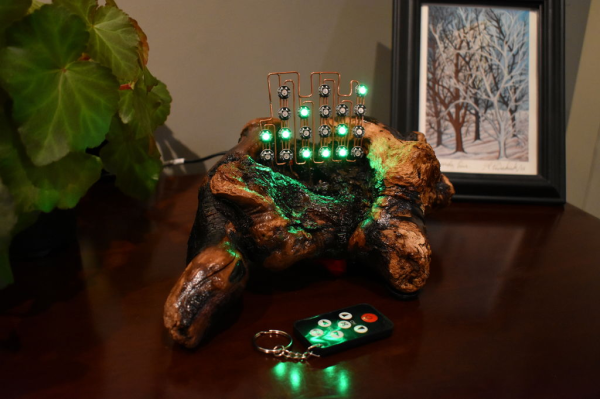
Thanks to color-coded segments, [sam] can tell at a glance if he has something coming up soon in Google Calendar, or if he can dive back into work. When nothing is scheduled, the segments are simply unlit.

We love the mid-century minimal look and craftsmanship of CalClock. This beauty runs on a Raspi Zero W, which fetches the 411 through the gooCal API and lights up the appropriate NeoPixels arrayed behind standard clock movement-driven hands.  [sam] could have diffused the NeoPixels with a single sheet of acrylic, but he went the extra mile to route and sand little acrylic ice cubes for all 24 segments.

Want more control of your day? [sam] took the time to upload both the clock face model and the code so you can. If you need help just getting started each day, check out this calendar-polling Raspi alarm clock.

Minimum Viable 1-D PONG

What makes a game a game? Like, how do we know that we’re looking at a variation of PONG when confronted with one? And how do we know how to play it? [Bertho] sought to answer this question as he designed what is probably the smallest-ever 1-D PONG game. His answer involves charlieplexing LEDs, using a voltage divider to save I/O pins, and a couple of AAAs that should last for a long, long time.

[Bertho]’s Minimum 1-D PONG, or m1dp for short, puts an ATTiny85 through its paces as gameplay quickly progresses from ‘I got this’ to ‘no one could possibly keep this up’. This state machine sleeps until one of the two buttons is pressed, at which time a wait animation starts. The action begins with the next button press.

Game play across only five LEDs makes for some pretty intense action, too. Fortunately, the buzzer is a big part of the experience. It sounds one tone for each LED when the ball is in play, and a different tone to confirm button presses. [Bertho] saved so many I/O pins with charlieplexing that he added a green LED that lights up when it’s OK to return the ball. If we were playing, we’d keep our eye on this LED instead of trying to watch the ball. We’re serving the demo after the break point, so don’t let it get past you.

For a study in minimalism, there sure is a lot going on here with all the different tones and animations. If you’d prefer maximalist 1-D PONG, there’s always LED strips. If dungeon crawlers with satisfying hardware are more your thing, you really need to check out Twang.

Continue reading “Minimum Viable 1-D PONG”