Building Penny’s Computer Watch From Inspector Gadget

When you help your bumbling Uncle Gadget with all kinds of missions, you definitely need a watch that can do it all. Penny’s video watch from Inspector Gadget has a ton of features including video communication with Brain and Chief Quimby, a laser, a magnet, a flashlight, a sonar signal, and much more.

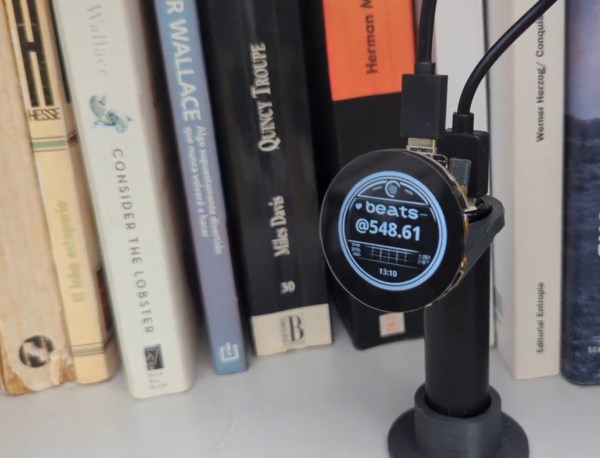
To round out her Penny costume, [Becky Stern] has created a 3D printed version of Penny’s incredibly smart watch. It listens for Penny’s iconic phrase — come in, Brain! — and then loads a new picture of Brain on the rounded rectangle TFT display. Inside the watch is an Arduino Nicla Voice, which has to be one of the tinier machine learning-capable boards out there.

[Becky] created the watch case in Tinkercad and modified a watch band from Printables to fit her wrist. With such a small enclosure to work with, [Becky] ended up using that really flexible 30 AWG silicone-jacketed wire for all the fiddly connections between the Arduino and the screen.

After getting it all wired up to test, she found that the screen was broken, either from pressing it into the enclosure, or having a too-close encounter with a helping hands. Let that be a lesson to you, and check out the build video after the break.

More interested in Uncle Gadget’s goodies? Check out these go-go-Gadget shoes and this propeller backpack for skiers.

Continue reading “Building Penny’s Computer Watch From Inspector Gadget

William Blake Was Etching Copper In 1790

You may know William Blake as a poet, or even as #38 in the BBC’s 2002 poll of the 100 Greatest Britons. But did you know that Blake was also an artist and print maker who made illuminated (flourished) books?

Blake sought to marry his art with his poetry and unleash it on the world. To do so, he created an innovative printing process, which is recreated by [Michael Phillips] in the video after the break. Much like etching a PCB, Blake started with a copper sheet, writing and drawing his works backwards with stopping varnish, an acid-resistant varnish that sticks around after a nitric acid bath. The result was a raised design that could then be used for printing.

Cleaning up the ink smudges before printing.

Blake was a master of color, using few pigments plus linseed or nut oil to create pastes of many different hues. Rather than use a brayer, Blake dabbed ink gently around the plate, careful not to splash ink or get any in the etched-away areas. As this was bound to happen anyway, Blake would then spend more time wiping out the etched areas than he did applying the ink.

Another of Blake’s innovations was the printing process itself. Whereas traditionally, illuminated texts must be printed in two different workshops, one for the text and the other for the illustrations, Blake’s method of etching both in the same plate of copper made it possible to print using his giant handmade press.

Want to avoid censorship and print your own ‘zines? Why not build a proofing press?.

Continue reading “William Blake Was Etching Copper In 1790”

Tile-Based Macro Pad Keeps Getting Better

If there’s one thing we love to see around here, it is the various iterations of a project. If you keep up with Keebin’, you know that [Michael Gardi] created a tile-based macropad after developing a tile system for yet another project. This macro pad would have 3D-printed tiles next to the keys that would not only make them easy to relabel, but give [Michael] a novel way to change the function when changing the tile using magnets and Hall effect sensors.

Well, fast forward to [Michael] actually using the thing, and he’s found that, more often than not, he’s pressing the tiles instead of the keys next to them. So it was time for another iteration: a macro pad with tile buttons. Much like the previous iteration, this one uses a Pro Micro for a brain and a handful of very cool Futaba MD switches that bear Cherry MX stems.

Those Futaba switches are activated by tile holder buttons, which were quite the feat to create. These tile holder buttons each contain two Hall effect sensors and have a Cherry MX-style recession on the other side to connect to the Futaba. Unfortunately, some usage has already damaged the connections, so the next iteration will include small PCBs for surface-mount Hall effect sensors and a main PCB, as well.

[Michael] can make these pretty cheaply, but are they cheap enough to be given away?

2023 Halloween Hackfest: Hack Skellington Is The Life Of The Party

[Matt Vella] has had a talking, non-posable skeleton knocking around for years. As cool as that sounds, [Matt] is really tired of its three stock phrases. Fast forward to this year — [Matt] got a posable skeleton and decided to go all out on this, the hackiest of all holidays. The result? Hack Skellington.

Between the eye socket-mounted camera, the speaker, and servos in the head, jaw, and one arm, Hack Skellington is decked out to scare trick-or-treaters (or anyone who gets close enough) in modern fashion. Thanks to ChatGPT and an AI-generated voice, Hack can recognize people and welcome them by name, look people in the eye, or simply move its arm when someone gets too close.

The brains of this operation is a Radxa Zero SBC programmed in Viam, though any SBC with Wi-Fi, GPIO, I²C, and USB should work just fine. [Matt] only spent about $150 total, half of which went to the skeleton itself. Be sure to check the spooky action out after the break.

You have until 9 AM PT on Tuesday, October 31st to enter the 2023 Halloween Hackfest. Procrastinators unite! Don’t want to animate a whole skeleton? Come to think of it, a severed, animated hand is even creepier, anyway.

Continue reading “2023 Halloween Hackfest: Hack Skellington Is The Life Of The Party”

Brick-Laying Machine Builds Without Mortar

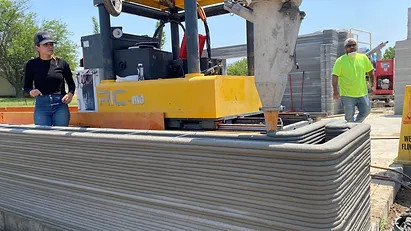
Move over, 3D printed houses. There’s a new game in town, and it is able to use standard concrete blocks to build the walls of a house in just one day.

Australian company FBR’s Hadrian X is a tablet-controlled system that follows CAD models to lay the blocks one by one. As you can see in the video after the break, the blocks are laid so quickly that there’s no time for mortar, so they dip the bottom of each block in construction adhesive instead. In the second video after the break, you can watch Hadrian-X build a curved wall.

There are several things to consider when it comes to outdoor robots, such as wind and unwanted vibration. In order to correct for these nuisances, FBR came up with Dynamic Stabilisation Technology (DST). While we don’t have a lot of details on DST, the company calls it “a highly accurate system that continuously adjusts the position of a robot’s end effector to ensure it is always held with stability at the correct point in 3D space.”

Curious about printed housing? Here’s the current-ish state of affairs.

Continue reading “Brick-Laying Machine Builds Without Mortar”

Paperless RFID Tags Are Carbon-Based

RFID tags are great little pieces of technology, but unfortunately, the combination of paper, metal, and silicon means they are as bad as some modern pregnancy tests — single-use electronic devices that can’t be recycled.

Some prototypes of the RFID tags.

A team of design program graduates from London’s Royal College of Art aim to change that. They’ve devised a mostly-paper RFID tag that’s as safe to recycle as a piece of paper with a pencil doodle on it.

The team’s startup, PulpaTronics have created a design that uses paper as its only material. The circuitry is marked on the paper with a laser set to low power, which doesn’t burn or cut the paper, but instead changes to composition to be conductive.

PulpaTronics were also able to create a chip-less RFID tag much the same way, using a pattern of concentric circles to convey information. The company estimates that these tags will reduce carbon dioxide emissions by 70%, when compared with traditional RFID tags. They’ll also cost about half as much.

RFID is used in many industries, but it’s also great for hacking. Here’s an 8-track player that harnesses the power of RFID tags to play songs off of an SD card.

Thanks for the tip, [gir.st]!

Hackaday Podcast 242: Mechanical Math, KaboomBox, And Racing The Beam

This week, Editor-in-Chief Elliot Williams and Kristina Panos met up from their separate but equally pin drop-quiet offices to discuss the best hacks of the previous week. Well, we liked these one, anyway.

First up in the news, it’s finally time for Supercon! So we’ll see you there? If not, be sure to check out the talks as we live-stream them on our YouTube channel!

Don’t forget — this is your last weekend to enter the 2023 Halloween Hackfest contest, which runs until 9 AM PDT on October 31st. Arduino are joining the fun this year and are offering some spooky treats in addition to the $150 DigiKey gift cards for the top three entrants.

It’s time for a new What’s That Sound, and Kristina was able to stump Elliot with this one. She’ll have to think of some more weirdo sounds, it seems.

Then it’s on to the hacks, beginning with an insanely complex mechanical central air data computer super-teardown from [Ken Shirriff]. We also learned that you can 3D-print springs and things by using a rod as your bed, and we learned whole lot about rolling your own electrolytic capacitors from someone who got to visit a factory.

From there we take a look at a Commodore Datassette drive that sings barbershop, customizing printf, and a really cool dress made of Polymer-dispersed Liquid Crystal (PDLC) panels. Finally we talk about racing the beam when it comes to game graphics, and say goodbye to Kristina’s series on USPS technology.

Check out the links below if you want to follow along, and as always, tell us what you think about this episode in the comments!

Download and savor at your leisure.

Continue reading “Hackaday Podcast 242: Mechanical Math, KaboomBox, And Racing The Beam”