CAT Is Not Your Average Meow-cropad

Are you completely over the idea of the keyboard in any flattish form and looking for something completely different for inputting your data? Or do you want a mega macropad for 3D design, GIMP or Inkscape work, or to use while relaxing with a nice first-person shooter? Then this ergonomic, double-fistable keyboard/controller mashup named CAT may be what you’re looking for.

Inside each of these slinky felines is pretty much what you’d expect to find — 25 or so switches and an Arduino Pro Micro. Interestingly enough, the switches are all lever-action and not push buttons. There are two breeds of CAT available to build or buy: one has 25 buttons, and the other has a joystick or trackball on the thumb between two upper and two lower buttons. You could have one type for each hand!

More information is available on the Lynx Workshop site, which is where you’ll also find tutorials and instructions for everything from the 3D printing to the electronics to the assembly and coding. There is even a bonus 3D modeling tutorial. Don’t want to invest the time to make your own CAT? These kitties are also available for pre-order. Claw past the break to check them out in action.

Looking for something with regular keyswitches? Oh, we have plenty of those.

Continue reading “CAT Is Not Your Average Meow-cropad”

Hackaday Podcast 163: Movie Sound, Defeating Dymo DRM, 3DP Guitar Neck, Biometrics Bereft Of Big Brother

Join Hackaday Editor-in-Chief Elliot Williams and Assignments Editor Kristina Panos as we spend an hour or so dissecting some of the more righteous hacks and projects from the previous week. We’ll discuss a DIY TPM module that satisfies Windows 11, argue whether modern guts belong in retrocomputer builds even if it makes them more practical, and marvel at the various ways that sound has been encoded on film. We’ll also rock out to the idea of a 3D-printed guitar neck, map out some paths to defeating DYMO DRM, and admire a smart watch that has every sensor imaginable and lasts 36+ hours on a charge. Finally, we’ll sing the praises of RS-485 and talk about our tool collections that rival our own Dan Maloney’s catalogue of crimpers.

Check out the links below if you want to follow along, and as always, tell us what you think about this episode in the comments below!

Direct download the show, so you can listen on the go!

Continue reading “Hackaday Podcast 163: Movie Sound, Defeating Dymo DRM, 3DP Guitar Neck, Biometrics Bereft Of Big Brother”

AARP Swipes Right On Senior Social Network

Can you believe that Facebook turns 18 this year? One of the troubled teenager’s biggest problems is that not only are the young people still leaving in droves, many of the remaining denizens are 50 or over and susceptible to the various predators and sources of misinformation that plague the site.

Well, AARP wants to change the landscape of social media for those who are approaching or already living out their twilight years. Basically, they want to lure them away from Facebook. The organization spent untold amounts of money creating Senior Planet Community, which is kind of like a baby version of reddit in that the site is broken into interest categories such as photography, gardening, pets, and fitness enthusiasts.

The site was developed by Older Adults Technology Service (OATS), who are an AARP affiliate. OATS were leading computer classes for seniors and moved online during the pandemic, and the idea grew from there.

The main difference is that Senior Planet Community is absolutely free (for now, at least), including a complete lack of advertisements. If Grandma’s gonna unwittingly spend hundreds on micro-transactions, it won’t be taking place here, and not just because there’s no mobile app or games just yet. As far as moderation, there’s a long list of house rules that involve courtesy and encourage the citing of sources. Posts can be reported should they violate the rules.

We’ll see how it goes. There are plenty of bad actors that could pretend to be age 50+, or don’t even have to lie about it. We also wonder how long they’ll be able to go without advertisers.

We’re all getting older, including Zuckerberg. Don’t believe it? Here’s video proof.

Main and thumbnail images via Unsplash.

REMOTICON 2021 // Hal Rodriguez And Sahrye Cohen Combine Couture And Circuitry

[Hal Rodriguez] and [Sahrye Cohen] of Amped Atelier focus on creating interactive wearable garments with some fairly high standards. Every garment must be pretty, and has to either be controllable by the wearer, through a set of sensors, or even by the audience via Bluetooth. Among their past creations are a dress with color sensors and 3D-printed scales on the front that change color, and a flowing pantsuit designed for a dancer using an accelerometer to make light patterns based on her movements.

Conductive Melody — a wearable musical instrument that is the focus of [Sahrye] and [Hal]’s Remoticon 2021 talk — was created for a presentation at Beakerhead Festival, a multi-day STEAM-based gathering in Calgary. [Sahrye] and [Hal] truly joined forces for this one, because [Sahrye] is all about electronics and costuming, and [Hal] is into synths and electronic music. You can see the demo in the video after the break.

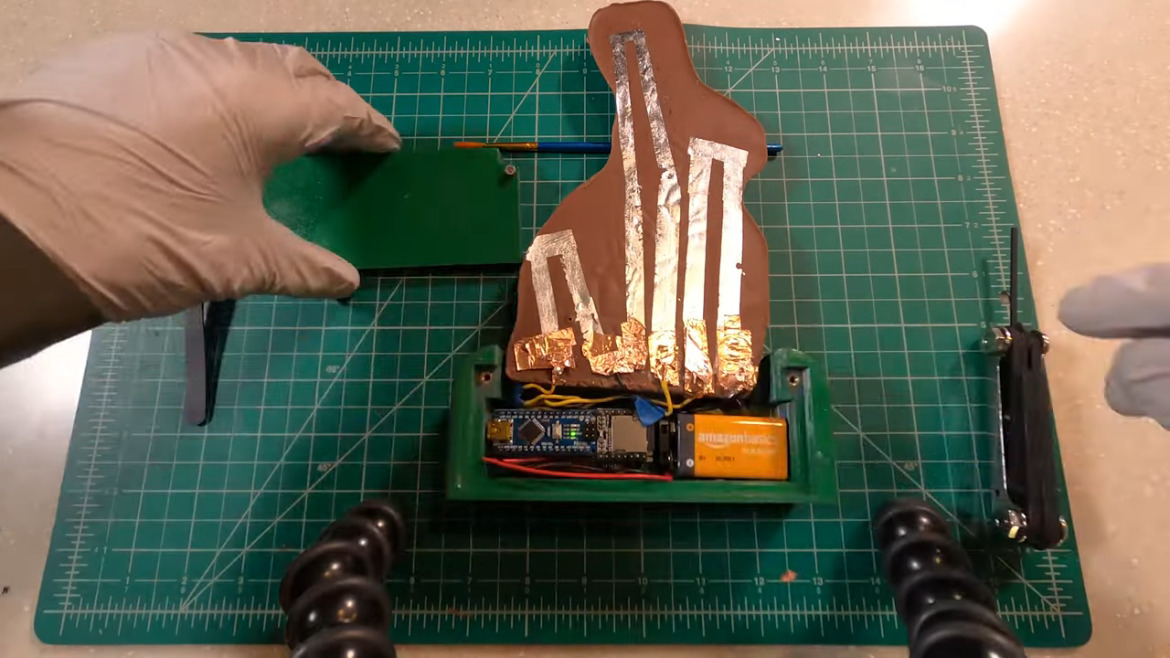
The dress’s form is inspired by classical instruments and the types of clothing that they in turn inspired, such as long, generous sleeves for harp players and pianists. So [Hal] and [Sahrye] dreamed up a dress with a single large playable sleeve that hangs down from the mid- and upper arm. The sleeve is covered with laser-cut conductive fabric curlicues that look like a baroque interpretation of harp strings. Play a note by touching one of these traces, and the lights on the front of the dress will move in sync with the music.

[Sahrye] started the dress portion of Conductive Melody with a sketch of the garment’s broad strokes, then painted a more final drawing with lots of detail. Then she made a muslin, which is kind of the breadboard version of a project in garment-making where thin cotton fabric is used to help visualize the end result. Once satisfied with the fit, [Sahrye] then made the final dress out of good fabric. And we mean really good fabric — silk, in this case. Because as [Sahrye] says, if you’re going to make a one-off, why not make as nicely as possible? We can totally get behind that.

[Sahrye] says she is always thinking about how a wearable will be worn, and how it will be washed or otherwise cared for. That sequined and semi-sheer section of the bodice hides the LEDs and their wiring quite well, while still being comfortable for the wearer.

Inside the sleeve is an MPRP121 capacitive touch sensor and an Arduino that controls the LEDs and sends the signals to a Raspberry Pi hidden among the ruffles in the back of the dress.

The Pi is running Piano Genie, which can turn eight inputs into an 88-key piano in real time. When no one is playing the sleeve, the lights have a standby mode of mellow yellows and whites that fade in and out slowly compared to the more upbeat rainbow of musical mode.

We love to see wearable projects — especially such fancy creations! — but we know how finicky they can be. Among the lessons learned by [Sahrye] and [Hal]: don’t make your conductive fabric traces too thin, and silver conductive materials may tarnish irreparably. We just hope they didn’t have to waste too much conductive fabric or that nice blue silk to find this out.

Continue reading “REMOTICON 2021 // Hal Rodriguez And Sahrye Cohen Combine Couture And Circuitry”

Is The IPhone Camera Too Smart? Or Not Smart Enough?

What is a photograph? Technically and literally speaking, it’s a drawing (graph) of light (photo). Sentimentally speaking, it’s a moment in time, captured for all eternity, or until the medium itself rots away. Originally, these light-drawings were recorded on film that had to be developed with a chemical process, but are nowadays often captured by a digital image sensor and available for instant admiration. Anyone can take a photograph, but producing a good one requires some skill — knowing how to use the light and the camera in concert to capture an image.

Eye-Dynamic Range

The point of a camera is to preserve what the human eye sees in a single moment in space-time. This is difficult because eyes have what is described as high dynamic range. Our eyes can process many exposure levels in real time, which is why we can look at a bright sky and pick out details in the white fluffy clouds. But a camera lens can only deal with one exposure level at a time.

In the past, photographers would create high dynamic range images by taking multiple exposures of the same scene and stitching them together.Done just right, each element in the image looks as does in your mind’s eye. Done wrong, it robs the image of contrast and you end up with a murky surreal soup.

Image via KubxLab

Continue reading “Is The IPhone Camera Too Smart? Or Not Smart Enough?”

ATtiny85 Snake Game Is A Circuit Sandwich

If there’s any looming, unwritten rule of learning a programming language, it states that one must break in the syntax by printing Hello, World! in some form or another. If any such rule exists for game programming on a new microcontroller, then it is certainly that thou shalt implement Snake.

This is [__cultsauce__]’s first foray away from Arduinoville, and although they did use one to program the ATtiny85, they learned a lot along the way.

It doesn’t take much to conjure Snake with an ’85 — mostly you need a screen to play it on (an OLED in this case), some buttons to direct the snake toward the food dot, a handful of passives, and a power source.

[__cultsauce__] started by programming the microcontroller and then tested everything on a breadboard, both of which are admirable actions. Then it was time to make this plywood and cork sandwich, which gives the point-to-point solder joints some breathing room and keeps them from getting crushed. Be sure to check it out in action after the break, and grab the files from GitHub if you want to charm your own ‘tiny Snake.

There’s a ton you can do with this miniature microcontroller, and that includes machine learning.

Continue reading “ATtiny85 Snake Game Is A Circuit Sandwich”

LEGO-Sorting Vacuum Defeats The Problem

What’s the worst thing about LEGO? Most would agree that it’s the fact that those bright and colorful pieces of ABS are somehow the most evil thing that can come between your bare feet and solid ground. [Unnecessary Inventions] have done a one-eighty from their handle and made a quite useful invention — a LEGO-sorting vacuum cleaner called Suck It.

Well, technically, it’s a shop vac attachment, but it does the job beautifully. [Unnecessary Inventions] started with a never-used machine and a clear plastic cylinder cut into fourths. Then he designed some 3D printable brackets that have two jobs: they hold the cylinder together again, and they do so in stages that collect and sort LEGO by size.

The sorting brackets have no top and bottom layers to them — they are all sorting holes and infill to allow maximum suction. But wait, it gets even better, because the brackets click together satisfyingly with embedded magnets. The only thing that would make this build better is some kind of head attachment that could gather more than a narrow swath at a time. Be sure to check out the build and demo video after the break.

Of course, with this method, you still have to open up the sections and put your LEGO away. You could just vacuum them straight into the box.

Continue reading “LEGO-Sorting Vacuum Defeats The Problem”