Wobble Disk Coffee Roaster Looks Good In Wood

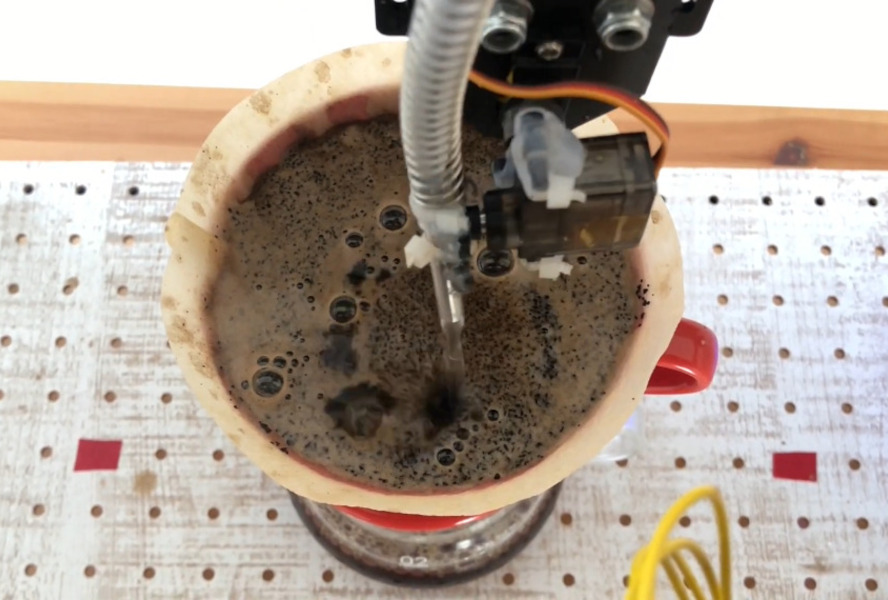
If you love coffee, you probably make it yourself at home most of the time using beans from some hipster coffee shop where the employees have full-sleeve tattoos and strong opinions. Maybe you even buy whole beans and grind them right before you use them. If you want to go all the way, you gotta roast those beans yourself. There are various ways to go about it, like repurposing a hot air corn popper. If you’re [Larry Cotton], you buy heaps of green beans and keep building wobble disk roasters until you’ve achieved DIY perfection.

[Larry]’s latest roaster boasts all-wood construction with no metal brackets or housings in the structural parts. This is good because you’re less likely to burn yourself on anything, and you aren’t sinking heat away from the beans. Nothing should get hot except the sifter, the beans, and the stiff triangle of wire that holds the heat gun nozzle in place. Once the roasting cycle is complete, [Larry] just shakes out the beans onto an adjacent screen that’s situated over a fan so they can cool off.

Unlike some of [Larry]’s previous designs, this one uses an 8-cup flour sifter situated over a heat gun. A battery-powered screwdriver drives the wobbling disk that churns the beans and helps them roast evenly, and a wooden arm holds down the power button. We love the simplicity of this machine, and think wobble disk roasters are mesmerizing to watch. Check out the video after the break to see it in action and learn how to build your own.

There’s more than one way to roast beans, and one of them is even officially sanctioned by Hackaday editor [Elliot Williams].

Continue reading “Wobble Disk Coffee Roaster Looks Good In Wood”

Responsive Paintings Do It With Heat And Light

Art is a conversation, yes. But normally, it’s a short one: the artist makes a statement and the audience responds, each bringing their own interpretations. The hard thing about being an artist is that once you release a piece into the world, it’s sort of bound and gagged in that it can’t defend itself from comments and misinterpretation.

On the other hand, interactive art allows for a longer discussion. Pieces are responsive and no longer mute. But so much of the interactive art out there is purely digital, and lacks a certain analog warmth that comes from physicality. For this year’s Hackaday Prize, [Laura] sought to put a digital interface on an analog visual piece and make paintings that change based on data inputs.

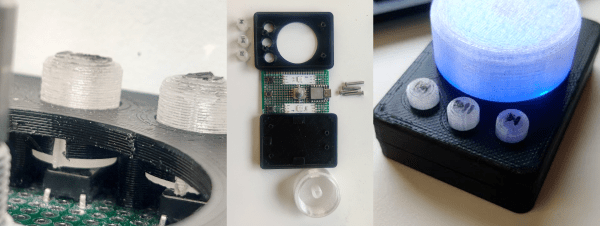
For now, [Laura] is focusing on adding two dynamic elements to her paintings: shifting color and light patterns in response to a viewer’s presence and/or actions using an Arduino and TinyML. For the color changes, [Laura] ended up mixing thermochromic pigment powder with a transparent gel medium.

This was a bit of a journey, because the regular kind of transparent medium came out too runny, and mixing the pigments with white paint made the colors come out lighter than [Laura] wanted and left white behind when heated. But transparent gel medium was just right. You can see the difference in this picture — the colors come out darker with the gel medium, and disappear almost completely with heat.

[Laura] didn’t want to just poke LEDs through the canvas, which in this case is a 1/8″ birch panel. Instead, there’s an RGB matrix shining behind a pair of thin, diffused cutouts filled with thermoplastic.

Check out the video after the break of a painting sketch that uses both techniques. Keep your eye on the purple triangles on the right side, and watch them slowly turn blue in real time as light patterns dance behind the diffused cutouts. Stick around for the second brief video that shows an updated light animation.

We’ve seen many ways of making interactive art, like this Rube Goldberg fairy tale ball maze that you control with your phone.

Continue reading “Responsive Paintings Do It With Heat And Light”

Virginia Apgar May Have Saved Your Life

Between the 1930s and the 1950s, something sort of strange happened in the United States. The infant mortality rate went into decline, but the number of babies that died within 24 hours of birth didn’t budge at all. It sounds terrible, but back then, many babies who weren’t breathing well or showed other signs of a failure to thrive were usually left to die and recorded as stillborn.

As an obstetrical anesthesiologist, physician, and medical researcher, Virginia Apgar was in a great position to observe fresh newborns and study the care given to them by doctors. She is best known for inventing the Apgar Score, which is is used to quickly rate the viability of newborn babies outside the uterus. Using the Apgar Score, a newborn is evaluated based on heart rate, reflex irritability, muscle tone, respiratory effort, and skin color and given a score between zero and two for each category. Depending on the score, the baby would be rated every five minutes to assess improvement. Virginia’s method is still used today, and has saved many babies from being declared stillborn.

Virginia wanted to be a doctor from a young age, specifically a surgeon. Despite having graduated fourth in her class from Columbia University College of Physicians and Surgeons, Virginia was discouraged from becoming a surgeon by a chairman of surgery and encouraged to go to school a little bit longer and study anesthesiology instead. As unfortunate as that may be, she probably would have never have created the Apgar Score with a surgeon’s schedule. Continue reading “Virginia Apgar May Have Saved Your Life”

Revolving Plant Tower Is Solar-Powered

Do you live in a small or yard-less space, but want to grow things anyway? You’re not totally out of luck — you’ll just have to get creative and probably vertical with your planting scheme. And since apartments and other smallish dwellings often have a limited amount of exposure, it would really help a lot if you could somehow rotate the plants so that they receive even sunlight.

[JT_Makes_It]’s rotating strawberry tower ticks all these boxes and more. The 12 V solar cell powers a small DC motor that spins at the gentle speed of 0.6 RPM. The tube is hanging from a swiveling carabiner that acts like a clutch — if a strong wind comes along or something bumps into it, the motor will continue to spin the carabiner.

[JT_Makes_It] already had a tube with holes, though they did cut several more into it. As built, this is not exactly apartment dweller-friendly, unless you have off-site access to things like plasma cutters and welding equipment. But as they point out, you could theoretically use PVC and a hole saw and make it shorter and therefore lighter. We think this looks great, although we’re a bit concerned about the weight. Not so much on the mechanism itself; that looks strong. We’re just wondering how long that carport frame will support it. Judge the build quality for yourself from the video after the break.

Did you know that strawberries can do tricks? Fasciation makes fanned-out berries, and vivipary makes them hairy.

Continue reading “Revolving Plant Tower Is Solar-Powered”

3D-Printed, Hot-Swap Keyboard PCB Generator Is Super Cool

About a month ago, [50an6xy06r6n] shared their hot swap 3D-printed circuit board for keyboard design with the mechanical keyboard subreddit. It’s more of a prototyping tool than a permanent fixture, though nothing is stopping you from using it permanently. Well, now it’s even better, and open source to boot.

[50an6xy06r6n] came up with this to test split ergo layouts faster and not have to solder anything — the switch pins make contact with the row wires and folded diode legs. In fact, prepping all the diodes is probably the thing that takes the longest.

The design can be generated from layout data, or you can convert directly from a KLE JSON file. We love how delightfully clean this keyboard breadboard generator looks, and we wish we had thought of it!

[50an6xy06r6n]’s PCB generator currently supports Cherry MX/clones and Kailh Choc switch footprints. If you want ALPS, somebody’s gonna have to send [50an6xy06r6n] some ALPS to make that happen.

As long as all the contact points are good, you should be able to use this as the final PCB indefinitely. We’ve certainly seen our share of 3D-printed wire guides. Really, you could print the whole thing, including the switches.

Drink Water On Schedule Or Else Flood Your Desk

How much water have you had to drink today? We would venture to guess that the answer is somewhere between ‘absolutely none’ and ‘not not nearly enough’. You can go ahead and blame poor work/life balance — that’s our plan, anyway — and just try to do better. All this working from home means the bathroom situation is now ideal, so why not drink as much water as you can?

But how? Well, you’re human, so you’ll need to make it as easy as possible to drink the water throughout the day. You could fill up one big jug and hoist it to your mouth all day long (or use a straw), but facing that amount of water all at once can be intimidating. The problem with using a regular-sized vessel is that you have to get up to refill it several times per day. When hyper-focus is winning the work/life tug-of-war, you can’t always just stop and go to the kitchen. What you need is an automatic water dispenser, and you need it right there on the desk.

[Javier Rengel]’s water pomodoro makes it as easy as setting your cup down in front of this machine and leaving it there between sips. As long as the IR sensor detects your cup, it will dispense water every hour. This means that if you don’t drink enough water throughout the day, you’re going to have it all over the desk at some point. [Javier] simply connected an Arduino UNO to a water pump and IR sensor pair and repurposed the milk dispenser from a coffee machine. Check it out in action after the break.

Of course, if you aren’t intimidated by the big jug approach, you could keep tabs on your intake with the right kind of straw.

Continue reading “Drink Water On Schedule Or Else Flood Your Desk”

EMOJO Chatbot Will Be There For You

We all need someone to talk to sometimes, and the pandemic has only made matters worse when it comes to the number of people living with anxiety and depression. Exchanging the simplest of pleasantries can make you feel whole again, but the masks make it hard to engage with strangers and judge their emotions, so your big trip to the grocery store can make you feel lonely in a crowd.

So you go back home, still feeling lonely, and maybe you turn on the TV. Watching people interact is probably the next best thing to actual interaction, and it might even make you laugh. But have you ever wished you could talk to the people on TV? With [aniketdhole]’s EMOJO chatbot, you’ll feel as though you’re among friends. And technically you are — all the dialogue is from the TV show Friends.

In Castaway, Tom Hanks didn’t give that volleyball a frowny face, now did he? Nor does he have a dopey grin. Instead, he wears a wry smile that suggests depth of character and a grasp of the dire situation at hand. But now we have emoji, and they do a pretty good job of conveying and evoking emotion. EMOJO is a visual chatbot that uses voice and emoji to make easy, two-way conversation to help chase the loneliness away. It uses a Raspberry Pi and a TFT display to take voice input from a Bluetooth headset, convert it to text, and then respond in kind with both voice and text. It was a finalist in the rethink displays round of the Hackaday Prize, and we can’t wait to see how its character develops. Be sure to check out the demo after the break.

Continue reading “EMOJO Chatbot Will Be There For You”