We’ve previously reported from the UK about the Online Safety Bill, a piece of internet safety legislation that contains several concerning provisions relating to online privacy and encryption. UK laws enter the statutes by royal assent after being approved by Parliament, so with the signature of the King, it has now become the law of the land as the Online Safety Act 2023. Now that it’s beyond amendment, it’s time to take stock for a minute: what does it mean for internet users, both in the UK and beyond its shores? Continue reading “The UK Online Safety Bill Becomes Law, What Does It Mean?”
Author: Jenny List3427 Articles
A Simple And Effective 3D Filament Splicer
There are times in every 3D print enthusiast’s life when it would be convenient to join two pieces of filament. The problem with simply melting them together is that the resulting join has a blob of plastic surrounding it which has difficulty making it through the printer’s internals. [Pete Prodoehl] has a solution, in the form of a well-executed splicing jig that’s sure to leave a join which will glide through your printer.
The trick lies in performing the join in a space only marginally wider than the filament width, in the case of 1.75 mm filament a short piece of 1.775 mm PTFE tube encased in a 3D printed clamp. A 90-degree cut piece of filament is fed through the tube and heated with a candle, then withdrawn into the tube where a 45-degree cut piece is pushed in to fuse with it. The result is a seamless and bulge-less join, that can pass through an extruder without issue and print continuous pieces from different filaments.
It’s a very effective technique, but it’s not the only one we’ve seen over the years. This one by comparison heats the filament in a hair straightener, and relies on gently pulling the join apart as it solidifies in order to reduce the bulge.
This Machine Has Lost Its Marbles
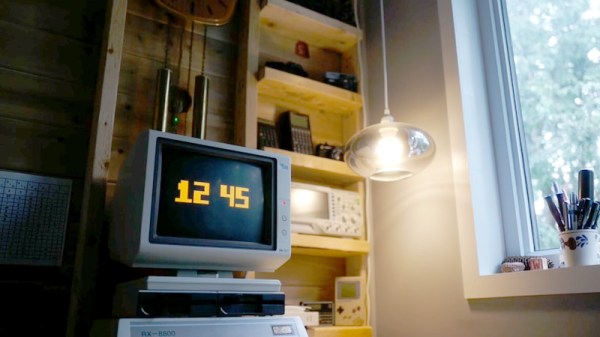
The astonishing variety of ways to tell the time which have appeared on these pages over the years provides a showcase of the talents and ingenuity of our community. Many clocks use designs we are familiar with, but every now and then along comes a clock that rings something new. So it is with [Ivan Miranda]’s latest work — a digital clock that shows the time with a dot matrix made of marbles. So far he’s published only part one of what will become a series. There’s technically no clock yet, but as it stands it’s enough of a marble machine to be a worthy project in its own right.
In the video below we see him solving the problems of creating free-running marble transport and handling via a conveyor belt, and solving such unexpected problems as cleanly releasing them from the belt, holding a row of marbles with a solenoid, and catching errant marbles that bounce free of the machine. The result is a rather pretty marble machine that makes an endless cascade of falling marbles on a curved track. We’re guessing that future videos will deal with the assembly of lines for the dot matrix display, such that the figures of the clock will be formed from black and white marbles, so this is a series to watch out for.
We’ve seen [Ivan]’s work in the past, not least for his giant 3D printer.
Make Your Own 1970s Magnetic Stripe Cards
We’re now all used to near-limitless storage on flash and other semiconductor technologies, but there was a time when persistent storage was considerably less easy to achieve. A 1970s programmable calculator from Sharp approached the problem with magnetic strips on special cards, and since [Menadue] has one with no cards, he set about making his own.
These cards are a little different to the credit-card-style cards we might expect, instead they’re a narrow strip with a magnetic stripe down their centre. The unusual feature can be found at the edge, where a row of perforations provide the equivalent of a clock line.
The newly manufactured cards have the clock slots machined along their edges, and then the magnetic part formed from self-adhesive magnetic strip. This last thing is a product we were not aware existed, and can think of plenty of possible applications.
The result as you can see in the video below the break are some cards with variable reliability. There’s a suggestion that white cards might work less well with the infrared light used in the clock detector, also a suspicion the low batteries make reading less easy, but still he’s able to retrieve a stored program. An extinct medium is revived.
Longtime readers will know we’ve spent time in calculator country before.
Continue reading “Make Your Own 1970s Magnetic Stripe Cards”
Making Magnetic Tape From Scratch
The use of magnetic tape and other removable magnetic media is now on the wane, leading to scarcity in some cases where manufacture has ceased. Is it possible to produce new magnetic tape if you don’t happen to own a tape factory? [Nina Kallnina] took the effort to find out.
It’s probably one of those pieces of common knowledge, that magnetic media use iron oxides on their surface, which is the same as rust. But the reality is somewhat more complex, as there is more than one iron oxide. We follow [Nina] through this voyage of discovery in a Mastodon thread, as she tries first iron filings, the rust, and finally pure samples of the two iron oxides Fe3O4 and Fe2O3. She eventually achieves a working tape with a mixture of Fe2O3 and iron powder, though its performance doesn’t match manufactured tape. It turns out that there are two allotropes of Fe2O3, and she leaves us as she’s trying to make the one with better magnetic properties.
These results look promising, and while there is evidently a very long way to go before a home-made magnetic coating could replicate the exacting demands of for example a hard drive platter it’s evident that there is something in pursuing this path.
This may be the first time we’ve seen tape manufacture, but we’ve certainly seen extreme measures taken to rejuvenate old tapes.
The IMac GPU Becomes Upgradeable, With PCIe
Over its long lifetime, the Apple iMac all-in-one computer has morphed from the early CRT models through those odd table-lamp machines into today’s beautiful sleek affairs. They look pretty, but is there anything that can be done to upgrade them? Maybe not today’s ones, but the models from the mid-2000s can be given some surprising new life. [LowEndMac] have featured a 2006 24″ model that’s received a much more powerful GPU, something we’d have thought to be impossible.
The iMacs from that era resemble a monitor with a slightly chunkier back, in which resides the guts of the computer. By then the company was producing machines with an x86 processor, and their internals share a lot of similarities with a laptop of the period. The card is a Mac Radeon model newer than the machine would ever be used with, and it sits in a chain of mini PCIe to PCIe adapters. Even then it can’t drive the original screen, so a replacement panel and power supply are taken from another monitor and grafted into the iMac case. This along with a RAM and SSD upgrade makes this about the most upgraded a 2006 iMac could be.
Of course, another approach is to simply replace the whole lot with an Intel NUC.
When Is Damascus Steel Not From Damascus?
If you grow up around a working blacksmith’s forge, there are a few subjects related to metalwork on which you’ll occasionally have a heated discussion. Probably the best known is the topic of wrought iron, a subject I’ve covered here in the past, and which comes from the name of a particular material being confused with a catch-all term of all blacksmith-made items. I’ve come to realise over recent years that there may be another term in general use which is a little jarring to metalwork pedants, so-called Damascus steel. Why the Syrian capital should pop up in this way is a fascinating story of medieval metalworking, which can easily consume many days of research.
Damascus? Where’s That?

The Damascus steel you’ll see in YouTube videos, TV shows, and elsewhere is a steel with complex bands and striations on its surface. It’s often used in knife blades, and it will usually have been chemically treated to enhance the appearance of the patterns. It’s a laminate material made by pattern welding layers of different steels together, and it will usually have been worked and folded many times to produce a huge number of very thin layers of those steels. Sometimes it’s not made from sheets or ingots of steel but from manufactured steel products such as chains, in an attempt to produce a result with more unusual patterns. Continue reading “When Is Damascus Steel Not From Damascus?”