A Network Adapter Thinks It’s A CD-ROM. Restore Its True Calling!

A mildly annoying trend over recent years has been for USB hardware devices to expose a CD-ROM drive containing their drivers for Windows users. Of course there’s no real CD in there, instead the software lives on a piece of flash memory. It’s usually not a problem as they also appear on the USB bus as their true calling, but not always.

[Martijn Braam] found himself the lucky owner of a USB network adapter which seemed to see its only purpose in life to be such a drive, and since he  wasn’t anxious to make another piece of e-waste, he broke it open to see if the fake CD drive could be disabled.

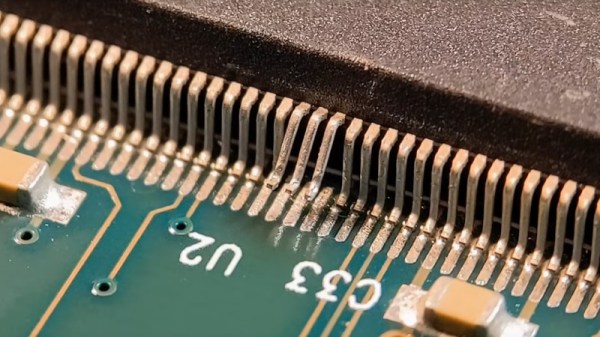
Inside the flimsy case he found a CoreChips SR9700 Ethernet controller, a chip for which there seems to be very little data in the wild. On the underside of the PCB was a flash chip, and as expected disabling this caused the CD drive to disappear to be replaced by the expected network card.

It’s a simple but useful hack, but there’s a little bonus for those unaware in the write-up. There’s a piece of software called USB_modeswitch that can perform this task on many cards, which is worth storing away in the event that it’s needed.

Raspberry Pi OS In-Place Upgrades, Not For The Faint Hearted

The Raspberry Pi series of boards are noted for their good software support, with a continuous flow of operating system upgrades such that an original Pi from 2012 will still boot the latest Pi OS. But these upgrades are best done by writing a fresh SD card, so oddly, the Pi remains surprisingly difficult in many cases to upgrade in place. [Iustin Pop] has taken a look at the problem, and finds that though it’s not always easy it remains possible with a bit or work.

An upgrade in place of a Raspberry Pi OS install that’s running on a headless device is probably the simplest of the lot, with a relatively small set of issues. Do it on a machine using the GUI though, and the switch from x.org to Wayland makes for a whole world of pain.

Perhaps most interesting for the insight it gives us into the way Raspberry Pi OS is derived from Debian, is the crossgrade process from the ARMhf build for earlier machines to the ARM64 one for the more recent ones. Here aside from a headache of differing paths and versions, he encounters the Pi-specific compilation tweaks put in place by the developers of Raspberry Pi OS, leading to the ARMhf version being a different branch from the original Debian than the ARM64 one.

Having read his examination of in-place upgrades we have to say that simply writing a new SD card remains the most attractive option. But sometimes along comes a remote system where that’s simply not possible, and this guide might just be very useful sometime.

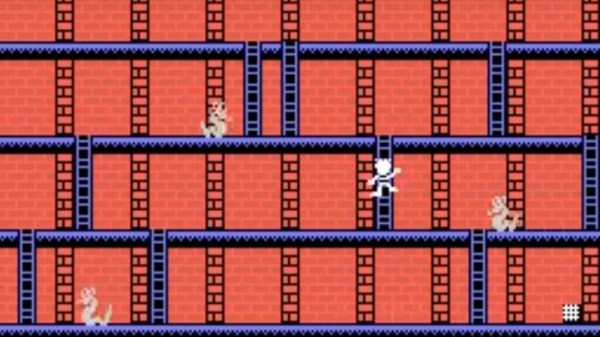
Digital Photography Comes To The Apple II

Back in the very early days of consumer digital photography, one of the first stars of the new medium came from Apple. The QuickTake 100 used a novel flat form factor and at its highest resolution could only shoot 640×480 images, but at the time it was a genuine object of desire. It came in Windows and Apple versions, and to use the Apple variant required a Mac of the day with appropriate software.

The interface was an Apple serial connector though, so it was quite reasonable for [Colin Leroy-Mira] to wonder whether it could work with Apple’s 8-bit machines. The result is QuickTake for the Apple IIc, the product that perhaps Apple should have brought us in an alternative 1994.

Fortunately the protocol has already been reverse engineered and forms part of the dcraw package, however the process of extracting the code wasn’t easy. The full resolution and colour of the original pictures has to be sacrificed, and of course once the custom serial cable has been made it’s a painfully slow process transferring the pictures. But to get anything running in this way on such elderly hardware which was never intended to  perform this task is an extremely impressive feat. We would have given anything for this, back in the 8-bit days.

If you have a QuickTake and want to use a more modern machine, we’ve got you covered there, too.

Only One Hacker At The Keyboard? Amateurs!

We imagine many of you have seen the ridiculous scene from the TV series NCIS in which a network intrusion is combated by two people working at the same keyboard at once. It’s become a meme in our community, and it’s certainly quite funny.  But could there be a little truth behind the unintentional joke? [Tedu] presents some possibilities, and they’re not all either far-fetched or without application.

The first is called Duelmon, and it’s a split-screen process and network monitor worthy of two players, while the second is Mirrorkeys, a keyboard splitter which uses the Windows keys as modifiers to supply the missing half. As they say, the ability to use both at once would be the mark of the truly 1337.

Meanwhile here at Hackaday we’re evidently closer to 1336.5, as our pieces are written by single writers alone at the keyboard. We would be fascinated to see whether readers could name any other potential weapons in the dual-hacker arsenal though, and we’d like to remind you that as always, the comments are open below.

The intense hacking scene from NCIS can be found below the break. Be warned though, it contains the trauma of seeing a computer unplugged without shutting down first.

Continue reading “Only One Hacker At The Keyboard? Amateurs!”

Android: Coming Soon To A RISC-V Processor Near You

In the roughly decade and a half since the Android mobile operating system appeared on the scene it has been primarily sold on devices with an ARM core at their heart, but along the way it has also appeared for other architectures. If you had a MIPS Android phone you may have been in the minority, but Intel phones enjoyed some popularity, and the up-and-coming new kid in the world of Android is RISC-V. For anyone interested in this last architecture it’s worth looking at the Google Open Source blog, in which they’ve published an overview of the current status of the project.

In short, it’s full steam ahead — as the development environment and emulation is in place for RISC-V Android. It’s certain we’ll start seeing RISC-V phones on the market soon, but perhaps that’s not the part which should interest readers the most. Over the last decade we have seen an explosion of inexpensive ARM single board computers, and though some of them such as the Raspberry Pi owe their heritage to set-top-box SoCs, it’s fair to say that a strong driver for this trend has been the proliferation of powerful mobile chips. A take-up of RISC-V driven by Android would mean a similar explosion of powerful SoCs with those  cores, leading we hope to much more accessible and powerful RISC-V computing. Sadly we expect them to still come with proprietary peripherals leading to plenty of closed source blobs, but we can’t have everything.

If you’d like to read more about the whole blob situation and RISC-V, we’ve got you covered.

Making A Solder Paste Stencil From What You Have On Hand

Sometimes there are moments when an engineer has to use whatever materials they have to hand in order to complete the job on time. Such a situation arose at the RevSpace hacker space in Den Haag, Netherlands, as they were the assembly venue for a conference badge.

Their problem was that the badge PCB had no solder paste stencil, and the solution was to laser cut one out of an unexpected material. The backing paper for self-adhesive vinyl sheet has properties not unlike those desired of a stencil, so they tried laser-cutting one from that material. The result was a robust stencil that outperformed the Mylar they had previously used, enabled the manufacture of 350 boards.

They think that the polymer layer on top of the paper may be silicone, and found that the laser didn’t unduly melt the edges of the cut. We’re not sure we’d feed random unknown plastics into our cutter, we’re guessing they have good quality ventilation. It’s mounted into a plywood jig in much the same way as a conventional stencil might be.

The badges were destined for WICCON, a Dutch conference from an organisation for women in cybersecurity. Sadly we’ve not seen a completed one so we’re not sure what it does, however we’re pleased to hear they were completed before the event. That’s a hurdle all badge designers will know well.

Long term readers may remember, that RevSpace have something of a history when it comes to assembling badges.

Need A Low-Mass Antenna In Space? Just Blow It Up!

A parabolic antenna is a simple enough device, a curved reflector designed to focus all the radiation from the direction it’s pointed into a waveguide or antenna at its feedpoint. They’re easy enough to make for a radio amateur, but imagine making one for a spacecraft. It must fold into a minimal space and weigh almost nothing, both difficult to achieve. An engineering academic doing work for NASA, [Christopher Walker], has a new way to make the parabolic surface that solves the spacecraft designer’s problems at a stroke, it forms its parabolic reflector on the inside of an inflatable structure. In this way relatively huge reflectors can be built in space, with easy folding and very little weight. Continue reading “Need A Low-Mass Antenna In Space? Just Blow It Up!”