Android: Coming Soon To A RISC-V Processor Near You

In the roughly decade and a half since the Android mobile operating system appeared on the scene it has been primarily sold on devices with an ARM core at their heart, but along the way it has also appeared for other architectures. If you had a MIPS Android phone you may have been in the minority, but Intel phones enjoyed some popularity, and the up-and-coming new kid in the world of Android is RISC-V. For anyone interested in this last architecture it’s worth looking at the Google Open Source blog, in which they’ve published an overview of the current status of the project.

In short, it’s full steam ahead — as the development environment and emulation is in place for RISC-V Android. It’s certain we’ll start seeing RISC-V phones on the market soon, but perhaps that’s not the part which should interest readers the most. Over the last decade we have seen an explosion of inexpensive ARM single board computers, and though some of them such as the Raspberry Pi owe their heritage to set-top-box SoCs, it’s fair to say that a strong driver for this trend has been the proliferation of powerful mobile chips. A take-up of RISC-V driven by Android would mean a similar explosion of powerful SoCs with thoseĀ  cores, leading we hope to much more accessible and powerful RISC-V computing. Sadly we expect them to still come with proprietary peripherals leading to plenty of closed source blobs, but we can’t have everything.

If you’d like to read more about the whole blob situation and RISC-V, we’ve got you covered.
Making A Solder Paste Stencil From What You Have On Hand

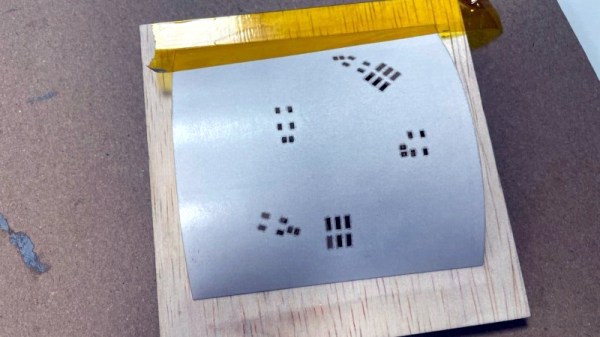
Sometimes there are moments when an engineer has to use whatever materials they have to hand in order to complete the job on time. Such a situation arose at the RevSpace hacker space in Den Haag, Netherlands, as they were the assembly venue for a conference badge.

Their problem was that the badge PCB had no solder paste stencil, and the solution was to laser cut one out of an unexpected material. The backing paper for self-adhesive vinyl sheet has properties not unlike those desired of a stencil, so they tried laser-cutting one from that material. The result was a robust stencil that outperformed the Mylar they had previously used, enabled the manufacture of 350 boards.

They think that the polymer layer on top of the paper may be silicone, and found that the laser didn’t unduly melt the edges of the cut. We’re not sure we’d feed random unknown plastics into our cutter, we’re guessing they have good quality ventilation. It’s mounted into a plywood jig in much the same way as a conventional stencil might be.

The badges were destined for WICCON, a Dutch conference from an organisation for women in cybersecurity. Sadly we’ve not seen a completed one so we’re not sure what it does, however we’re pleased to hear they were completed before the event. That’s a hurdle all badge designers will know well.

Long term readers may remember, that RevSpace have something of a history when it comes to assembling badges.

Need A Low-Mass Antenna In Space? Just Blow It Up!

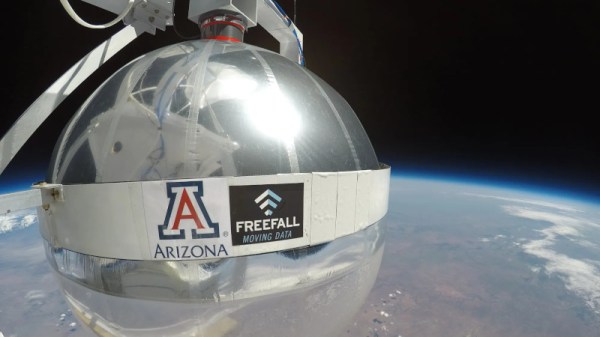
A parabolic antenna is a simple enough device, a curved reflector designed to focus all the radiation from the direction it’s pointed into a waveguide or antenna at its feedpoint. They’re easy enough to make for a radio amateur, but imagine making one for a spacecraft. It must fold into a minimal space and weigh almost nothing, both difficult to achieve. An engineering academic doing work for NASA, [Christopher Walker], has a new way to make the parabolic surface that solves the spacecraft designer’s problems at a stroke, it forms its parabolic reflector on the inside of an inflatable structure. In this way relatively huge reflectors can be built in space, with easy folding and very little weight. Continue reading “Need A Low-Mass Antenna In Space? Just Blow It Up!”

The UK Online Safety Bill Becomes Law, What Does It Mean?

We’ve previously reported from the UK about the Online Safety Bill, a piece of internet safety legislation that contains several concerning provisions relating to online privacy and encryption. UK laws enter the statutes by royal assent after being approved by Parliament, so with the signature of the King, it has now become the law of the land as the Online Safety Act 2023. Now that it’s beyond amendment, it’s time to take stock for a minute: what does it mean for internet users, both in the UK and beyond its shores? Continue reading “The UK Online Safety Bill Becomes Law, What Does It Mean?”

A Simple And Effective 3D Filament Splicer

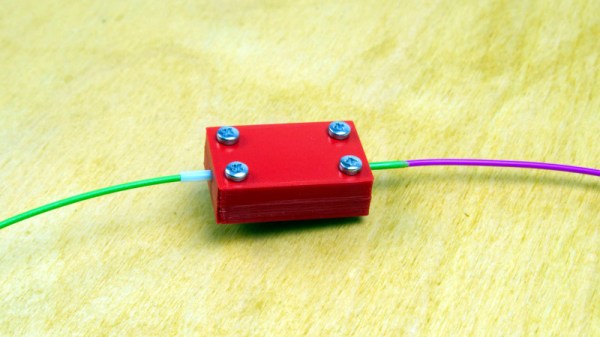
There are times in every 3D print enthusiast’s life when it would be convenient to join two pieces of filament. The problem with simply melting them together is that the resulting join has a blob of plastic surrounding it which has difficulty making it through the printer’s internals. [Pete Prodoehl] has a solution, in the form of a well-executed splicing jig that’s sure to leave a join which will glide through your printer.

The trick lies in performing the join in a space only marginally wider than the filament width, in the case of 1.75 mm filament a short piece of 1.775 mm PTFE tube encased in a 3D printed clamp. A 90-degree cut piece of filament is fed through the tube and heated with a candle, then withdrawn into the tube where a 45-degree cut piece is pushed in to fuse with it. The result is a seamless and bulge-less join, that can pass through an extruder without issue and print continuous pieces from different filaments.

It’s a very effective technique, but it’s not the only one we’ve seen over the years. This one by comparison heats the filament in a hair straightener, and relies on gently pulling the join apart as it solidifies in order to reduce the bulge.

This Machine Has Lost Its Marbles

The astonishing variety of ways to tell the time which have appeared on these pages over the years provides a showcase of the talents and ingenuity of our community. Many clocks use designs we are familiar with, but every now and then along comes a clock that rings something new. So it is with [Ivan Miranda]’s latest work — a digital clock that shows the time with a dot matrix made of marbles. So far he’s published only part one of what will become a series. There’s technically no clock yet, but as it stands it’s enough of a marble machine to be a worthy project in its own right.

In the video below we see him solving the problems of creating free-running marble transport and handling via a conveyor belt, and solving such unexpected problems as cleanly releasing them from the belt, holding a row of marbles with a solenoid, and catching errant marbles that bounce free of the machine. The result is a rather pretty marble machine that makes an endless cascade of falling marbles on a curved track. We’re guessing that future videos will deal with the assembly of lines for the dot matrix display, such that the figures of the clock will be formed from black and white marbles, so this is a series to watch out for.

We’ve seen [Ivan]’s work in the past, not least for his giant 3D printer.

Continue reading “This Machine Has Lost Its Marbles”

Make Your Own 1970s Magnetic Stripe Cards

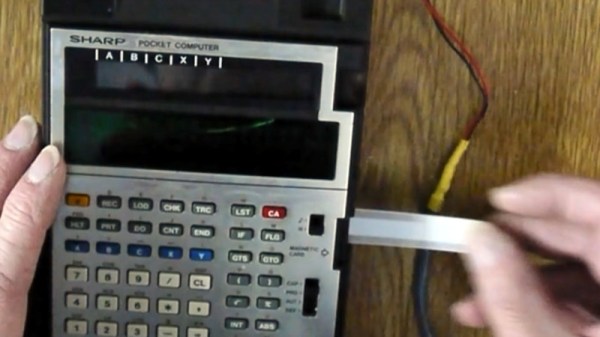
We’re now all used to near-limitless storage on flash and other semiconductor technologies, but there was a time when persistent storage was considerably less easy to achieve. A 1970s programmable calculator from Sharp approached the problem with magnetic strips on special cards, and since [Menadue] has one with no cards, he set about making his own.

These cards are a little different to the credit-card-style cards we might expect, instead they’re a narrow strip with a magnetic stripe down their centre. The unusual feature can be found at the edge, where a row of perforations provide the equivalent of a clock line.

The newly manufactured cards have the clock slots machined along their edges, and then the magnetic part formed from self-adhesive magnetic strip. This last thing is a product we were not aware existed, and can think of plenty of possible applications.

The result as you can see in the video below the break are some cards with variable reliability. There’s a suggestion that white cards might work less well with the infrared light used in the clock detector, also a suspicion the low batteries make reading less easy, but still he’s able to retrieve a stored program. An extinct medium is revived.

Longtime readers will know we’ve spent time in calculator country before.

Continue reading “Make Your Own 1970s Magnetic Stripe Cards”