Raspberry Pi Reveals A Little About Their RP1 Peripheral

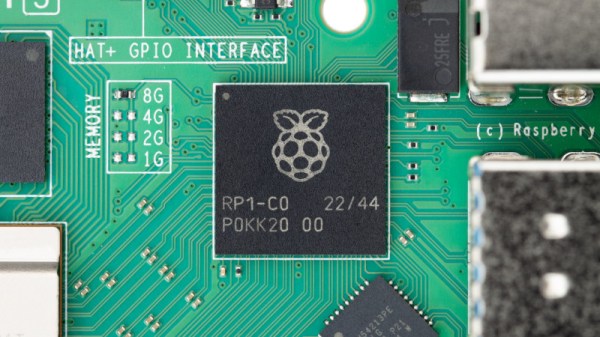
The Raspberry Pi 5 is the new hotness from the Cambridge-based single board computer vendor, thanks in part to its new wonder-chip peripheral that speeds up much of its interfacing with the world. The RP1 hangs of the CPU’s PCIe bus and takes on many functions previously in the SoC, and those curious about it now have a little bit of information. Eben Upton has posted an article about the chip, and there’s a partial datasheet and a video in which the engineers talk about the chip as well.

The datasheet is intended to help anyone wishing to write a hardware driver for a Pi 5, and they admit that it doesn’t reveal everything on the silicon. We don’t expect them to put this chip up for sale on its own because doing so would enable their competitors to produce something much closer to a Pi 5 clone. It does reveal a few nuggets, though; there are a couple of Cortex M3 cores for housekeeping, and alongside all the interfaces we know from earlier boards it has, perhaps most interestingly for Hackaday readers, a 12-bit analogue-to-digital converter. This has always been on our Pi wishlist and is a welcome addition.

So, if you read the datasheet and watch the video below, you’ll learn a lot about the interfaces and how to talk to them, but not quite so much about the full workings of the chip itself. They hint that there’s more to be released, but since the Pi people have a history of not letting go of the family silver, we won’t expect the keys to the kingdom.

Have a read of our Pi 5 launch coverage.

Continue reading “Raspberry Pi Reveals A Little About Their RP1 Peripheral”
Use Your Old SLR As A Digital Camera?

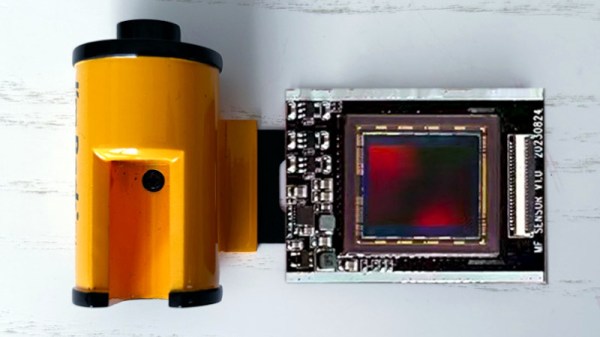
Back in the late 1990s as the digital revolution overtook photography there were abortive attempts to develop a digital upgrade for 35mm film cameras. Imagine a film cartridge with attached sensor, the idea went, which you could just drop into your trusty SLR and continue shooting digital. As it happened they never materialised and most film SLRs were consigned to the shelf. So here in 2023 it’s a surprise to find an outfit called I’m Back Film promising something very like a 35mm cartridge with an attached sensor.

The engineering challenges are non-trivial, not least that there’s no standard for distance between reel and exposure window, and there’s next-to-no space at the focal plane in a camera designed for film. They’ve solved it with a 20 megapixel Micro Four Thirds sensor which gives a somewhat cropped image, and what appears to be a ribbon cable that slips between the camera back and the body to a box which screws to the bottom of the camera. It’s not entirely clear how they solve the reel-to-window distance problem, but we’re guessing the sensor can slide from side to side somehow.

It’s an impressive project and those of us who shot film back in the day can’t resist a bit of nostalgia for our old rigs, but we hope it hasn’t arrived too late. Digital SLRs are ubiquitous enough that anyone who wants one can have one, and meanwhile the revival in film use has given many photographers a fresh excuse to use their old camera the way it was originally intended. We’ll soon see whether it catches on though — the crowdsourcing campaign for the project will be starting in a few days.

Oddly this isn’t the first such project we’ve seen, though it is the first with a usable-size sensor.

Just When You Think Everything In Robotic Combat Has Been Tried Before…

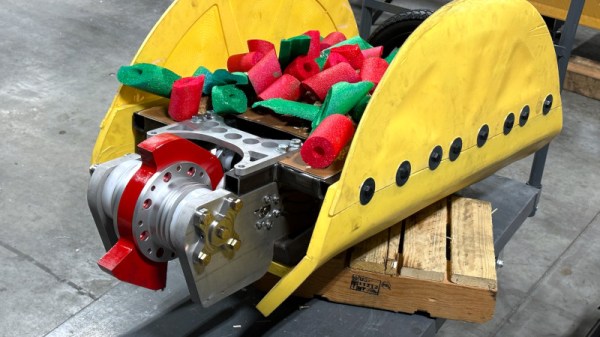
Since the first combat robots emerged around three decades ago, it seems as though every conceivable configuration has been tried at some point or other. Whether it’s a two-wheeled wedgebot, a walker, a four-wheeled flip-bot, or whatever, someone’s already been there. But how about a self-righting taco with a novel two-wheel drive system? It’s called Taco Tuesday, its team lead [Carter Hurd] has sent us the video below the break, and it’s worth a second look because the technique might find a place outside the arena.

The robot with [Carter] sitting behind it

So what exactly is novel about this bot? It has a single big fat wheel near the front in a longitudinal direction, and a larger slimmer one at the back in a transverse direction. The former wheel propels it around the arena while the latter wheel acts as a rear-wheel steering system, allowing it to pivot round and face an attacker very quickly indeed.

It’s this maneuverability which we think could find an application in other machines, though the same problem they have of sideways friction on that rear wheel would need to be overcome.

The video follows the bot through a BattleBots competition in Las Vegas, and shows us some of the damage they receive in combat. The drive system needs a bit more refinement, but this outing certainly proves it has plenty of potential.

Some of us here at Hackaday have a bit of a soft spot for fighting robots.

Continue reading “Just When You Think Everything In Robotic Combat Has Been Tried Before…”

Just What Is Tone, In A Microphone?

As long-time Hackaday readers will know, there is much rubbish spouted in the world of audio about perceived tone and performance of different hi-fi components. Usually this comes from audiophiles with, we’d dare to suggest, more money than sense. But oddly there’s an arena in which the elusive tone has less of the rubbish about it and it in fact, quite important. [Jim Lill] is a musician, and like all musicians he knows that different combinations of microphones impart a different sound to the recording. But as it’s such a difficult property to quantify, he’s set out to learn all he can about where the tone comes from in a microphone.

He’s coming to this from the viewpoint of a musician rather than an engineer, but his methodology is not diminished by this. He’s putting each mic on test in front of the same speaker at the same position, and playing a standard piece of music and a tone sweep through each. He doesn’t have an audio analyser, reference speaker and microphone, or anechoic chamber, so he’s come up with a real-world standard instead. He’s comparing every mic he can find with a Shure SM57, the go-to general purpose standard in the world of microphones for as long as anyone can remember, being a 1960s development of their earlier Unidyne series. His reasoning is that while its response is not flat the sound of the SM57 is what most people are used to hearing from a microphone, so it makes sense to measure the others against its performance.

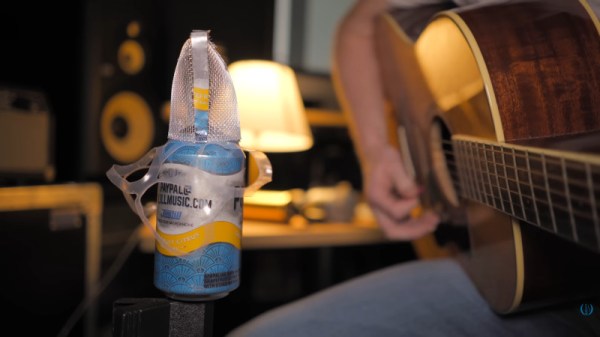
Along the way he tests a huge number of microphones including famous and expensive ones from exclusive studios and finally one he made himself by mounting a cartridge atop a soda can. You’ll have to watch the video below the break for his conclusions, we can promise it’s worth it.

Continue reading “Just What Is Tone, In A Microphone?”

Spuds Lend A Hand In The Darkroom

If film photography’s your thing, the chances are you may have developed a roll or two yourself, and if you’ve read around on the subject it’s likely you’ll have read about using coffee, beer, or vegetable extracts as developer. There’s a new one to us though, from [cm.kelsall], who has put the tater in the darkroom, by making a working developer with potatoes as the active ingredient.

The recipe follows a fairly standard one, with the plant extract joined by some washing soda and vitamin C. The spuds are liquidised and something of a watery smoothie produced, which is filtered and diluted for the final product. It’s evidently not the strongest of developers though, because at 20 Celcius it’s left for two hours to gain an acceptable result.

The chemistry behind these developers usually comes from naturally occurring phenols in the plant, with the effectiveness varying with their concentration. They’re supposed to be better for the environment than synthetic developers, but sadly those credentails are let down somewhat by there not being a similar green replacement for the fixer, and the matter of a load of silver ions in the resulting solutions. Still, it’s interesting to know that spuds could be used this way, and it’s something we might even try ourselves one day.

We’ve even had a look at the coffee process before.

Rock Salt May Lead The Way To Better Batteries

The regular refrain here when it comes to announcements of new battery chemistries hailed as potentially miraculous is that if we had a pound, dollar, or Euro for each one we’ve heard, by now we’d be millionaires. But still they keep coming, and it’s inevitable that there will one or two that break through the practicality barrier and really do deliver on their promise. Which brings us tot he story which has come our way today, the suggestion that something as simple as rock salt could triple the energy density of a lithium-ion vehicle battery.

The research led from Lawrence Berkeley National Laboratory started around the use of cobalt in the battery cathode, an expensive and finite resource with the added concern of being in large part a conflict mineral from the Democratic Republic of Congo. Cobalt is used inĀ  the cathodes because its oxide crystals form a stable layered structure into which the lithium ions can percolate. Alternative layered-structure metal oxides perform less well in retaining the lithium ions, making them unsuccessful substitutes. It seems that the three-dimensional structure of a rock salt crystal performs up to three times better than any layered oxide, which is where the excitement comes from.

Of course, if it were that simple we’d all be using three-times-more-powerful, half-price 18650s right now, which of course we aren’t. The challenge comes in making a rock salt cathode which both holds the lithium ions, and keeps that property reliably over the thousands of charge cycles needed for a real-world application. This one may yet be anther dollar on that metaphorical pile, but it just might give us the batteries we’ve been looking for.

Then again, when you’re looking at exciting battery chemistry, why limit yourself to lithium?

Using 5V Programmable Logic Here In The 2020s

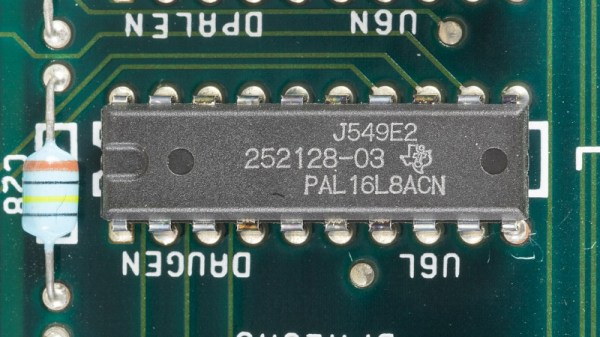
Do you speak GAL? [Peterzieba] does, and has pulled together a collection of documents and tools so that you can too. There’s a dividing line in electronic engineering education, between those who were taught about FPGAs, and those who weren’t. Blurring that line slightly is gate array logic (GAL). These devices were a preceursor to the FPGA, with a much simpler structure, and usually in those days UV-erasable in the same manner as an EPROM. And oddly enough, they, or at least their successor compatible parts, are still available, and as handy DIP devices that talk to 5 volt logic.

The guide goes into detail about the parts, the terminology surrounding them, and the CUPL language which raises a few memories for us. There are several possible workflows, including for those not faint of heart, the possibility of writing a fusemap by hand. We’re impressed by that one.

If these devices interest you, our colleague Bil Herd wrote a two-part guide (part one, and part two) which should answer your questions.

Thanks [Bjonnh] for the tip!

Featured image: “Commodore Amiga 1000 – sub board – Texas Instruments PAL16L8ACN-0126” by Raimond Spekking