2023 Cyberdeck Challenge: KOAT0 Portable Terminal

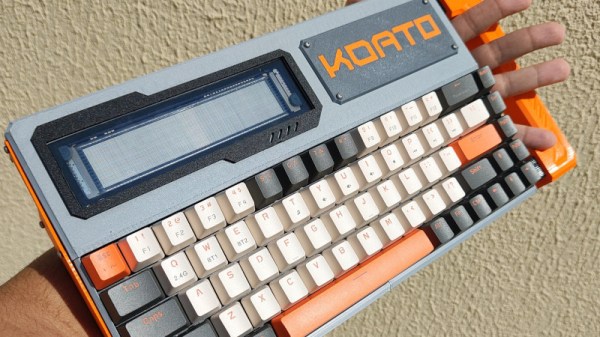
We’ve had cyberdecks as part of the scenery for long enough now that there are a series of common elements that appear across many different builds. The Raspberry Pi, for instance, or the mechanical keyboard, with a 3D printed body. [RobsonCuto]’s KOAT0 Portable Terminal has some of those in a particularly slim and neat design. The orange and grey color scheme is great really pops. Where this deck really shines though, is the display.  He’s eschewed LCDs or OLEDs, even CRTs, and gone for an unusual choice in a dot-matrix VFD.

The VFD in question is commonly available on AliExpress where it appears to be used for displaying Chinese characters. It’s not an obvious choice for a cyberdeck, so once the tidy-looking case is complete the real challenge in this project becomes how to drive it from the Pi. To that end, he appears to have some kind of text output working but still needs to complete a framebuffer driver. We applaud the effort and we really like the display.  We’re curious as to how its meager resolution might best be used in a Linux device.

All in all, this is a ‘deck we’d be happy to use ourselves if it were an option. We particularly like the on-the-arm style of use, and we’re pretty sure it’s the first time we’ve seen one of these displays on these pages.

Privacy And Photography, We Need To Talk

One of the fun aspects of our global community is that there are plenty of events at which we can meet up, hang out, and do cool stuff together. They may be in a Las Vegas convention center, a slightly muddy field in England, or a bar in Berlin, but those of us with a consuming interest in technology and making things have a habit of finding each other. Our events all have their own cultures which make each one slightly different from others.

The German events, for example, seem very political to my eyes — with earnest blue-haired young women seeking to make their mark as activists, while the British ones are a little more laid-back and full of middle-aged engineers seeking the bar. There are some cultural things which go beyond the superficial though and extend into the way the events are run, and it’s one of these which I think it’s time we had a chat about.

Our Community Takes Privacy Seriously

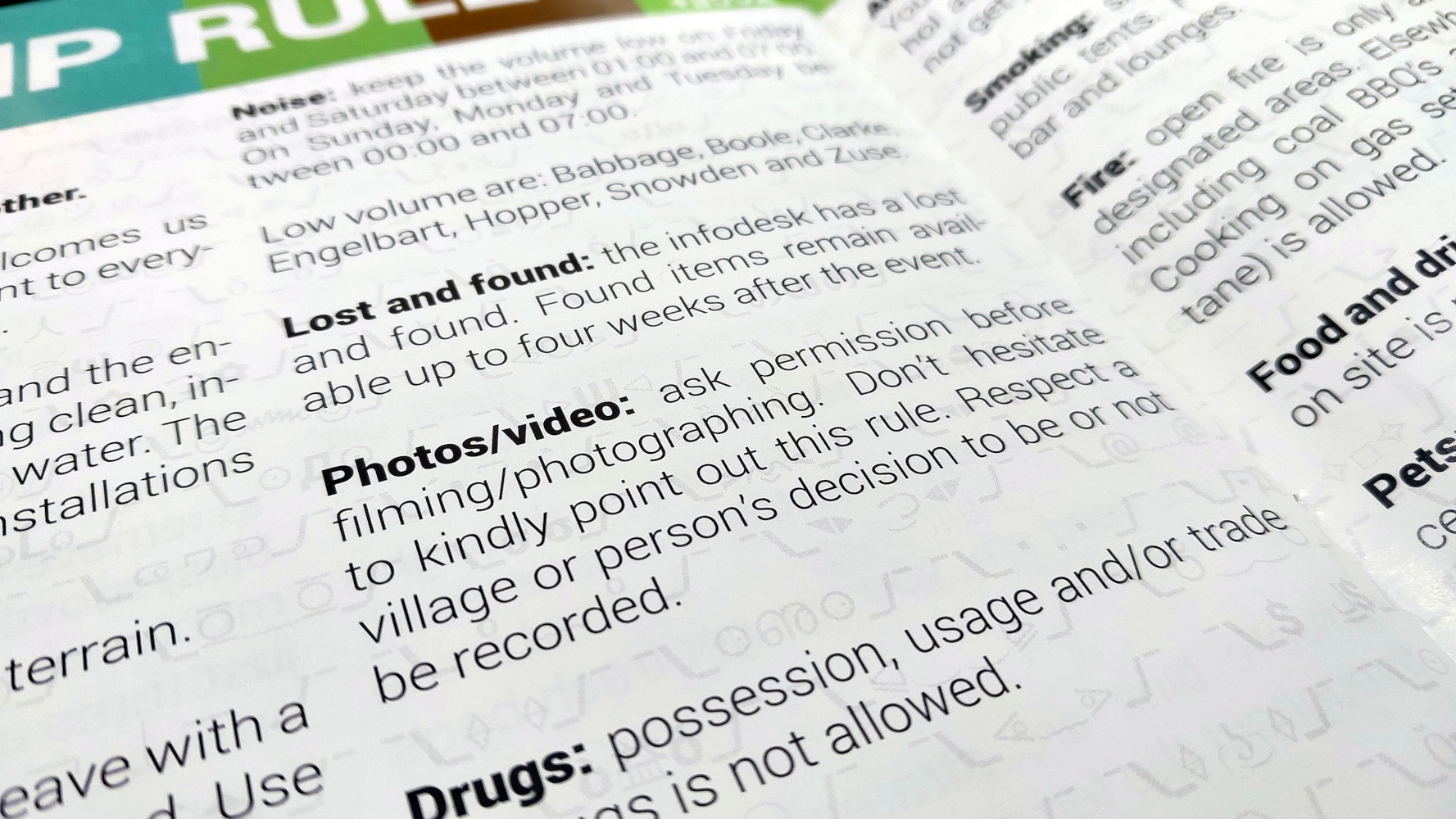
The relevant section about photography in the SHA2017 code of conduct.

The hacker community differs from the general public in many ways, one of which is that we tend to have a much greater understanding of privacy in the online age. The Average Joe will happily sign up to the latest social media craze without a care in the world, while we quickly identify it as a huge data slurp in which the end user is the product rather than the customer.

The work of privacy activists in our community in spotting privacy overreaches may pass unnoticed by outsiders, but over the years it’s scored some big wins that benefit everyone. Part of this interest in privacy appears at our events; it’s very much not done to take a photograph of someone at a hacker event without their consent. This will usually be clearly stated in the code of conduct, and thus if taking a picture featuring someone it’s imperative to make damn sure they’re OK with it. Continue reading “Privacy And Photography, We Need To Talk”

Flexure PCB Actuators Made Before Your Very Eyes

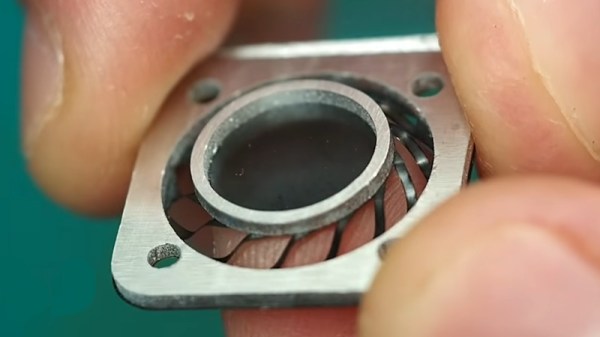
When we see something from [Carl Bugeja], we expect to see flexible PCBs and magnets being pushed to do unexpected things. His latest video in which he designs a set of PCB actuators using flexure joints certainly doesn’t fail to please.

His intent is to create a simple actuator in which a magnet is placed over a coil, and moves upward within the confines of he flexure which surrounds it. And rather than try individual designs one after the other he’s created a huge all-in-one test array of different flexure actuators, each having a slightly different design and construction to whichever one is next to it. There are plenty of magnet flips as he tests them, and using this approach he’s quickly able to eliminate the designs which work less well.

To give an idea how these actuators might be best used, he tried them in a few applications. Their lifting force is relatively tiny, but he found them possibly suitable for a haptic feedback device. Of particular interest is that as the structure is a PCB it’s relatively straightforward to run a line to the magnet and turn it into a touch sensor. The idea of an all in one sensor and haptic feedback component is rather appealing, we think.

If you’ve not seen Carl’s work before, we’ve encountered him many times over the years.

Continue reading “Flexure PCB Actuators Made Before Your Very Eyes”

Impossible WiFi On An Ancient Mac Portable

The Macintosh Portable was possibly one of the coolest computing devices to be seen with back at the end of the 1980s, providing as it did a Mac in a slightly nicer version of the hefty luggable portables of the day than the PC world could offer. Inside was a mere 68000, but it ran Mac OS system 6 and looked light years ahead of any comparable PC in doing so.

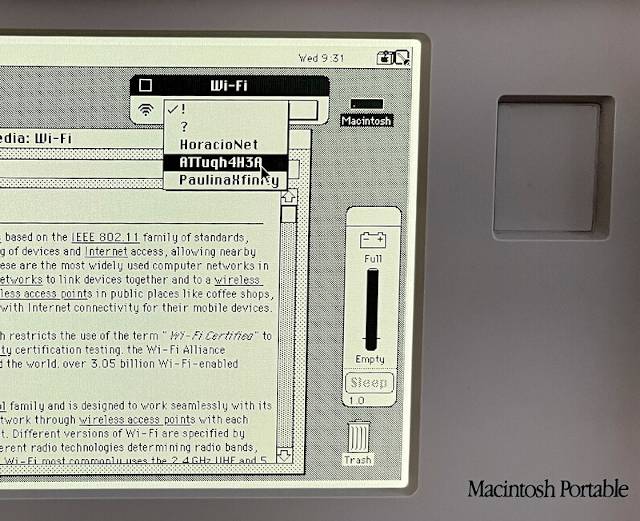
Back in 1989 it wasn’t even the norm for a computer to have built-in Ethernet, and WiFi was still a gleam in the eye of some Dutch engineers, so how has [Joshua Stein] managed to get his Mac Portable on a wireless network here in 2023? The answer contains a few surprises.

When seeing a WiFi upgrade for a classic retrocomputer the usual expectation is that it’s done by emulating a modem connection to the Internet over a serial port. But this wireless network card is a bit different, it’s a real network card capable of being used for much more than just connecting to the Internet.

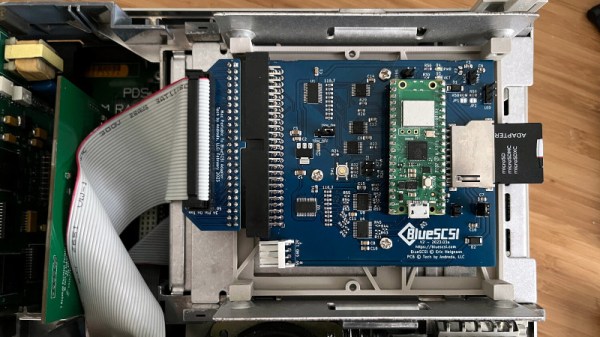
We have to admit to not knowing that there were SCSI Ethernet interfaces back in the day, and it’s one of these that he’s created. He’s building on a decade’s work in producing disk emulators for the SCSI bus, and he’s taken the code for a Raspberry Pi Pico version and adapted the SCSI driver part to interface with the onboard WiFi on a Pico W. Altogether it’s a beautiful piece of work, and you can color us impressed.

An Open Source Mobile Phone Based On The ESP32

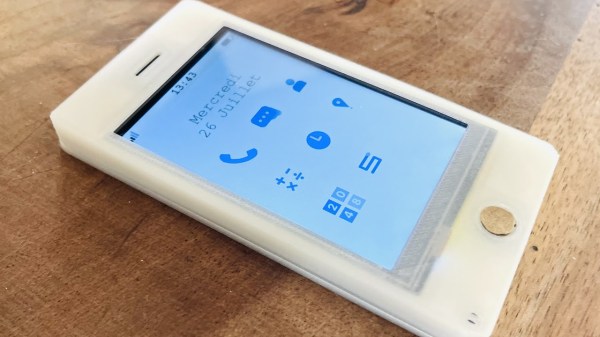
As microcontrollers become ever faster and cheaper, something we’ve been expecting has been an open source smartphone based not upon a high-end chip, but on a cheap commodity one. In the electronic badge arena we’ve come pretty close, but perhaps it’s left to [Gabriel Rochet] to deliver the first one that brings everything together. His Paxo phone is now on version 4, and while the French-language website link stubbornly resists translation with Google translate, English speakers can find a description of its capabilities along with the software in a GitHub repository.

The hardware is surprisingly straightforward, with a resistive touch screen and a PCB featuring power management, an ESP32 main processor, and a GSM module. The 2G connectivity may not be the fastest, or even available in your country, but otherwise the feature set looks more than reasonable for a basic mobile phone.

We like this project a lot, because as we said it starts to deliver on the promise of the 2018 EMF badge and the 2022 MCH badge. We think the former badge’s designers might find something of interest in it.

This Car Has Wooden Performance

If you were to take a look at the car parked closest to where you are sitting, there’s an overwhelming probability that its main structural parts are made of steel. A few might be aluminium and fewer still composite materials, but by and large that’s it for automotive structures. This hasn’t stopped the inventive Russians at [Garage 54] from experimenting though, and in their latest they’ve made a car with a chassis made of wood. Not carefully sawn and assembled wooden structural components, oh no. These are wooden tree trunks and branches.

Of course it’s an opportunity for them to run wild on their very successful schtick of the crazy Eastern European YouTuber, but behind that it’s entertaining to watch how they adapt a drive train — taken we’re guessing from the FIAT 124-derived Zhiguli, or Lada as most of us would know it — to such an unconventional chassis. A lot of wire binding is used, and even then the car has a lot of the flexible about it. We’re not so sure about the differential without oil or indeed the front suspension that appears to be developing a lean, but they do manage to take it out of the forest and onto the road.

Are unconventional and definitely-not-road-legal motors your thing? Here’s another, courtesy of some Dutch lads.

Continue reading “This Car Has Wooden Performance”

Improving A Kodak Film Digitizer

Despite the near-complete collapse of its ecosystem in the face of portable videocassette camcorders in the 1980s, somehow the 8 mm format, smallest of the movie films, has survived the decades. There’s a special aura around an 8 mm image which electronic recordings don’t replicate, plus for film makers there’s an attraction to working with real film. Unsurprisingly almost all of the devices used with 8 mm film have ceased to be manufactured, but a few items escaped the cut. It’s still possible to buy an 8 mm digitizer for example, and it’s one of these with a Kodak brand that [Mac84] has. Unsatisfied with its image quality, he’s set about tinkering with its firmware to give it some video adjustment possibilities and remove its artifact-prone artificial sharpening.

Helped by the device having a handy EEPROM from which to extract the code, he was able to recover the firmware intact. From here on he was in luck, because the digitizer’s Novatek CPU is shared with some dash cams and this had spawned a hacker scene. From there he was able to find the relevant area and adjust those settings, and after a few false starts, re-flash it to the device.

The results can be seen in the video below the break, and perhaps reveal much about what we expect from an image in the digital age. The sharpened images look good, until we see untampered versions which are closer to the original.

If you don’t have a Kodak scanner you can always build one yourself, and meanwhile like many people we are still wondering what happened to that new Super 8 camera they announced in 2018 but never released.

Continue reading “Improving A Kodak Film Digitizer”