Field Testing A Home Made WiFi Antenna

Most readers will be aware that a good way to extend WiFi range is to use a better antenna for those 2.4 GHz signals, but at the same time such high frequency hijinks have something of a reputation of being not for the faint-hearted. [Dereksgc] puts that reputation to the test by building a helical WiFi antenna — and if that weren’t enough — he also subjects it to a field test. In a real field, is there any other way?

We’ve put both videos below the break, and you can find his helical antenna calculator on his website and the parametric CAD file for the scaffold in his GitHub repository. He first delivers a crash course in the fundamentals of helical antennas before diving into the construction, and even soldering on an impedance matching strip. The field testing involves setting up a base station with an FTP server on a phone, and connecting to it with a variety of antennas over increasing distance across farmland. We’ve characterised antennas in this way before, and it really does give an immediate view of their performance.

In this case the helix comfortably outperforms a commercial patch antenna and a laptop’s internal antenna, making such an antenna a very worthwhile piece of work whether you’re making a fixed link or indulging in a bit of casual wardriving.

The tools mentioned here will make helical antennas a snap, but this isn’t the first time we’ve touched on the subject.

Continue reading “Field Testing A Home Made WiFi Antenna”

An ESP In Your Mini TV

When miniature LCD TVs arrived on the market they were an object of desire, far from the reach of tech-obsessed youngsters. Now in the age of smartphones they’re a historical curiosity, but with the onward march of technology you can have one for not a lot. [Taylor Galbraith] shows us how, with an ESP32 and an LCD we rather like because of its CRT-like rounded corners.

What he’s created is essentially a small media player, but perhaps what makes it of further interest is its migration from a mess of wires on a breadboard to a rather nice PCB. He’s not released the board files at the time of writing, but since the software can all be found in the GitHub repository linked above, we live in hope. On it are not only the ESP and the screen, but also a battery management board, an audio amplifier, and a small speaker. For now it’s a bare board, but we hope he’ll complete it with a neatly designed case for either a pocket player or a retro-styled mini TV. Until then you can see his progress in the videos below the break.

If you’re after more ESP32 media player inspiration, this isn’t the first retro-themed media player we’ve brought you.

Continue reading “An ESP In Your Mini TV”

An Android Phone Powers A Self Driving Car

As auto manufacturers have brought self-driving features to their products, we’re told about how impressive their technologies are and just how much computing power is on board to make it happen. Thus it surprised us (and it might also surprise you too) that some level of self-driving can be performed by an Android phone. [Mankaran Singh] has the full details.

It starts with the realization that a modern smartphone contains the necessary sensors to  perform basic self-driving, and then moves on to making a version of openpilot that can run on more than the few supported phones. It’s not the driver-less car of science fiction but one which performs what we think is SAE level 2 self driving, which is cruise control, lane centering, and collision warning. They take it out on the road in a little Suzuki on a busy Indian dual carriageway in the rain, and while we perhaps place more trust in meat-based driving, it does seem to perform fairly well

Self driving features are codified into a set of levels for an easy reference on what each is capable of doing. We’ve taken a look at it in the past, should you be interested.

Escalate The NERF Arms Race With Self-Firing Missiles

NERF guns are a toy that appeals to adults and youngsters alike — if you’ve never had the chance to pelt your friends with safe and kid friendly foam darts in a surprise ambush, you haven’t lived. But just as with real-world weapons of the type superpowers put in shows of military strength, there’s an arms race in the world of NERF. Mere darts aren’t enough, and there’s a range of missiles for the bellicose youngster intent on skirting the brink of global foam dart annihilation. These come with a catch though in the shape of a lackluster launcher, and this has prompted [Joel Creates] to create a self-firing NERF missile with a secondary rocket motor.

A supercapacitor stores enough energy to light a small scrap of guncotton explosive when sent through a heater coil, and this should be enough to launch the missile. Perhaps this whole video should sit in “Don’t try this at home kids” territory, but try he does, with multiple dead ends along the way. The final try is a secondary rocket motor inside the missile that’s triggered by a micro switch upon leaving the standard NERF launcher. It’s not a resounding success, but we’re sure you’ll agree it’s an entertaining video to get there.

We’ve featured quite a few NERF hacks over the years, including this large auto-aimer.

Continue reading “Escalate The NERF Arms Race With Self-Firing Missiles”

Never Drill In The Wrong Place, With This Camera!

It’s fair to say that one of the biggest advances for the electronic constructor over the last decade or so has been the advent of inexpensive small-order PCB manufacture. That said, there are still plenty who etch their own boards, and for them perhaps the most fiddly part of the process comes in drilling holes accurately. It’s to aid in this task that [John McNelly] has created a camera with a periscope, to give the drill bit perfect alignment with the hole.

The idea is simple enough, an off-the-shelf all-in-one microscope camera points sideways at a mirror allowing it to look upwards. The viewport is placed under the drill and the crosshairs on the microscope are lined up with the end of the drill. Then the board can be placed on top and the pad lined up with the crosshairs, and a perfectly placed hole can be drilled. It’s a beautiful piece of lateral thinking which we like, as it ends that lottery of slightly off-centre holes. You can see it in glorious portrait-mode action in the video below the break.

Oddly this isn’t the first PCB drilling microscope we’ve shown you. but it may well be the more elegant of the two.

Continue reading “Never Drill In The Wrong Place, With This Camera!”

This Camera Does Not Exist

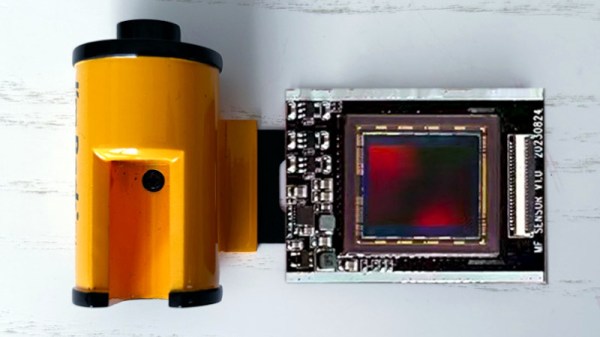
Blender is a professional-grade 3D-rendering platform and much more, but it suffers sometimes from the just-too-perfect images that rendering produces. You can tell, somehow. So just how do you make a perfectly rendered scene look a little more realistic? If you’re [sirrandalot], you take a photograph. But not by taking a picture of your monitor with a camera. Instead, he’s simulating a colour film camera in extraordinary levels of detail within Blender itself.

The point of a rendering package is that it simulates light, so it shouldn’t be such a far-fetched idea that it could simulate the behaviour of light in a camera. Starting with a simple pinhole camera he moves on to a meniscus lens, and then creates a compound lens to correct for its imperfections. The development of the camera mirrors that of the progress of real cameras over the 20th century, simulating the film with its three colour-sensitive layers and even the antihalation layer, right down to their differing placements in the focal plane. It’s an absurd level of detail but it serves as both a quick run-down of how a film camera and its film work, and how Blender simulates the behaviour of light.

Finally we see the camera itself, modeled to look like a chunky medium format Instamatic, and some of its virtual photos. We can’t say all of them remove the feel of a rendered image, but they certainly do an extremely effective job of simulating a film photograph. We love this video, take a look at it below the break.

Continue reading “This Camera Does Not Exist”

How To Land A Model Rocket Vertically

Perhaps most readers will remember when they saw the first SpaceX demonstration of a rocket stage landing vertically on the pad under control. It’s something of a shock to be reminded that their first suborbital demonstration “hops” were around a decade ago, and how quickly what was once so special has become commonplace. We’re now in the era of the more complex model rockets having the same capability, with [BPS.space] managing it last year, and now [TTS Aerospace] sharing a video showing how they achieved the same feat.

The basics of the system revolve around a directed rocket nozzle, but to make it work is a lot more complex than simply hooking up a flight controller and calling it good. The steps in arriving at a landable rocket are examined, with plenty of failures shown along the way. Even the legs are more complex than they might appear, having to combine lightness, ease of unfurling under the power of elastic, and enough strength and give to survive a rough landing.

Those of us from countries where model rocketry is a highly licensed activity can only look on in envy at these projects, and we look forward to seeing where this avenue leads next. We covered the [BPS.space] rocket last year, should you be interested.

Continue reading “How To Land A Model Rocket Vertically”