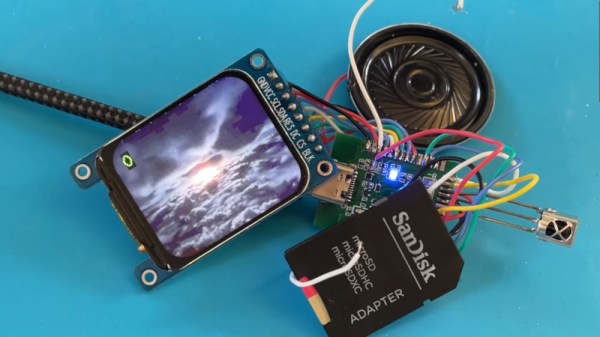
Back in the day a miniature television, probably on a wristwatch, was the stuff of science fiction. Now, it’s something which can be done with a commodity microcontroller, as [Atomic14] shows us with the ESP32-TV that plays both video and sound. Even with modern silicon it’s still somewhat pushing the envelope.
As he explains in the video below the break, not all formats are simple enough to be decoded on the fly by a microcontroller. But he finds an AVI file to be within its capabilities which can be created with a bit of ffmpeg wizardry. The board is a fairly standard ESP32 device with an I2C bus, and the video stream isn’t too fast for this meager interface. You’ll maybe recognize the Muppets clip, but it’s possible that the early-80s BBC comedy staple The Young Ones might have passed you by if you’re not British.
We think this code is likely to be of use in quite a few projects, and it would be great to see it further refined. Small video players for not a lot of money can never be a bad thing.
Previous ESP32 video projects which have appeared on these pages have been more likely to involve driving a display directly.
Many of us will have seen the various active assistive devices which have appeared over the last few years to help people with a hand tremor. Probably the best known was a fork with a set of servos and an accelerometer, that kept the end of the utensil steady despite the owner’s hand movements. It’s a field which has the potential to help many people, but it’s undeniable that such technology comes with a cost.
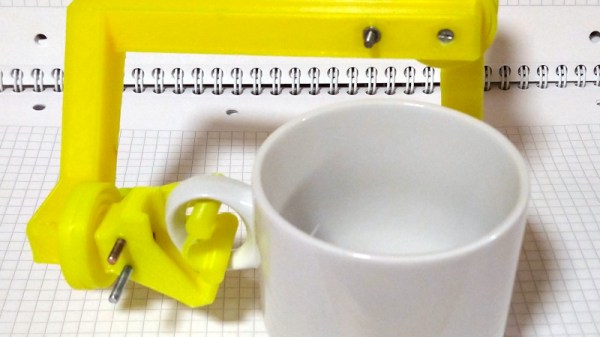
What if the same effect could be achieved passively, without all those electronics? It’s something [Jacob] is investigating with his mechanical anti-tremor cup handle. It’s a university project completed as part of his studies so it’s very much a work-in-progress which if we’re being fair isn’t quite there yet, but we think the potential in this idea of bringing a useful assistive device at least bears further attention.
The write-up is available as a Norwegian PDF file so takes a little bit of Google Translate cut and pasting for an Anglophone. Sadly due to what must be report format requirements set by the university it’s long on procedure and shorter on engineering calculations than we’d like, but there’s an attempt to calculate the properties of the helical springs in each of the joints to match the likely forces. Our intuition is that the design as shown would require significantly more mass on the end of it than that of the mug and beverage alone to achieve some form of stability, but despite that as we said it’s an interesting enough idea that it deserves more thought.
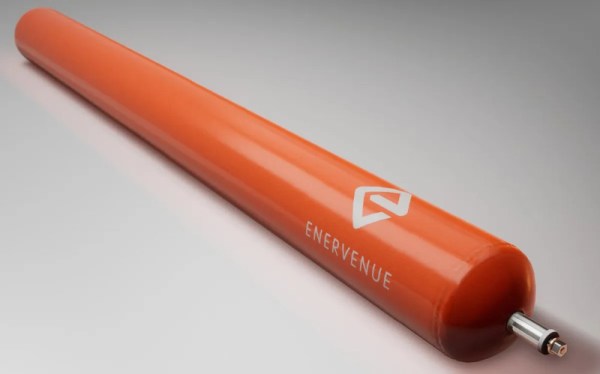
You may have heard us here remarking in the past, that if we had a pound, dollar, or Euro for every miracle battery technology story we heard that was going to change the world, we would surely be very wealthy by now. It’s certainly been the case that many such pronouncements refer to promising chemistries that turn out only to be realizable in a lab, but here there’s news of one with a bit of pedigree. Nickel hydrogen batteries have a long history of use in space, and there’s a startup producing them now for use on the ground. Could they deliver the energy storage Holy Grail?
The cathode in a nickel-hydrogen battery is formed by nickel hydroxide, and the anode is formed of hydrogen. If a gas as an anode sounds far fetched, we’re guessing that their structure is similar to the zinc-air battery, in which zinc hydroxide forms in a paste of powdered zinc, and works against oxygen from the air over a porous conductive support. What gives them their exciting potential is their ability to take more than 30,000 charge/discharge cycles, and their relative safety when compared to lithium ion cells. Hydrogen in a pressure vessel might not seem the safest of things to have around, but the chemistry is such that as the pressure increases it reacts to form water. The cost of the whole thing is reduced further as new catalysts have replaced the platinum used by NASA on spacecraft.
We really hope that these batteries will be a success, but as always we’ll wait and see before calling it. They may well be competing by then with the next generation of zinc-air cells.
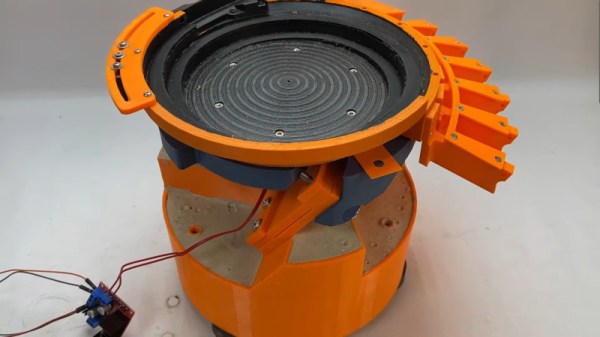
If you spend much time around industrial processes, you may have seen a vibrating bowl feeder at work. It’s a clever but simple machine that takes an unruly pile of screws or nuts and bolts, and delivers them in a line the correct way up. They do this by shaking the pile of fasteners in a specific way — a spiral motion which encourages them to work to the edge of the pile and align themselves on a spiral track which leads to a dispenser. It’s a machine [Fraens] has made from 3D printed parts, and as he explains in the video below the break, there’s more to this than meets the eye.
The basic form of the machine has a weighted base and an upper bowl on three angled springs. Between the two is an electromagnet, which provides the force for the vibration. The electromagnet needed to be driven with a sine wave which he makes with an Arduino and delivers as PWM via an H-bridge, but the meat of this project comes in balancing the force and frequency with the stiffness of the springs. He shows us the enormous pile of test prints made before the final result was achieved, and it’s a testament to the amount of work put into this project. The final sequence of a variety of objects making the march round the spiral is pure theatre, but we can see his evident satisfaction in a job well done.
Oddly this isn’t the first bowl feeder we’ve seen, though it may be one of the most accomplished. We particularly like this tiny example for SMD parts.
The more accomplished 8-bit microcomputers of the late 1970s and early 1980s had a dedicated display chip, a CRT controller. This took care of all the jobs associated with driving a CRT display, generating the required timing and sequencing all the dots to make a raster. With a CRT controller on hand the CPU had plenty of time to do other work, but on some cheaper machines there was no CRT controller and the processor had to do all the work of assembling the display itself.
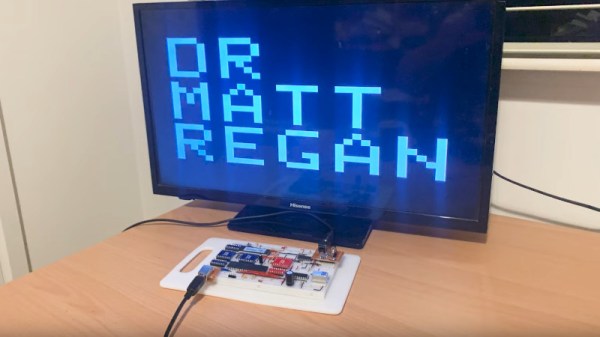
[Dr. Matt Regan] had a Sinclair ZX81 which relied on this technique, and he’s put up the first of what will become a series of videos offering a deep dive into this method of creating video. The key to its operation lies in very careful use of timing, with operations executed to keep a consistent number of clock cycles per dot on the display. He’s making a very low resolution version of the display in the first video, which he manages to do with only an EPROM and a couple of 74 logic chips alongside the Z80. We’re particularly impressed with the means of creating the sync pulses, using opcodes carefully chosen to do nothing of substance except setting a particular bit.
This method of assembling a display on such a relatively slow microprocessor has the drawback of no means of creating a grayscale, and of course it’s only available in glorious black and white. But it’s the system which gave a first experience of computing to millions, and for that we find the video fascinating. Take a look, below the break.
Everyone likes to play with high voltages, right?. Even though the danger of death goes up with every volt, it’s likely that a few readers will have at some time or other made fancy long sparks. You’re reading this so you lived to tell the tale, and we’d only ever counsel only doing so safely, but the point of this piece lies not in the volts themselves but in a touch of frustration at the voltage generators. There’s a circuit I see so often which annoys me every single time, so here if you don’t mind I’m going to deliver both a little rant and a look into flyback converters.
It’s Got Coils, so It’s A Transformer
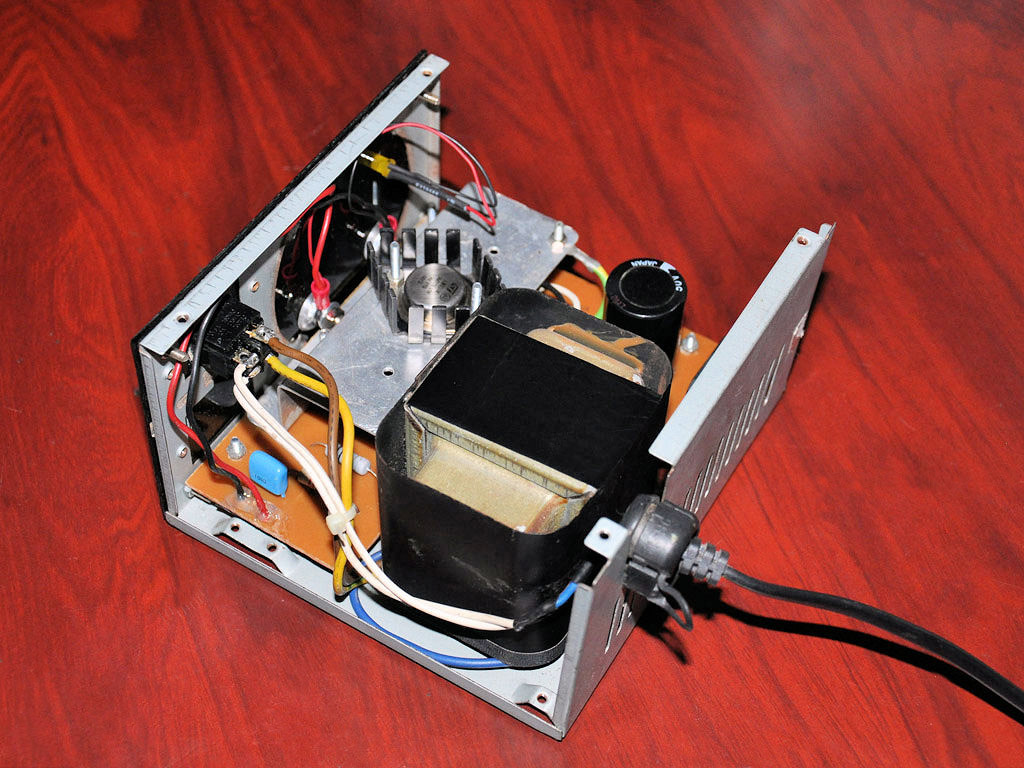
Linear power supplies with a mains transformer are a surprisingly rare sight now. Dilshan Jayakody, CC BY-SA 2.0.
How does a transformer work? An alternating current in a primary winding induces an opposite current in its secondary winding. The voltage out is equal to the turns ratio times the voltage in. Thus if you want to make a high voltage, it’s simply a case of finding a transformer with the right turns ratio, and applying the right AC to the input.
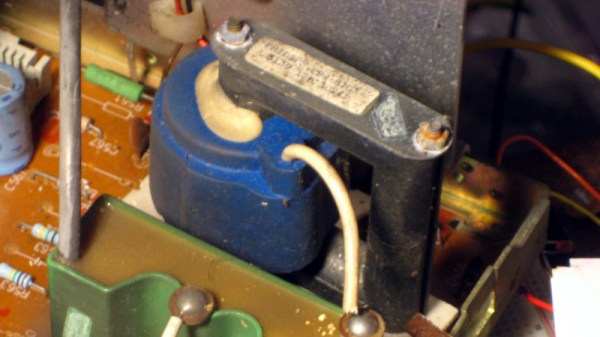
A handy choice for a high voltage transformer has been for years a TV line output transformer, also sometimes known as a flyback transformer. You could find these in CRT displays and TVs, and they consist of a square ferrite core with a big chunky high voltage overwinding for the CRT anode circuit and a load of lower voltage windings. TV designers were always out to save on parts costs, so they often had windings for all the voltage rails inside the set as well as the anode voltage, using the timebase as a crude switching power supply. Continue reading “A Pulse Of Annoyance About Oscillators, Followed By A Flyback Of A Rant”→
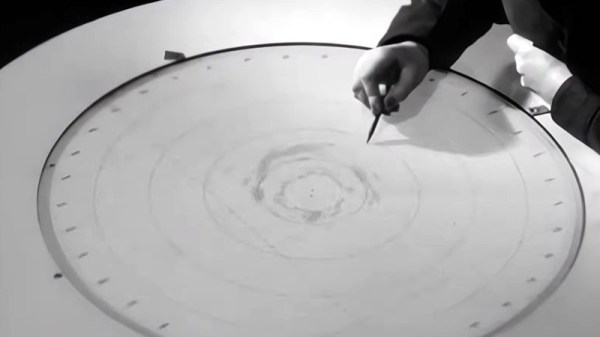
When you’ve been a fact-sponge for electronics trivia for over four decades, it’s not often that an entire class of parts escapes your attention. But have you seen the Skiatron? It’s a CRT that looks like a normal mid-20th-century tube, until it’s switched on. Then its secret is revealed; instead of the glowing phosphor trace we’d expect, the paper-white screen displays a daylight-readable and persistent black trace. They’re invariably seen in videos of radar installations, with the 360 degree scans projected onto large table-top screens which show the action like a map. It’s like e-ink, but from the 1940s. What’s going on?
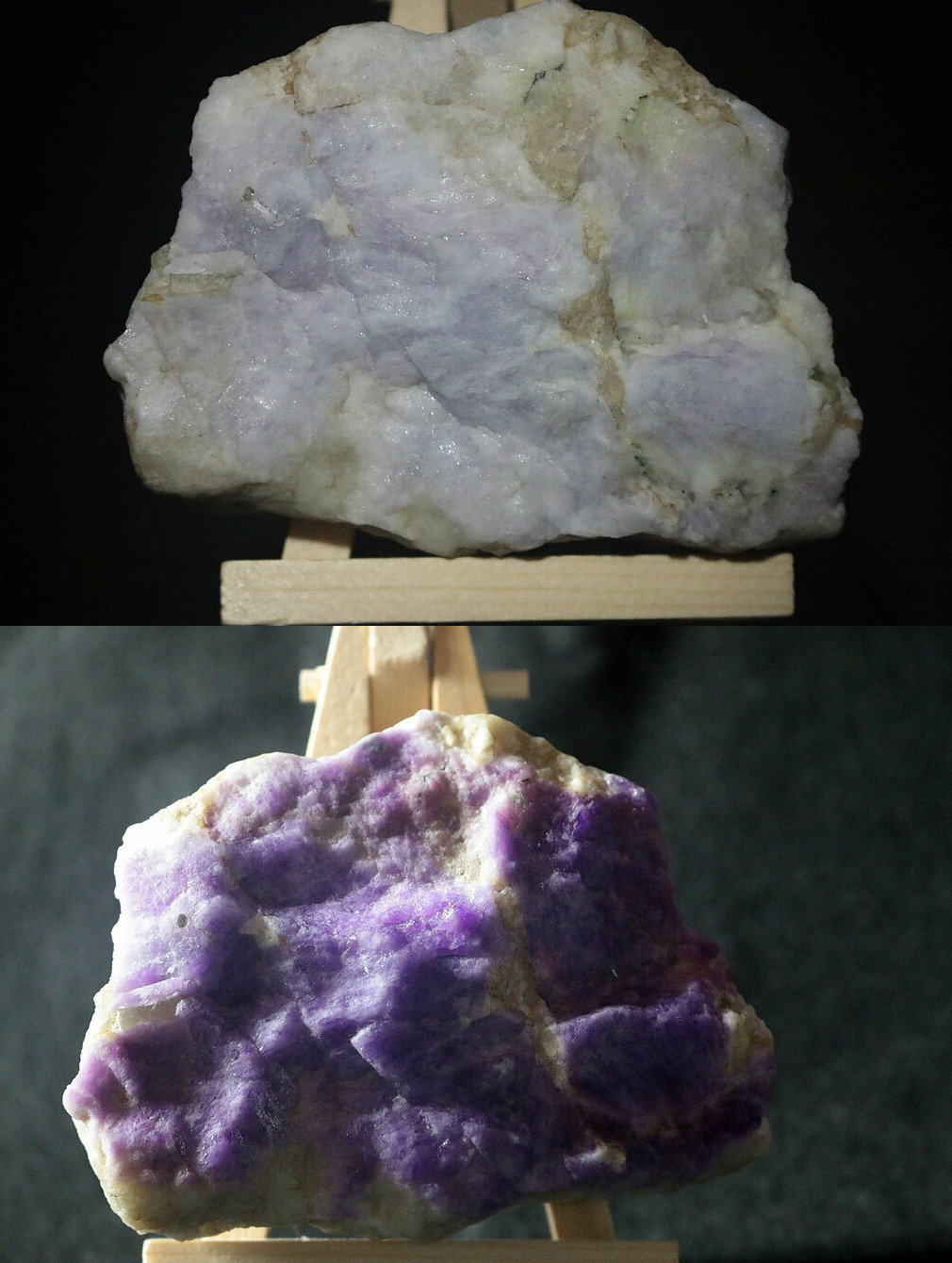
The tenebrescent mineral Hackmanite, before and after UV exposure. Leland Green…, CC BY-SA 2.0 and CC BY-SA 2.0.
The phosphor coating on a traditional CRT screen is replaced by a halide salt, and the property on which the display relies is called tenebrescence, changing colour under the influence of radiation. This seems most associated online with UV treatment of some minerals and gemstones to give them a prettier look, and its use a s a display technology is sadly forgotten.
A high-school physics understanding of the phenomenon is that energy from the UV light or the electron beam in the case of the tube, places some electrons in the crystal into higher energy levels, at which they absorb some visible light wavelengths. This is reversible through heat, in some substances requiring the application of heat while in others the heat of room temperature being enough. Of course here at Hackaday we’re hands-on people, so into the EPROM eraser went a small amount of table salt in a makeshift dish made of paper, but sadly not to be rewarded by a colour change.
On a real dark-trace CRT the dark trace would be illuminated from behind by a ring light round the glass neck of the tube. An interesting aside is that, unlike phosphor CRTs, they were more suitable for vertical mounting. It seems that small amounts of phosphor could detach themselves from a vertically mounted screen and drop into the electron gun, something that wasn’t a problem for tenebrescent coatings.
This display tech has shuffled off into the graveyard of obsolescence, we’re guessing because CRT technology became a lot better over the 1950s, and radar technologies moved towards a computerised future in which the persistence of the display wasn’t the only thing keeping the information on the screen. It seems at first sight to be a surprise that tenebrescent coatings have never resurfaced in other displays for their persistence, but perhaps there was always a better alternative whether it was ultra-low-power LCDs or more recently e-ink style devices.
For more bleeding-edge 1950s radar displays, we’ve previously brought you Volscan, a radar with an early form of GUI, which no doubt was one of those which consigned dark-trace CRTs to history.