Tetris Joins Minecraft And DOOM In Running A Computer

There is a select group of computer games whose in-game logic is enough for them to simulate computers in themselves. We’ve seen it in Minecraft and DOOM, and now there’s a new player in town from a surprising quarter: Tetris.

One might wonder how the Russian falling-blocks game could do this, as unlike the previous examples it has a very small playing field. And indeed it’s not quite the Tetris you’re used to playing, but a version played over an infinite board. Then viewed as a continuous progression of the game it can be viewed as somewhat similar to the tape in a Turing machine.

The various moves and outcomes are referred to through a Tetris scripting language, so states can be represented by different sets of blocks and holes while logic elements can be be built up using the various shapes and the game logic. From those a computer can be built, represented entirely in Tetris moves and shapes. It’s a little mind-bending and we’d be lying if we said we understood every nuance of it, but seemingly it works well enough to run the game from within itself.. If it had the catchy music from the NES version, we’d declare it perfect.

Hungry for more? Here’s DOOM doing some adding, and of course Minecraft has a rich computing history.


IoT Archaeology Leads To API Resurrection

What happens when someone’s personal project is turned into a startup which becomes something of a publicity darling, then collapses with very little product shipped and takes all its customers’ money with it?

That’s the subject of a blog post from [Kevin Chung], who investigated the legacy of NYCTrainSign, a company whose product was an LED NYC subway sign and which has become a meme byword for a startup scam. Along the way he found himself reverse engineering its API, and eventually even purchasing the expired domain name to resurrect the API for any NYCTrainSigns that may still be out there.

Securing a second-hand NYCTrainSign, he dismantled it to see what made it tick. Inside the handmade wooden case was an array of LED panels, driven by a Raspberry Pi 3 and an Adafruit LED panel HAT. This gave pause for thought, as the component choice gives rise to a very high BoM cost which was unsustainable given their habit of steep discounts.

The software proves straightforward enough to reverse engineer, and since the original domain was for sale he bought it and set up a replacement API. Do you have one of the few signs that made it to customers? Now you can run it again.

The rest of the piece tells a tale that will be familiar to startup veterans: one of far too much marketing, too many bosses, and too little engineering to create a viable product. The founders remain tight-lipped about what happened and where the money went, but since there are few more efficient money pits than a badly-run startup, it’s more likely that ill-advised spending is to blame than someone running off with suitcases of cash.

If you’d like a public transit sign without the dodgy start-up, we’ve got you covered.

You Can Now Fix Your Deere

Over the last few years we have brought you many stories about John Deere tractors, and how their repair has been locked down such that only manufacturer-authorised technicians can work on them. They’ve become a poster child in the battle for the right to repair, a symbol of the worst practices. Finally now we can bring you some good news of sorts, as the agricultural giant has signed a memorandum of understanding with the American Farm Bureau Federation to ensure that their products will henceforth be repairable by people without Deere approval.

We can’t imagine that Deere will have taken this step willingly, and while we’d like to imagine that consumer protests in favour of right-to-repair have hit their mark, we’re guessing that it’s more of an economic pressure at work alongside the threat of legislation outside their native America. If farmers getting caught out waiting for a Deere van to arrive while their crop withers in the field wasn’t enough, when the price of a second-hand tractor without the DRM outstrips that of a newer one with it, eventually the sales of new tractors will also suffer.

So this is good news, and we’re guessing that other agricultural manufacturers doing the same DMCA practices will now follow suit. But it’s not a complete victory. The problem starts not with the DMCA restriction itself, but with the extension of the machine’s computer system into every part, including those many parts which simply don’t need it. It’s not a complete victory if anyone can now use the software to register a new hydraulic valve with the system; instead that hydraulic valve should not have to be authorised in the first place. It’s this creeping unnecessary complexity which is the true enemy of right-to-repair, and we shouldn’t forget that.

Header image: Dwight Sipler, CC BY 2.0.

Can AI Replace Your DM?

The current hotness is anything to do with artificial intelligence, and along with some interesting experiments comes a lot of mindless hype. The question is, what can it do for us! [Jesse] provides a fun answer by asking ChatGPT to perform as a Dungeons and Dragons dungeon master.

There are many ways to approach a game of D&D, and while some take the whole thing very seriously indeed we prefer to treat it as a lightly inebriated band of intrepid heroes smacking each other and assorted monsters with imaginary swords and war hammers. Would the AI follow the nerdiest cliches to their pedantic conclusions, or would it sense that the point of a game is to have fun?

Continue reading “Can AI Replace Your DM?”

Forth Cracks RISC-V

Over the decades there have been many programming languages, some of which have flowered briefly, and others that have stuck around despite newer, better, and faster competition. Few languages embody this last group more than FORTH, over five decades old and still cropping up wherever a simple, elegant, fast, and compact stack-based programming language fits the bill. [Alexander Williams] has now taken it somewhere new, with a FORTH in RISC-V assembly which runs on the GD32 series of microcontrollers that are RISC-V lookalikes of the popular STM32 ARM parts.

We have to admit to last having used FORTH on an 8-bit home computer in the 1980s, aside from a moment’s idle play on discovering that the Open Firmware on Apple computers is a FORTH interpreter. Thus we’re intrigued by this implementation, but not from a position of FORTH expertise. We’d expect such an efficient language to be extremely quick though, so it’s definitely something to keep an eye on for when a suitable dev board comes our way. If it interests you, take a look at the GitHub repository.

Release Less Magic Smoke, With A Bulb Limiter

As electronics have moved lower in voltage, it’s perhaps less common to work on live-mains equipment. Thus particularly among younger hardware hackers it sometimes seems as though such work is viewed as so dangerous as to be only for the foolhardy. In practice it remains safe, so long as appropriate precautions are taken and a few pieces of useful safety equipment are present. One of those mains bench essentials is something less common in 2022, a mains current limiter using a set of switched incandescent light bulbs. [Donna LaRocco] shares a modern take on the idea, incorporating a digital mains voltmeter.

The idea is that a mains device under test is connected in series with a light bulb of a suitable wattage to let through enough current to run the device in normal operation, but to light up and bring down the voltage if the device draws too much. It’s an extremely simple but effective tool. Traditionally these are built using household electrical fittings on a board, and this one is no exception. The voltmeter comes from the RV market where voltage drop is an issue, no doubt giving European readers a chance to chuckle with their 230 V outlets.

If mains safety needs your attention, it’s a subject we’ve addressed in the past.

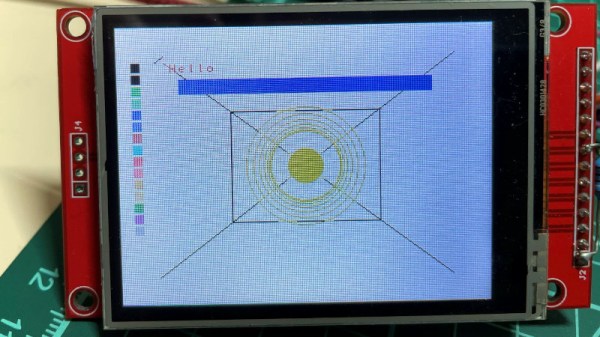
Classic Video Chip Drives A Modern TFT

A lot of us have a soft spot for retrocomputers, and there’s nothing quite like running original hardware. Unfortunately if you’re after the truly original touch then that means carrying along the family TV from 1982, and that’s where life becomes annoying. What if there were a way you could easily drive an LCD panel from a classic video controller? Help is at hand for owners of TI TMS9928A video chips, courtesy of [umaker], with a clever interface board that drives an SPI or parallel TFT.

At its heart is not the FPGA you might expect, but an STM32G4 microcontroller on an STM Nucleo board. This digitizes the R-Y and Y components from the TMS chip which would originally have been destined for an NSC or PAL encoder, does the color conversion through its algorithm, and transfers the result to the screen. This is a task which would back in the day when NTSC or PAL were king have been seen as extremely computationally intensive, so it’s a mark of just how capable an STM can be that a few dollar microcontroller can do it.

We can see this technique proving to be extremely useful across a lot of different retro color graphic applications. We’re not sure whether its lag would be too much for a light gun game, but it would be nice to think that it would result in handheld retro machines.

We encountered this project previously, when as part of its development he needed a sync separator.