Recreating A Non-Standard USB Cable

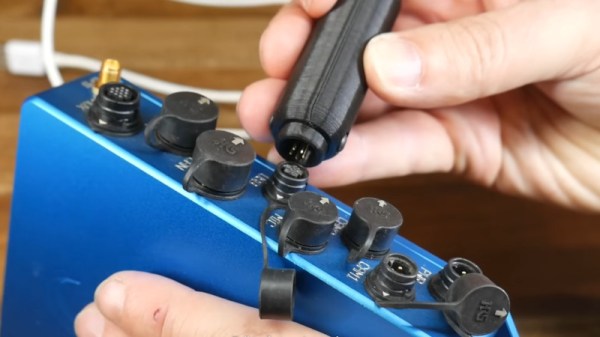
USB is a well-defined standard for which there are a reasonable array of connectors for product designers to use in whatever their application is. Which of course means that so many manufacturers have resorted to using proprietary connectors, probably to ensure that replacements are suitably overpriced. [Teaching Tech] had this problem with a fancy in-car video device, but rather than admit defeat with a missing cable, he decided to create his own replacement from scratch.

The plug in use was a multi-way round design probably chosen to match the harshness of the automotive environment. The first solution was to hook up a USB cable to a set of loose pins, but after a search to find the perfect-fitting set of pins a 3D printed housing was designed to replace the shell of the original. There’s an ouch moment in the video below the break as he receives a hot glue burn while assembling the final cable, but the result is a working and easy to use cable that allows access to all the device functions. Something to remember, next time you have a proprietary cable that’s gone missing.

Continue reading “Recreating A Non-Standard USB Cable”

Squeeze Over A Minute Of Movie Filming Onto A 35mm Still Cartridge

There’s an allure to shooting film in the digital age which isn’t quite satisfied by digital filters for your smartphone camera. Aside from the technical challenge of working with a medium limited in sensitivity compared to its electronic replacement there are aesthetic reasons for wanting to shoot with particular lenses not found on any modern cameras. Sadly though, movie film in formats such as Super 8 is expensive to buy and even more expensive to develop.

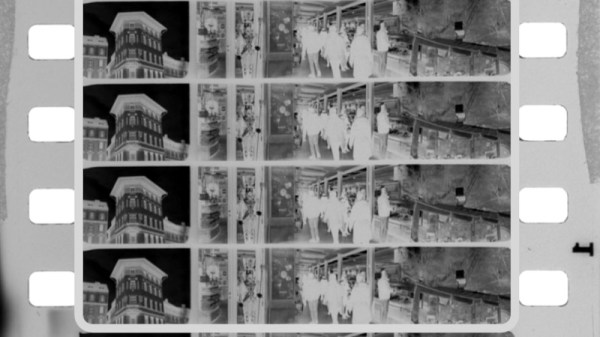
It’s a problem [Blaž Semprimožnik] addressed with his Okto 35 camera, a unique design that fits a minute and 7 seconds of 8mm-like movie filming onto a much cheaper roll of 35mm still camera film. How does it achieve this feat? By splitting the width of the film into four parallel tracks of 8mm-sized frames.

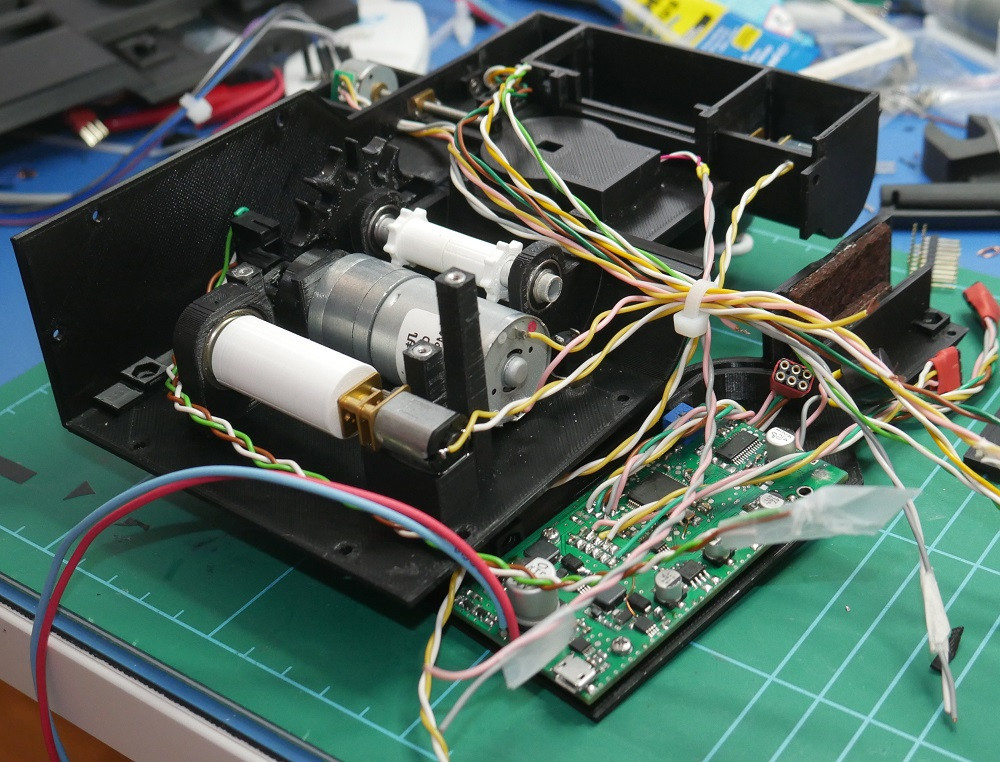
The camera is a 3D printed design, with all mechanical functions performed by stepper motors to avoid the complex gear trains that would have been found in cameras from the home movie heyday. Each frame advance is a single sprocket hole on the 35mm film, and the track selection is performed automatically by moving the C-mount lens assembly sideways.
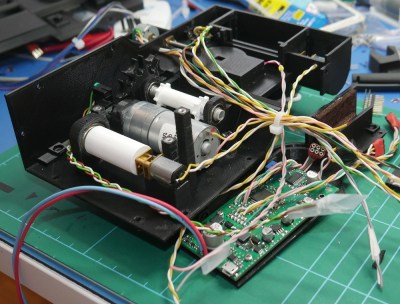
The result is a camera which is definitely unconventional, but which delivers something very close to that 8mm experience at a much lower cost per frame. There’s no reflex viewfinder or through-the-lens light metering, but since this is a camera likely to be used by enthusiasts rather than by 1970s consumers we’re guessing this won’t be a problem for most users.

There doesn’t appear to be anything in the way of downloadable STL files or other resources, probably because there’s a possibility he might put the camera into limited production. For the amount of work that he’s evidently put in we wish him luck, and given that the bench on which this is being written has more than one 8mm camera on it, we’re even slightly tempted by one. You might be too, after you’ve watched the video below the break.

This is a novel approach to a 35mm movie camera for still film cartridges, but it’s by no means the first. Previous ones we’ve seen have been full-frame designs though, capturing only a few seconds per roll.

Continue reading “Squeeze Over A Minute Of Movie Filming Onto A 35mm Still Cartridge”

Op Amp Challenge: An Op-Amp Buck Regulator

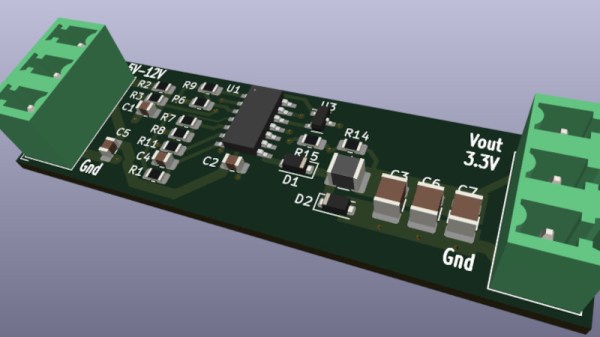
Switching regulators have delivered such convenience and efficiency compared to their linear siblings, that it’s now becoming rare to see an old-style three-terminal regulator. Modern designs have integrated to such an extent that for many of us the inner workings remain something of a mystery. It’s still possible to make switching regulators from first principles though, which is what [Aaron Lager] has done by designing a buck regulator from a quad op-amp IC,

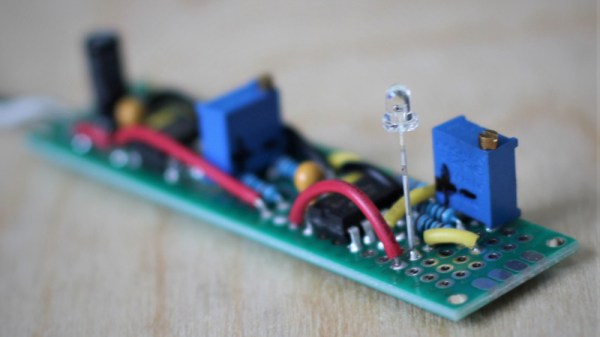
It’s an entry in our Op Amp Challenge and it appears to be a work in progress, but the design is solid enough. We’re no fans of the schematic style of representing an op-amp chip as a rectangle rather than individual op-amps, but it’s simply a PWM generator with a final op-amp used as a driver for the usual diode-inductor-capacitor network. We’re guessing that the op-amp driver won’t make this the most powerful of switchers, but in this case that’s hardly the point. Build this if you’re interested in taking an op-amp out of its normal sphere, or if you’re interested in the workings of a buck converter.

Need more in the way of switching regulators from first principles? We’ve got you covered, with the ultimate regulator kit of parts, the Fairchild UA723.

My Great-Great-Grandad, The Engineer Who Invented A Coffee Pot

In the study of genealogy it’s common to find people who will go to great lengths involving tenuous cross-links to establish royalty or famous figures such as George Washington or William Shakespeare in their family tree. There’s no royal blood and little in the way of fame to be found in my family tree, but I do have someone I find extremely interesting. One of my great-great-grandfathers was a Scottish engineer called James R Napier, and though his Wikipedia entry hasn’t caught up with this contribution to 1840s technology, he was the inventor of the vacuum coffee pot.

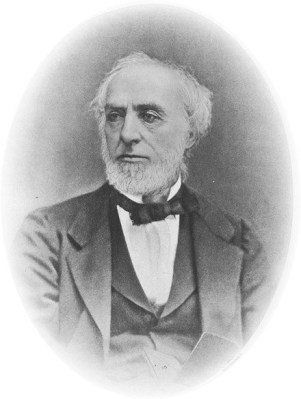
James R NapierHe was born in Glasgow in 1821 and was the son of a successful shipbuilder, Robert Napier, into whose business he followed once he’d received his education. He’s probably most well known today for his work in nautical engineering and for inventing Napier’s Diagram, a method for computing magnetic deviance on compass readings, but he was also a prolific engineer and author whose name crops up in fields as diverse as air engines, weights and measuresdrying timber, and even the analysis of some dodgy wine. The coffee percolator was something of a side project for him, and for us it’s one of those pieces of family lore that’s been passed down the generations. It seems he was pretty proud of it, though he never took the trouble to patent it and and thus it was left to others to profit from that particular invention.

Vacuum Coffee Pots: Impressive, But Slooow

Just what is a vacuum coffee pot, and what makes it special? The answer lies in the temperature at which it infuses the coffee. We take for granted our fancy coffee machinery here in the 21st century, but a century and a half ago the making of coffee was a much simpler and less exact process. Making coffee by simply boiling grounds in water can burn it, imparting bitter flavours, and thus at the time a machine that could make a better cup was seen as of some importance. Continue reading “My Great-Great-Grandad, The Engineer Who Invented A Coffee Pot”

The World’s First Agricultural Right To Repair Law

Long time readers will know that occasionally we mix up our usual subject matter with a dash of farm equipment. Usually the yellow and green variants that come from John Deere, as the agricultural manufacturer has become the poster child for all that is wrong in the fight for the right to repair. An old Deere is worth more than a nearly new one in many places, because for several years now their models have had all their parts locked down by DRM technologies such that only their own fitters can replace them. Now after a long legal fight involving many parties, the repair and parts company iFixit sound justifiably pleased as they announce the world’s first agricultural right to repair law being passed in the US state of Colorado. (Nitter)

This may sound like a small victory, and it will no doubt be followed by further rearguard actions from the industry as similar laws are tabled in other states. But in fact as we read it, with this law in place the game is de facto up for the tractor makers. Once they are required to release any access codes for the Coloradans those same codes will by extension be available to any other farmers, and though we’re guessing they won’t do this, they would be best advised to give up on the whole DRM idea and concentrate instead on making better tractors to fix their by-now-damaged brands.

It’s exciting news for everybody as it proves that right-to-repair legislation is possible, however since this applies only to agricultural machinery the battle is by no means over. Only when all machines and devices have the same protection can we truly be said to have achieved the right to repair.

We’ve reported on this story for a long time, here’s a previous piece of legislation tried in another state.

The Cheap And Available Microwave Playground

There’s something of a mystique about RF construction at the higher frequencies, it’s seen as a Black Art only practiced by elite wizards. In fact, UHF and microwave RF circuitry is surprisingly simple and easy to understand, and given the ready availability of low-noise block downconverters (LNBs) for satellite TV reception there’s even a handy source of devices to experiment on. It’s a subject on which [Polprog] has brought together a handy guide.

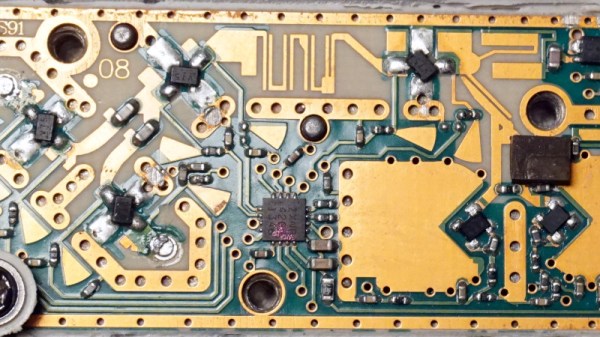
A modern LNB has some logic for selecting one of a pair of local oscillators and to use vertical or horizontal polarization, but remains otherwise a very simple device. There’s an oscillator, a mixer, and an RF amplifier, each of which uses microwave transistors that can with a little care be repurposed. The page demonstrates a simple transmitter, but it’s possible to create more powerful  devices by using the amplifier stage “in reverse”.

Meanwhile the oscillator can be moved by loading the dielectric resonators with PVC sleeving, and the stripline filters can even be modified with a fine eye for soldering and some thin wire. Keep an eye out in thrift stores and yard sales for old satellite dishes, and you can give it a go yourself. It’s a modern equivalent of the UHF tuner hacking enjoyed by a previous generation.

Op Amp Challenge: What’s Your Monitor’s Delay?

In the days of CRT displays, the precise synchronization between source and display meant that the time between a video line appearing at the input and the dot writing it to the screen was constant, and very small. Today’s display technologies deliver unimaginable resolutions compared to the TV your family had in the 1970s, but they do so at the expense of all their signal processing imposing a much longer delay before a frame is displayed. This can become an issue for gamers, but also with normal viewing, because in some circumstances the delay can be long enough for it to be audible in a disconnect between film and soundtrack. It’s something [Mike Kibbel] has addressed with his video input delay meter, and it makes for a very interesting project.

At its heart is an FPGA, and in the video below the break he goes into great detail about its programming. It both generates a DVI output to drive the monitor and performs the measurement. The analog to digital converter side of the circuit is interesting, he has a photodiode and an op-amp driving a comparator to form a simple 1-bit converter. He takes us through the design process in detail, with such useful little gems as the small amount of hysteresis applied to the comparator.

There are probably many ways this project could have been implemented, but this one is both technically elegant and extremely well documented. Definitely worth a look!

Continue reading “Op Amp Challenge: What’s Your Monitor’s Delay?”