Is An ADS-B Receiver The Solution For Drone Pilots?

Over the years here at Hackaday, we’ve covered a range of stories about the ongoing panic surrounding drone flights. From plastic bags reported as drone incidents through to airports closed with no evidence of drones being involved, it’s clear that drone fliers are an embattled group facing a legal and aeronautical establishment that seems to understand little about them or their craft.

It sometimes seems to be a no-win situation for fliers, but perhaps [XJet] has something which might improve matters. He’s published a video showing off a portable ADS-B receiver which could be used by drone pilots to check for any aircraft in the vicinity and perhaps more importantly allow the drone community to take the moral high ground when problems occur.

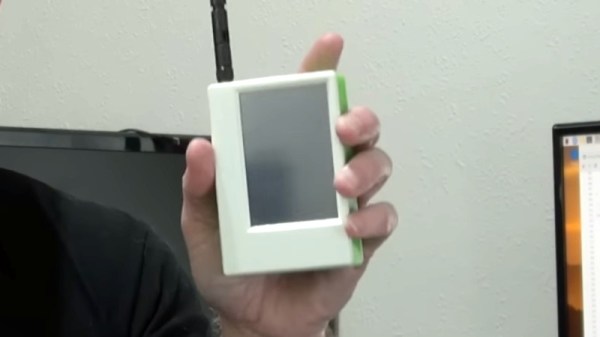
The receiver isn’t particularly special, being a Raspberry Pi with LCD screen and an RTL-SDR receiver in a nice 3D printed enclosure. He says he’ll be publishing all software and build details in due course. But it’s the accessibility which makes it such a good idea, instead of being a very expensive safety device it’s a receiver that could probably be made with a less powerful Pi for under $100.

There is of course a flaw in the plan, that not all pilots are concerned enough for their safety to fit an ADS-B transponder to their aircraft, and so are invisible to both the thus-equipped drone pilot and air traffic control alike. This puts the onus on pilots to consider ADS-B an essential, but from the drone flier’s point of view we’d consider that a spotter should be part of their group anyway.

Curious what the fuss is about? Let us take you on a journey.

Continue reading “Is An ADS-B Receiver The Solution For Drone Pilots?”
Vectrex Light Pen Works Without A Raster

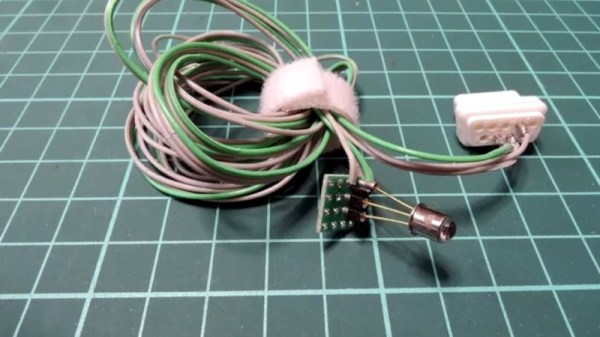
Sometimes the simplest of projects end up revealing the most interesting of things, as for example is the case with [Ryo Mukai]’s light pen for the Vectrex console. It’s an extremely simple device using an integrated light sensor with built-in Schmitt trigger, but for us the magic isn’t in the pen itself but in discovering how it worked with the Vectrex’s vector graphics.

Light pens were a popular accessory in the 8-bit computing days, offering a relatively inexpensive pointing device that gave your micro an even more futuristic feel. On most computers that used a raster-scanning TV display they simply picked up the flying dot on the screen as it passed the end of the pen, but the Vectrex with its display not scanning all of the screen at once needed a different approach.

This piqued our interest, and the answer to how it was done came from PlayVectrex. There was a target X on the screen which could be picked up with the pen, and when picked up it would surround itself with a circle. Crossing the dot as it flew round the circle would tell the console where the pen was, and the position would move to fit. For those of us who only saw a Vectrex in a shop window back in the day, mystery solved! We’ve placed a video showing the process below the break.

This isn’t the first light pen we’ve seen, they can even be connected to modern computers, too.

Continue reading “Vectrex Light Pen Works Without A Raster”

Op Amp Contest: A Slice Of The ’70s

The 1970s was a great time to be an electronics hobbyist, as a whole new world of analogue integrated circuits was coming down in price while new devices would appear to tempt the would-be constructor. Magazines and project books were full of simple circuits to do all manner of fun things, including many synthesizers and sound generators.

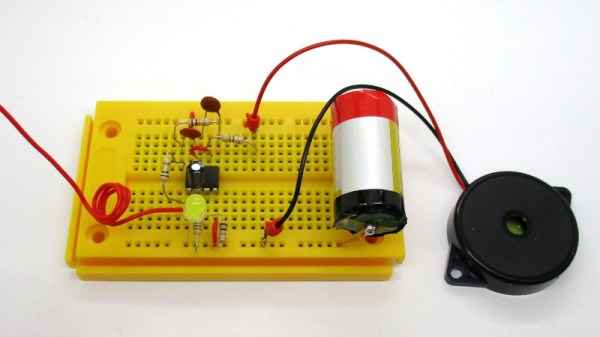
We’re reminded of those days by [Burkhard Kainka]’s triggered sound generator, which couples an op-amp timer to another op-amp phase shift oscillator to produce a sound described as “the unwilling meowing of a cat, which does not want to be disturbed“. Yes, we did make things like this back in the day.

The timer is triggered by a few millivolts on its input, which can come from a bit of mains hum or a flash of light to an LED operating as a photodiode. This provides enough DC voltage to the input of the phase shift oscillator to start oscillation, and in turn the oscillator drives a piezo speaker. It’s a fun little project, it shows that a microcontroller isn’t always needed to make something work, and maybe those of you without the experience of a 1970s childhood can learn a little bit of analogue magic from it. Need to know op-amps better? Read our primer!

3D Print For Extreme Temperatures (But Only If You’re NASA)

At the level pursued by many Hackaday readers, the advent of affordable 3D printing has revolutionised prototyping, as long as the resolution of a desktop printer is adequate and the part can be made in a thermoplastic or resin, it can be in your hands without too long a wait. The same has happened at a much higher level, but for those with extremely deep pockets it extends into exotic high-performance materials which owners of a desktop FDM machine can only dream of.

NASA for example are reporting their new 3D printable nickel-cobalt-chromium alloy that can produce extra-durable laser-sintered metal parts that van withstand up to 2000 Fahrenheit, or 1033 Celcius for non-Americans. This has obvious applications for an organisation producing spacecraft, so naturally they are excited about it.

The alloy receives some of its properties because of its oxide-dispersion-strengthened composition, in which grains of metal oxide are dispersed among its structure. We’re not metallurgists here at Hackaday, but we understand that the inconsistencies in the layers of metal atoms caused by the oxides in the crystal structure of the alloy leads to a higher energy required for the structure to shear.

While these particular materials might never be affordable for us mere mortals to play with, NASA’s did previously look into how it could greatly reduce the cost of high-temperature 3D printing by modifying an existing open source machine.

Half Crystal Radio, Half Regenerative Radio

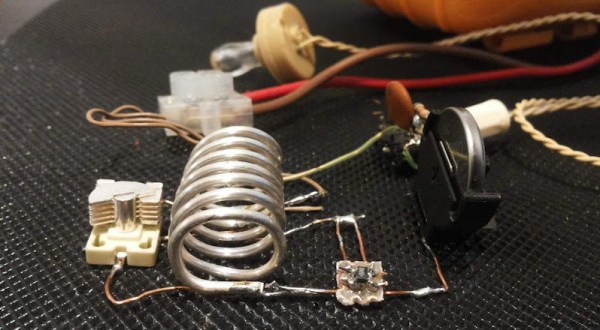
A rite of passage in decades past for the electronics experimenter was the crystal radio. Using very few components and a long wire antenna, such a radio could pick up AM stations with no batteries needed, something important in the days when a zinc-carbon cell cost a lot of pocket money. The days of AM broadcasting may be on the wane, but it’s still possible to make a crystal set that will resolve stations on the FM band. [Andrea Console] has done just that, with a VHF crystal set that whose circuit also doubles as a regenerative receiver when power is applied.

The key to a VHF crystal set lies in the highest quality tuned circuit components to achieve that elusive “Q” factor. In this radio that is coupled to a small-signal zero voltage threshold FET that acts as a detector when no power is applied, and the active component in a regenerative radio when it has power. The regenerative radio increases sensitivity and selectivity by operating at almost the point of oscillation, resulting in a surprisingly good receiver for so few parts. Everyone should make a regenerative radio receiver once in their life!

Op Amp Contest: Go Down An Octave, No FFT, No PLL, No Oscillator!

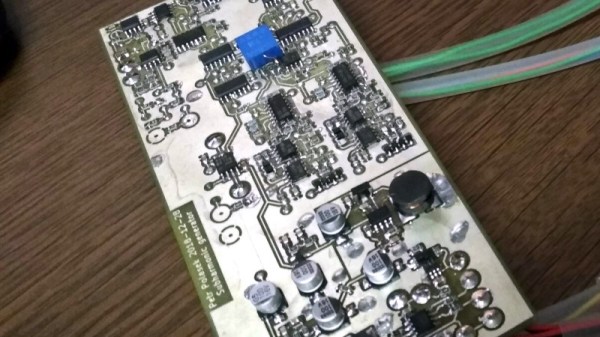
We like a project that makes us think, and that was certainly the case with [MS-BOSS]’s octave downshifter that’s an entry in our current op-amp contest. Instead of resorting to an FFT, or a PLL, it uses a technique best described as a custom analogue computer to implement the maths of octave downshifting. It’s an extremely clever approach, and we don’t mind admitting took us more than one read to understand how it works.

Just as you would with any mathematical problem, he’s split the job of halving the frequency into its constituent mathematical functions. The square root calculation circuit is probably the one that most required the dredging up of dimly-remembered analogue circuitry undergraduate courses for us.

The result is a fascinating read that’s well worth taking the time to understand if you have any interest in analogue electronics. It’s by no means the easiest way to make this particular effect in 2023, as we’re much more used to seeing our community make digital effects, but if you fancy yourself as any kind of op-amp designer, you really need to give it a look.

Shake Your PCB Etching, With An Old Optical Drive

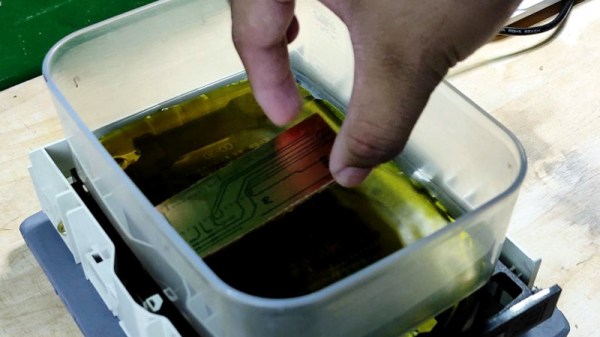
Easy PCB fabrication in China has revolutionised electronic construction at our level, but there are still times when it makes sense to etch your own boards. It’s a messy business that can also be a slow one, but at least a project from [earldanielph] takes away one chore. It agitates the etchant solution round the board, by moving the tank backwards and forwards on the drawer of an old optical drive.

The first part of the build is simply removing all parts of the drive except the drawer mechanism and its motor. This is still, in most cases, a DC motor, so an Arduino can easily drive it with a motor control shield. It’s worth a moment to reflect on how little there is to a modern optical drive.

The Arduino receives a sketch that moves the tray backward and forward, and a piece of ply is attached to the tray. This becomes a stand for a plastic tub containing the etchant and board, and the liquid is soon swishing back and forwards over the surface. You can see the result in the video below the break. Definitely a saving over manual agitation. It’s an inventive machine, but it’s not the first PCB agitator we’ve seen.

Continue reading “Shake Your PCB Etching, With An Old Optical Drive”